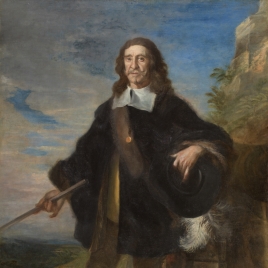
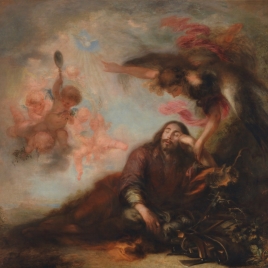
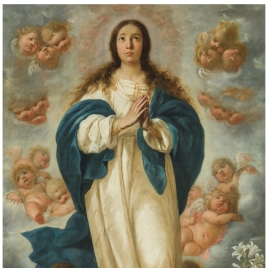
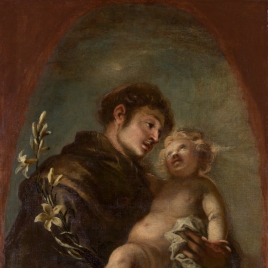
Francisco de Herrera the Younger
Sevilla (Spain), 1627 - Madrid (Spain), 1685Painter and architect, son of the eponymous painter called the Elder -an important and personal artist in the first Sevillian naturalism- and his wife María de Hinestrosa. He trained in his early years with his father, a rigid and difficult man, with whom he had problems and perhaps a breakup. Married in 1647 and immediately divorced, he traveled to Italy and remained there for several years "perfecting his painting", according to Palomino, and cultivating the still life of fish that earned him the nickname of "the Spaniard of fish". In 1653, on his return, he painted in Madrid the main altarpiece of the Carmelites of San Hermenegildo, whose main canvas is in the Prado. In 1655 he is in Seville and paints there in 1656 the "Triunfo del Sacramento" of the Hermandad Sacramental del Sagrario of the cathedral and, in 1657, the "Apotheosis of San Francisco" in the chapel of the saint in the same cathedral. In 1660 the Sevillian Academy is constituted, of which Murillo and Herrera are presidents, alternating both in the tasks.
Since November 1660 he no longer appears as president and probably in that year he moved to Madrid, apparently called by Philip IV. In Madrid he started in 1663 the execution of the fresco paintings of the dome of the sanctuary of Atocha, concluded in 1665 - royal patronage - and received with great praises that granted him the possibility of working for the Crown. In 1672, he made the decorations for Vélez de Guevara's work "Los celos hacen estrellas", on the Queen's birthday. In the same year he obtained the title of painter of the King, and in 1677 he was named Master of Works of Royal Building Projects. In this capacity, he intervened giving traces and supervising the decorations with which Madrid received the wife of King Charles II, Maria Luisa de Orleans, in 1679.
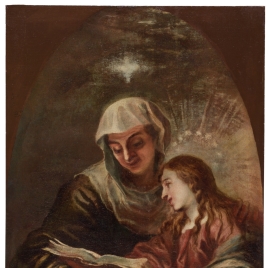
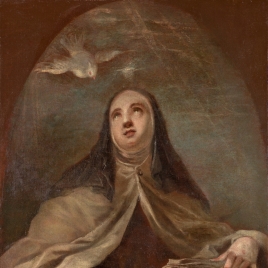
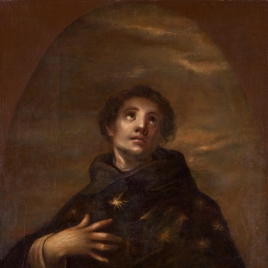
In the following years he carried out works of painting and architecture (altarpieces above all) and in 1680 he moved to Zaragoza to direct the works of the basilica of the Pilar on his traces, until 1682. He died in August 1685. His personality, as portrayed by Palomino, who knew him, was singular: vain and haughty, with a lively and biting wit, "satirical and diabolical". As an artist he is one of the fundamental masters of the full Baroque, bold in his dynamic and colorful compositions, with a fluid and light brush, which sometimes thickens into lumps and at other times has the softness of watercolor. His influence was decisive in the development of the late Madrid Baroque, in artists such as Matías de Torres and Escalante and in Sevillian painting, especially in Murillo himself. The Prado preserves the canvases painted for the church of the Augustinian Recollects in Madrid (P5144, P3366, P3066, P3065, P5145, P07113 and P7534) (Pérez Sánchez, A. E. in: E.M.N.P, 2006, volume IV, pp. 1277-1278).