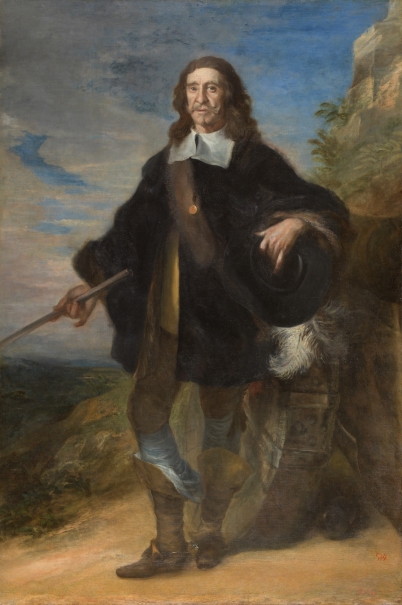
An Artillery General (Diego de Quiroga Fajardo?)
Ca. 1665. Oil on canvas.Not on display
One of Herrera´s least known phases was that of portrait painter. This exceptional portrait of excellent quality –which Pérez Sánchez described as ‘superb and surprising’– was attributed to Francisco Rizi by Pedro de Madrazo until 2023.
The painter depicted a General of Artillery in front of an open-air landscape at the foot of what seems to be a rocky wall. He is leaning on a cannon wheel next to which two cannonballs are resting in a darkened area. The general appears with a staff of command in his right hand and a black hat with white feathers in the other hand. He wears a wide white French collar and has long hair. A leather belt, from which hangs an insignia of the Order of Calatrava, adorns his black, wolfskin sleeved, velvet coat.
Given the dates, the possible identity of the subject can be narrowed to one of two men who belonged to the Calatravan Spanish military order. On the one hand, Alonso Dávila y Guzmán, Lord of Arevalillo and Hernán Gallego, adviser to the Supreme War Council and General of Artillery in the army of Badajoz, Knight of Calatrava from 1646. On the other hand, the Madrid-born Diego de Quiroga Fajardo, Knight of Calatrava from 1649, General of Artillery in the Kingdom of Naples and of the Collateral Council. The person here portrayed is more likely to be the latter, given his links with the court at a time when Herrera was rising in those social circles, around 1660–1665.
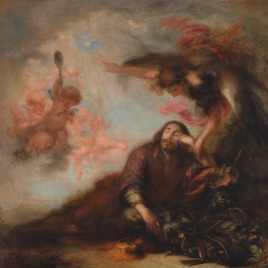
The studies carried out by the Museo del Prado´s technical department have been definitive in their confirmation of the artist as Francisco de Herrera the Younger. For example, the boots which are in the style of Charles II guards´ uniform and after the French fashion, are modelled with tellingly loose brushstrokes, especially in the upper part of the footwear which opens up to reveal white and blue breeches, as are the feathers of the hat, in keeping with the artist’s characteristic technique, also discernible in the painting of the hands. The same applies to the landscape on the left of the canvas. Infrared reflectography reveals certain brush strokes on the plants similar to those found in the landscape of the ‘Saint Joseph´s Dream’ in the Aldeavieja altarpiece. The same way of rubbing the paint quickly and leaving traces of the brushstroke can be seen in the white collar of the general. The reflectography also revealed the use of a thick-bristled brush, concentrating the oil in the grooves. The ultraviolet photograph shows the fillings with which the illustration has been modelled, as well as the light on the nose. They share similarities with those in the portrait by Luis García de Cerecedo (location unknown). Another element that links this work to Herrera´s style is the way in which the figure is silhouetted, leaving marks of dragging and something similar to a stencil around it, a procedure also evident in the details of the ‘Saint Peter’ of the Agustinos Recoletos. Technical studies of the fabric with taffeta weave on which the General was painted indicate that it comes from the same roll as the canvas used in the execution of the painting of Saint Peter.
Navarrete Prieto, Benito, 'Francisco de Herrera, el Mozo. Un general de artillería ¿Diego Quiroga Fajardo?. En: Herrera el Mozo y el Barroco total, Madrid, Museo Nacional del Prado,, 2023, p.206-209 nº 35