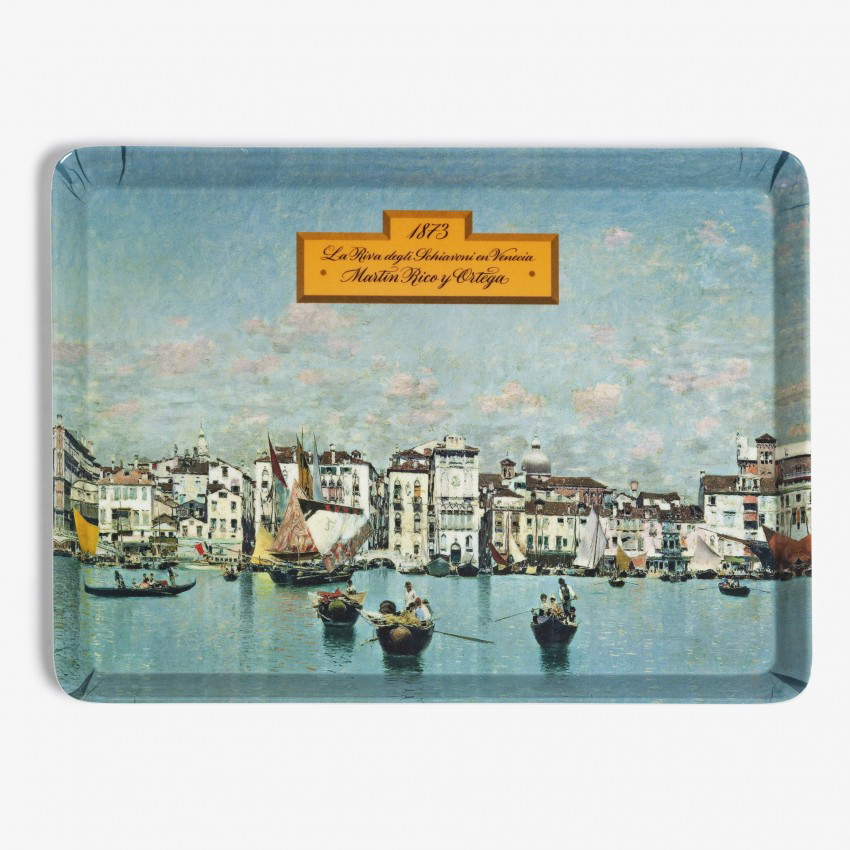
Martín Rico y Ortega
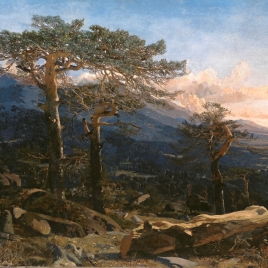
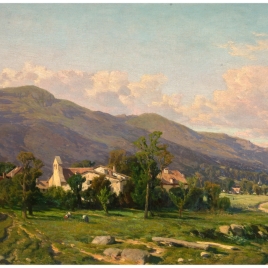
Madrid (Spain), 12.11.1833 - Venice (Italy), 13.4.1908Regular in his youth to the classes of the Liceo Artístico y Literario and the workshop of the painter Vicente Camarón Torra (1803-1864), Rico was a student at the School of the Academy of Fine Arts of San Fernando, where he was trained as a landscape painter.
Thus, he began to compete with works of this genre in the National Exhibitions of Fine Arts from 1858 to 1867, and soon began to achieve success, always conditioned by the overwhelming presence of the Belgian Carlos de Haes, who capitalized on the interest of Spanish critics for the landscape.
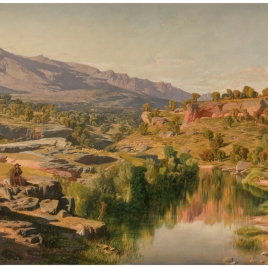
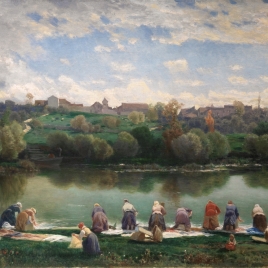
In 1859 he moved to Paris, where he perfected his knowledge with Calamme, but soon became interested in outdoor painting, influenced by the Barbizon School and the work of Charles Daubigny (1817-1878). Due to the Franco-Prussian war, he returned to Madrid and from there he traveled to Granada in the company of Mariano Fortuny, who determined his preciosist plastic art. The painting "La Torre de las Damas en la Alambra de Granada" is an exceptional testimony of that time. Rico was, without a doubt, the most important landscape painter of Fortuny's circle, and one of the most internationally successful Spanish artists of the 19th century; his technique, extremely refined thanks to a precise drawing and a bright, brilliant and exalted tonality, is the most valuable debt he owes to the Catalan master.
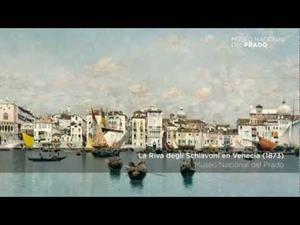
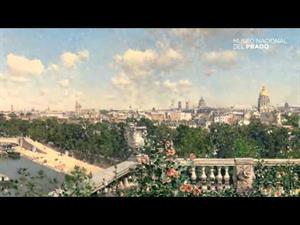
Also in the company of Fortuny he visited Venice in 1872, and from then on the city of canals would be the favorite setting for the artist to develop his urban views, although he also painted spectacular panoramic views of other capitals, such as the "View of Paris from the Trocadero", which belonged to the Marquise of Manzanedo. In fact, Rico settled permanently in Paris in 1874, and from there he developed his prolific artistic production, disputed by European and American art dealers. In that city, where he was internationally recognized, he organized a room dedicated to a retrospective exhibition on Fortuny, after his death, at the Paris Universal of 1878, where he also won the third medal. He was also awarded a prize in the 1888 edition of the competition.
Brother of the outstanding engraver Bernardo Rico (1825-1894), who from 1895 was director of La Ilustración Espanola y Americana, a medium from which he would disseminate much of his brother's work (G. Navarro, C. in: El siglo XIX en el Prado, Museo Nacional del Prado, 2007, pp. 485-486).