A country, surroundings of Azañón
1859. Oil on canvas.Not on display
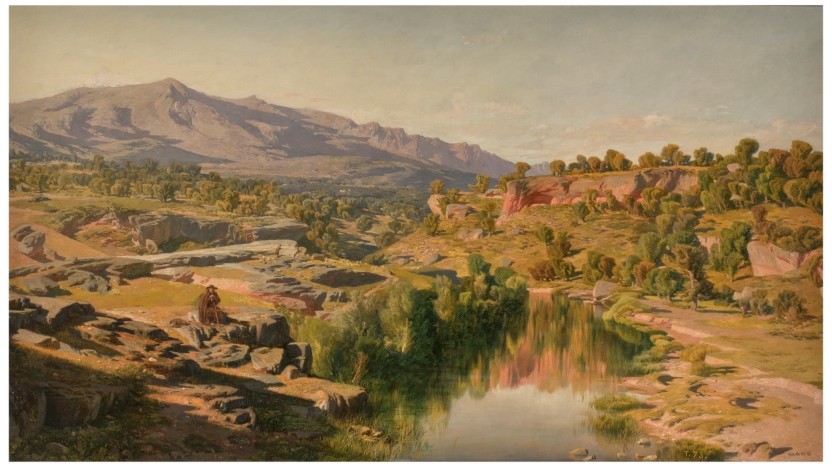
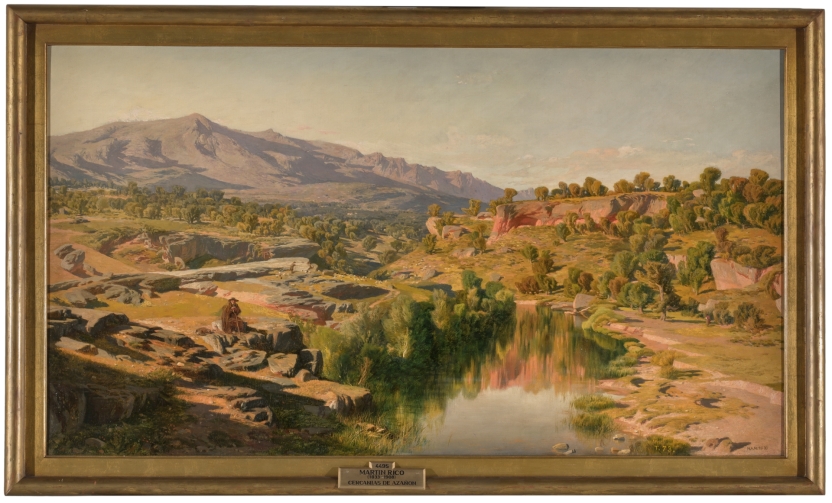
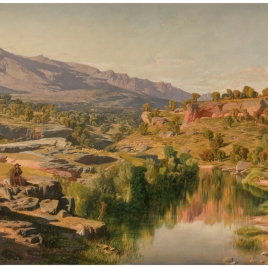
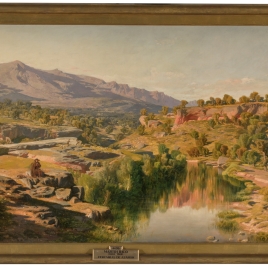
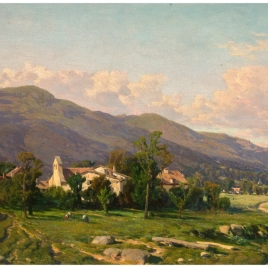
This is the largest work that Rico painted during his first period in Spain. It is the result of an artistic project carried out in the locality of Azañón, near the municipality of Trillo (Guadalajara), in the Alcarria. He carried out the project together with his friend, the landscape painter Serafín Avendaño (1838–1916). In his reports, the artist believed that the project took place in 1857. Nevertheless, he also stated that each of them had avoided looking at the other’s works, so as not to be influenced. This was due to the proximity of the landscape scholarship competition, which was held much later, in 1861. In any case, given the evolution of his early work, the painting must date from at least 1859.
The painting is indeed an important milestone in Rico’s career. The prominence of mountain backgrounds in his earlier works are less common here. However, the mountains, in this case the mountains of Umbría Negra, the profile and morphology of which he studied in another painting, also present a slope to the right, as is also the case in ‘A Guadarrama Landscape’. The artist painted this work in much less intense bluish tones than those that critics had reproached him for in that work. This is due to the fact that the painter avoided the sunset. On the other hand, he modified the landscape to suit his taste. He also eluded the depiction of the village, which should have appeared from that point of view, depicting instead a wooded area around a river, close to the Tagus, which flows nearby.
This is the first appearance of a watercourse in his work, a feature which would be the most important theme in his later production. His capture of reflections in the vertical brushstrokes is already notable here, and he would later perfect this in his works in the Casa de Campo. In accordance with a common resource in landscape painting of the period, the composition takes place around the meanders of the river, already revealing the serenity present in his mature work. There are three figures: in the foreground there is an old shepherd with a dog; in the midground there is another shepherd with a flock of sheep, and to the right there is a woman. These figures highlight the artist’s interest in animating the landscape, as is common in all his later work.
Rico’s assimilation of the nature he was studying is very different to the environments which he had worked on before. This led to his successful interpretation the clay-rich lands, characteristic of the Alcarria, and the well-marked volumes of its varied landscape. He composed a harmony of reddish and orange tones that has its complementary counterpoint in the greens of the trees. The study of lights emphasises the elements of the landscape. This differentiates the reflections of the vegetation at the bottom of the river from those on its left bank, which are darker. Together with the oblique shadows of the foreground on the left, this creates a certain dynamism in the composition.
Barón, Javier, El paisajista Martín Rico (1833-1908), Madrid, Museo Nacional del Prado, 2012, p.134-135 n.8