Raphael (Raffaello Sanzio)
Urbino (Italy), 1483 - Rome (Italy), 1520Raphael has always been recognized as one of the greatest artists of the High Renaissance in Italy. In his short life he was acclaimed as a painter, designer and architect, and worked for two of the greatest patrons of his time, Popes Julius II and Leo X. At the origins of his enormous success were his artistic heritage and constant study. His father, Giovanni Santi, was a painter and poet at the Montefeltro court in Urbino and, although he died when his son was not yet twelve years old (in August 1494), it is likely that he taught him the first rudiments of painting. Raphael was also an estimable poet, and the sensitivity with which he approached the subjects of his paintings suggests an intellectual debt to his father and the culture of the court of Urbino. His technical and intellectual gifts were able to flourish thanks to the ease with which he apparently moved in the circles of power in Urbino, Florence and Rome, and also because in his people skills (which the sixteenth-century historian Giorgio Vasari points out in his "Lives") he must have resembled Giovanni Santi. His most important teacher was not his father but Pietro Perugino. Both the nature of his apprenticeship with Perugino and its date and duration have been much debated, but there are reliable contemporary accounts of its reality, and its influence on Raphael's style was lasting.
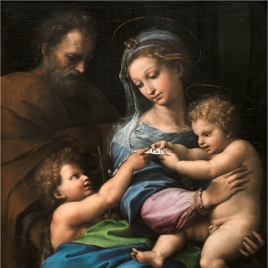
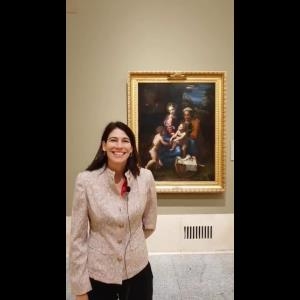
Raphael executed his first independent paintings for Urbino and the Umbrian towns of Perugia and Città di Castello around 1500-1507, and all bear the imprint of Perugino's style. His first documented commission is a large altarpiece he painted in 1500-1501 for the church of St. Augustine in Città di Castello (fragments in Paris, Brescia and Naples), but in 1504 he settled in Florence, where Michelangelo and Leonardo were revolutionizing the Florentine Renaissance with their dramatic battles for the Palazzo Vecchio and other works. The young Raphael immersed himself in the new art, and many drawings show that he studied aspects of both masters' styles. Influences of both can be seen in "Sacra Famiglia con l'agnello" (1507, Prado), a representative example of the small-format painting (not altar paintings but devotional paintings and portraits) he did in Florence.
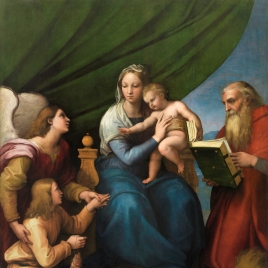
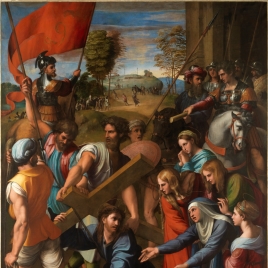
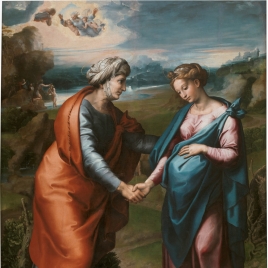
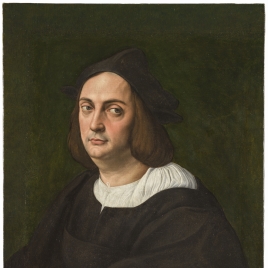
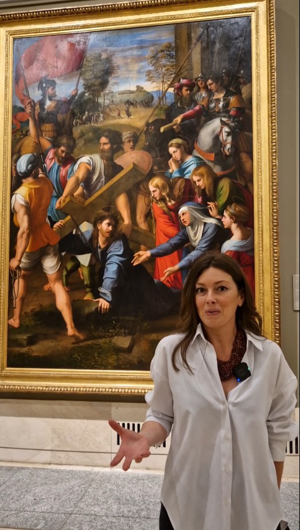
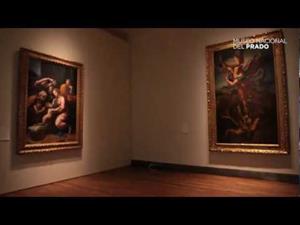
In late 1508 or early 1509 he was called to Rome by Julius II (pope from 1503 to 1513), to work, along with Perugino, Lotto, Sodoma and others, on the redecoration of the rooms of the Vatican palace now known as stanze. Initially part of a team, Raphael soon assumed responsibility for the entire ensemble, and the project kept him busy until his early death. His first frescoes, in the Stanza della Segnatura (ca. 1508-1511), comprise "La disputa del sacramento" and "Scuola di Atene", and represent a peak of the High Renaissance in Rome. In "La disputa del sacramento" we can find the same character whose portrait was painted by Raphael on a panel in the Prado: "Il Cardinale", painted in Rome around 1510-1511. It is one of the greatest portraits of the 16th century, and demonstrates the new Venetian influences that Raphael had assimilated in Rome (especially that of Lorenzo Lotto, and later that of Sebastiano del Piombo), as well as his great technical skill. The success the painter achieved in Rome was such that he was soon overwhelmed by commissions for painting, design and architecture, and his workshop grew to become the driving force of the Roman Renaissance. After Leo X (pope from 1513 to 1521) was elevated to the throne, Raphael made altar paintings for other places, among them "Madonna del Pesce" (ca. 1513, Prado), painted for a chapel of St. Dominic in Naples, and "Lo Spasimo" (ca. 1517, Prado), painted for the convent of Santa Maria delle Anguie in Palermo. These two works, which were transferred from panel to canvas around 1813, allow us to appreciate the monumentality that his figures and narrative compositions had acquired in comparison with his previous paintings. The second one, particularly dramatic, reveals influences of northern engravings as well as those of Michelangelo and Leonardo. These altar paintings and later ones had enormous repercussions in the Roman art of the High Renaissance, and even in the Baroque (in artists such as Guido Reni and the Carracci). At the same time Raphael was working on various projects for Leo X, including the continuation of the frescoes of the stanze (he completed the Stanza di Heliodoro, 1511-1514, and the Stanza dell'Incendio di Borgo, 1514-1517) and the preparation of the "Raphael Cartons" (1515-1516, Royal Collection, on deposit at the Victoria and Albert Museum, London) for a set of tapestries for the Sistine Chapel (now in the Musei Vaticani). When Bramante died in 1514, he was appointed architect of the new St. Peter's in Rome, and architecture (and archaeology) progressively filled his time, so that he had to rely more and more on his workshop to meet the commissions of his numerous clients.
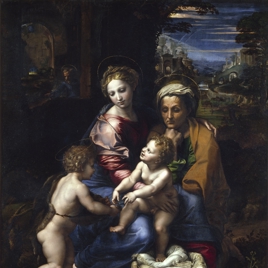
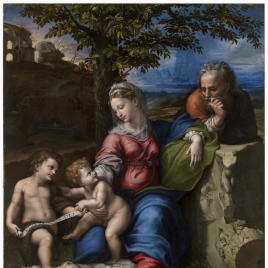
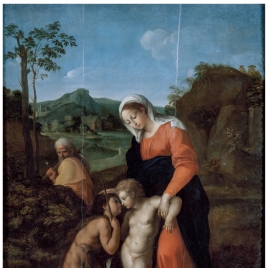
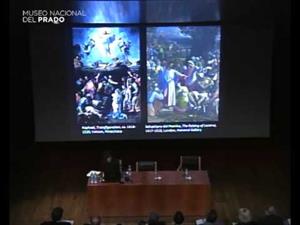
Giulio Romano, the principal of his assistants and future artistic heir, collaborated with him in the execution of "La Sacra Famiglia della Quercia" (Prado) and "La Sacra Famiglia con l'agnello" (Prado), works that reflect the evolution of his style towards a greater finish and the intense chiaroscuro that is characteristic of his last years (ca. 1518-1520). The same tendency can be seen in completely autograph works such as the small "Sacra Famiglia con San Giovanni Battista" (Prado), which can be dated to around 1518. Raphael died on his thirty-seventh birthday, and his body was veiled in the Vatican at the foot of his last masterpiece, "La Transfigurazione" - of which there is a copy by his pupil Giovan Francesco Penni in the Prado - before being buried in the Pantheon in Rome. He was honored at his death as he had been in life, and celebrated in countless poetic panegyrics. Vasari, although he regarded Michelangelo as the central figure in his "Lives of the Artists", presents him in this book with the utmost reverence as an exemplary artist and saintly model (in a pun on the surname Santi). In the following centuries his fame reached hagiographic dimensions, culminating in the 19th century with the cult of the Nazarenes and the devotion of artists such as Ingres. His place in the pantheon of great artists declined in the early twentieth century, when the figure of the frustrated genius became more prominent than that of the accomplished scholar, although lately the development of his personal style has been the subject of intense attention, and general opinion once again admires in him the greatest scholar-assimilator of his time, something already commented by his contemporaries, while recognizing that his extraordinary stylistic trajectory -very well represented in the paintings of the Prado- summarizes the achievements of art in the first two decades of the 16th century (Henry, T. in: Enciclopedia M.N.P., 2006, volume V, pp. 1810-1813).
His portrait by Henri Joseph Hesse corresponds to the work G03874, Museo del Prado.