Gerard David
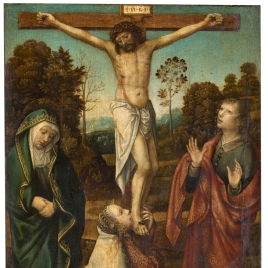
Oudewater (Netherlands), ca. 1450/60 - Bruges (Belgium), 1523Born in the Dutch town of Oudewater near Gouda at an undetermined date, in 1484 Gerard David moved to Bruges, where he died in 1523. Some of the works ascribed to him have been considered characteristic of the early years before he settled in Bruges, especially because they recall northern Netherlandish artists such as Dirk Bouts and Geertgen tot Sint Jans (c. 1460/65–after 1490). However, no pictures from that period have been securely documented. Of the more than sixty paintings that are attributed to him, none is signed and only two are known to be fully documented – not enough to be able to trace a stylistic and chronological development in his output. They are the “Justice of Cambyses” in Bruges (“The Arrest of Sisamnes” and “The Flaying of Sisamnes”, Groeningemuseum, inv. GRO0040.I–0041.I), two panels painted for the aldermen’s chambers in Bruges town hall, one of which bears the date 1498, the year the payment is furthermore recorded, and the Rouen “Virgin among Virgins” (Musée des Beaux-Arts, inv. D.803.4), executed for the Carmelite convent of Sion in Bruges in 1509.
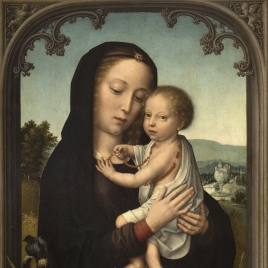
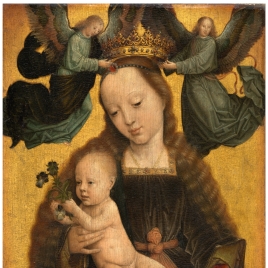
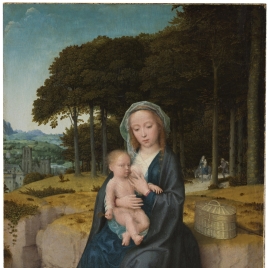
Most of the works that are ascribed to David display a marked resemblance to the early masters established in Bruges, especially Jan van Eyck, some of whose compositions he borrowed, and Hugo van der Goes, an artist with a comparable technique from whose compositions he also drew. There are likewise close similarities to the oeuvre of Hans Memling, with whom David coincided, taking over from him as dean of the confraternity of Saint Luke, and whose subjects – especially the Virgin and Child – he largely repeated. His style was initially based on the technical finesse of the first Netherlandish masters and evolved towards nervous, paint-laden brushstrokes. He produced monumental works but also devotional paintings steeped in tenderness. As well as paintings, there are drawings attributed to him, some in silverpoint, and several illuminations of books of hours, proving him to be a versatile artist.
David had several assistants, among them Ambrosius Benson (c. 1495–1550), who brought a lawsuit against him in 1519 over the ownership of several drawings. Many painters were furthermore influenced by his style: Adriaen Isenbrant (c. 1490–1551), Albrecht Cornelis (c. 1475–1532) and even miniaturists such as Simon Bening (1483/84–1561). He may even have had a workshop in Antwerp from at least 1515. David was the most influential artist in Bruges in the early 1500s and provides a key link between the first Netherlandish masters and those of his own day (J. J. Péez Preciado,"Fifteenth-century netherlandish painting at the Museo Nacional del Prado. Catalogue raisonné", Museo del Prado, 2024, p. 109).