formularioRDF
The itinerary <em>TITULORECORRIDO</em> has been successfully created. Now you can add in works from the Collection browser
<em>TITULOOBRA</em> added to <em>TITULORECORRIDO</em> itinerary

Metabuscador

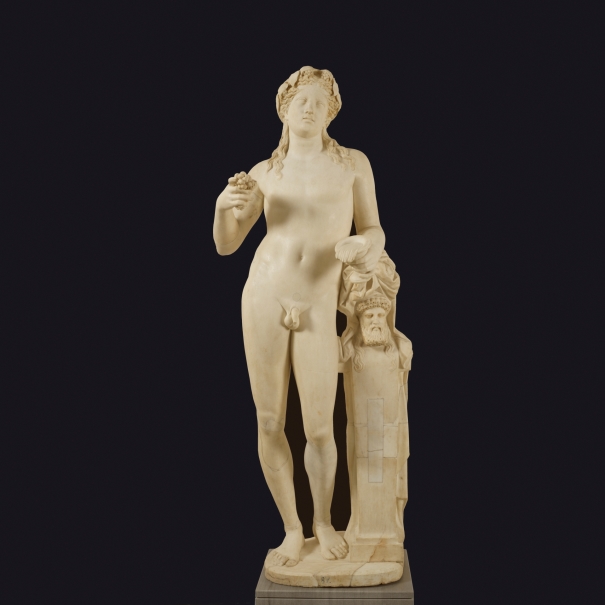
Dionysus
Sculpted . Ca. 150
The Roman copy of a late Hellenistic model (125-100 B. C.) which, on account of its relaxed posture, recalls Praxiteles’ art. The god, who is leaning on a herm, a distinctive feature of the late first century B. C., personifies the abundance of a good life through his soft, sensual body. He was also worshipped in Antiquity as the benefactor of humanity for his gift of wine.
ARTWORK
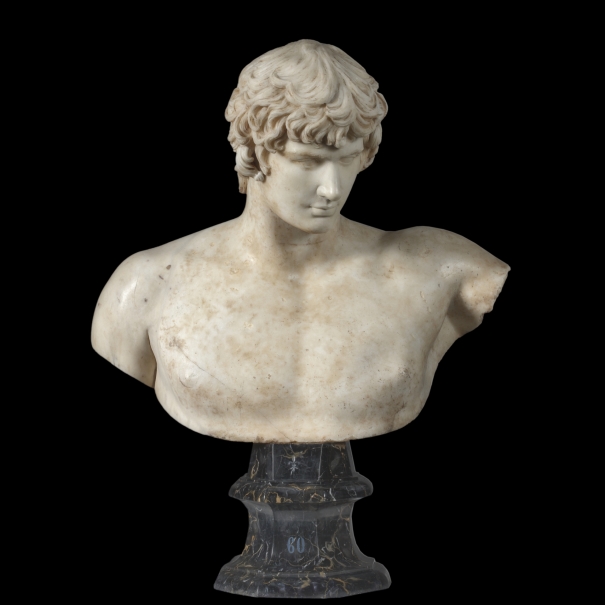
Antinous
Sculpted . 131 - 132
A Roman work datable from just after the death of Antinuous (130 A. D.), when his friend, the Emperor Hadrian, ordered that he be worshiped as a divinity. Thus, portraits of this young favorite became ideal images based on neo-Attic Greek esthetics and characterized by a peculiar melancholy. With his abundant curly hair, ideal facial features and silent, melancholy beauty, the work lies between a portrait and the image of a Greek god. The large size of the bust is a distinctive feature of portra
ARTWORK
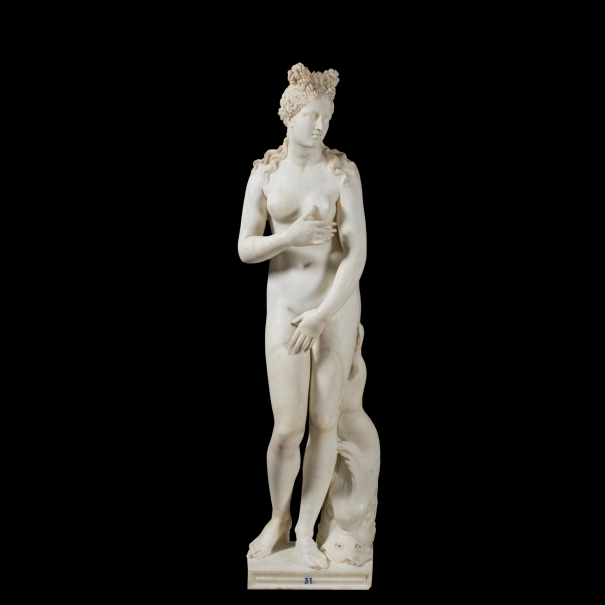
Venus with a dolphin
Sculpted . 140 - 150
This sculpture is one of the numerous Roman replicas and variants of the Capitoline Venus in the Museo Capitolino in Rome. This version slightly lengthens the proportions of the Hellenistic original created between 280 and 250 B. C. In the fourth century B.C., Praxiteles created the first image of a nude Aphrodite emerging from the waves. This Aphrodite of Cnidus was so successful that a great variety of “chaste” Afrodites were made. Among the later, two large copies are outstanding: this work a
ARTWORK
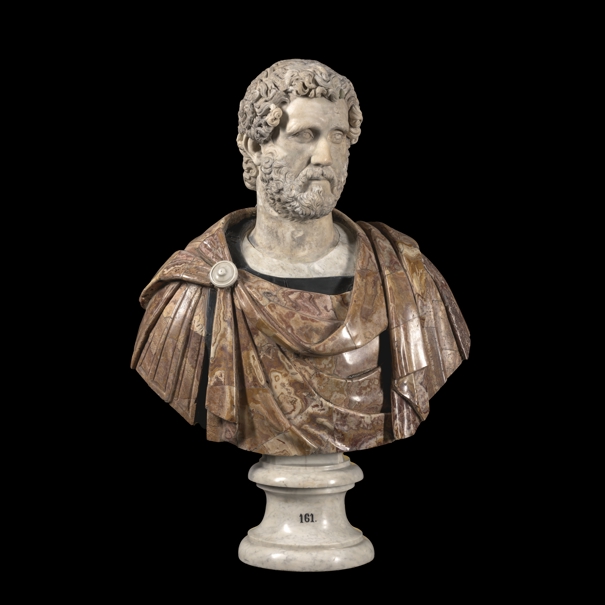
Antoninus Pius
Sculpted . 140 - 150
A bust of the Roman emperor, Antoninus Pius (86-161 A.D.), of a type set by the government itself from the moment he took power. This type of portrait went essentially unchanged during his entire reign. This monumental head of the long-lived Roman emperor has various modern additions. The hair and beard are based on depictions of his adoptive father, the Emperor Hadrian, but the face has individualised details. In the Historia Augusta Antoninus is described as “noble with gentle features, sober,
ARTWORK
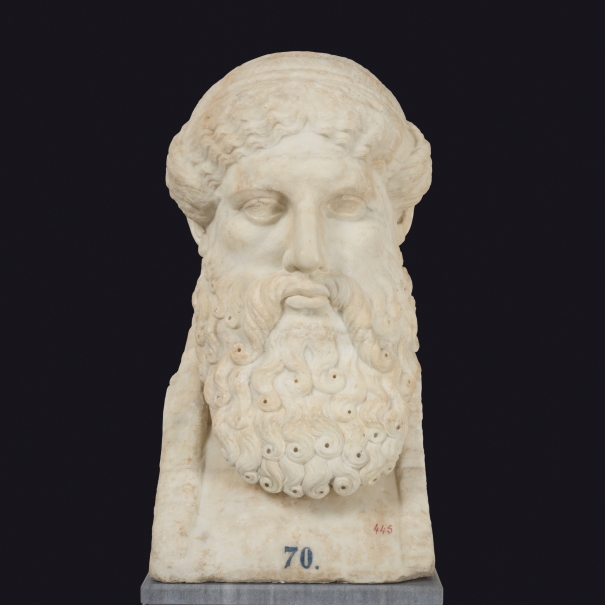
Dionysus
Sculpted . 75 - 100
This Roman herm, which was probably made to decorate a theatre, uses an image of Dionysus in the form of a mask, created between 425 and 400 B. C. in Athens. At that time, it was usual to hang these masks, which only reproduce the god’s head, in the sanctuaries of Dionysus for his worship. The archaic hairstyle is also repeated in masks of the Classical period.
ARTWORK
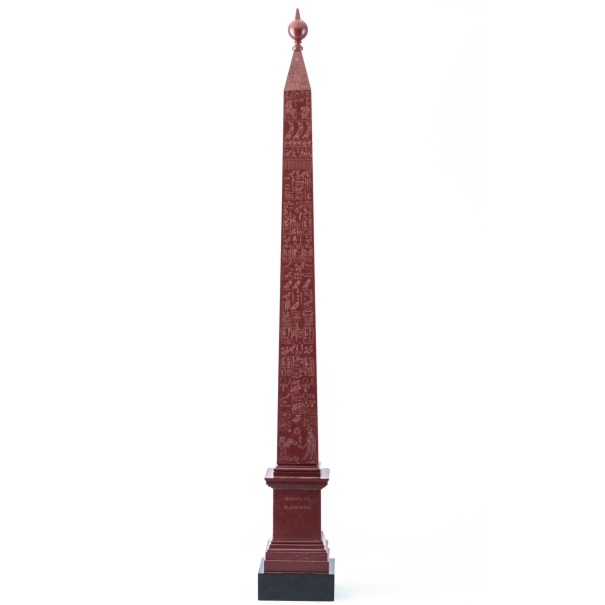
Red obelisk
Sculpted . Before 1851
Given by Pope Pius IX (1792-1878) to Queen Isabel II of Spain, it reproduces the so-called Flaminian Obelisk in the centre of the Piazza del Popolo in Rome. Its attribution remains uncertain; it may have been made in the circle of the sculptor and mosaicist Benedetto Boschetti, who made high quality souvenirs in the mid-nineteenth century and was awarded a medal at the Great Exhibition in London in 1851.
ARTWORK
Roman workshop – (Attributed to: Benedetto Boschetti)
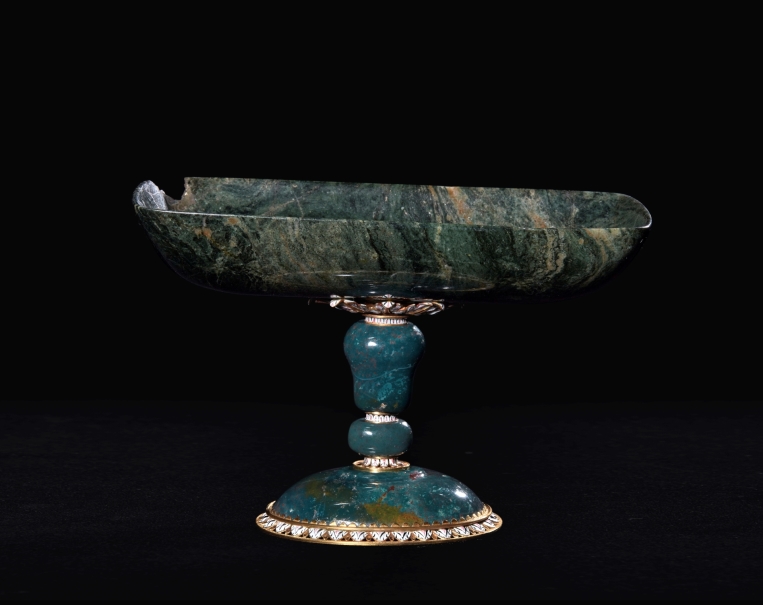
Cup in the form of a kneading trough
Sculpted, Enamelled . I a.C. century
A high cup formed by an ancient fragment of serpentine and a foot and stem of heliotrope. The bowl, with a rectangular mouth, is joined by a ring mount and enamelled leaves to the balustroid stem, with a low knop between round brackets of enamelled gold. Oval in shape, it has a rounded profile and a rich openwork cluster of enamelled gold leaves. The enamels are opaque and consist of light touches of black and purple on a white ground. The mount belongs to the so-called “feuillages” type, of whi
ARTWORK
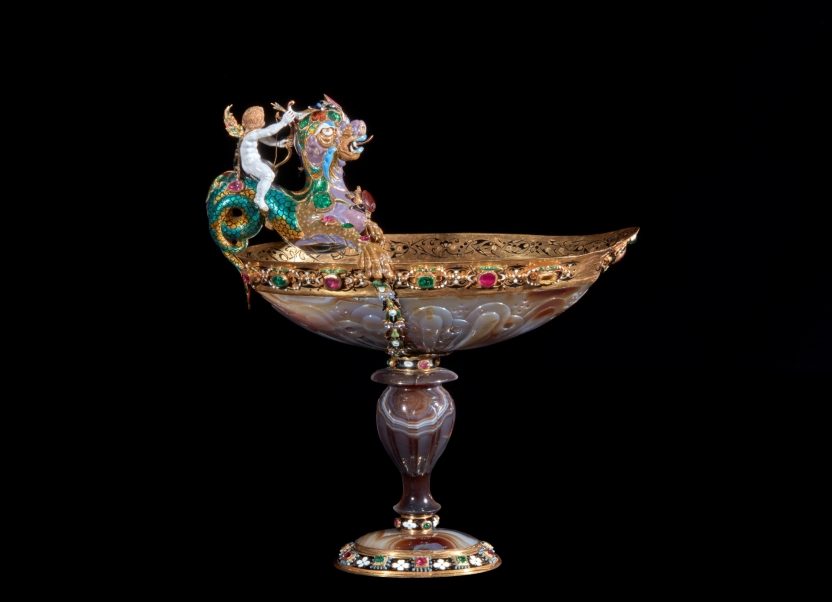
Boat-shaped agate cup with Cupid on a dragon
Chased, Carved, Enamelled, Mounted / set . XVI century
Vessel made up of three pieces of agate and six enamelled gold mounts. The boat-shaped bowl is decorated externally with a carved band of interlaced ovals separated by five-pointed fleurons. Running around the lip is a smooth gold mount, enamelled on the interior, with overlaid adornments of green leaves and white berries with incrustations of rubies and emeralds. At the stern is a Cupid enamelled in white with his bow and quill set with diamonds. He is riding a monster with the head and body of
ARTWORK
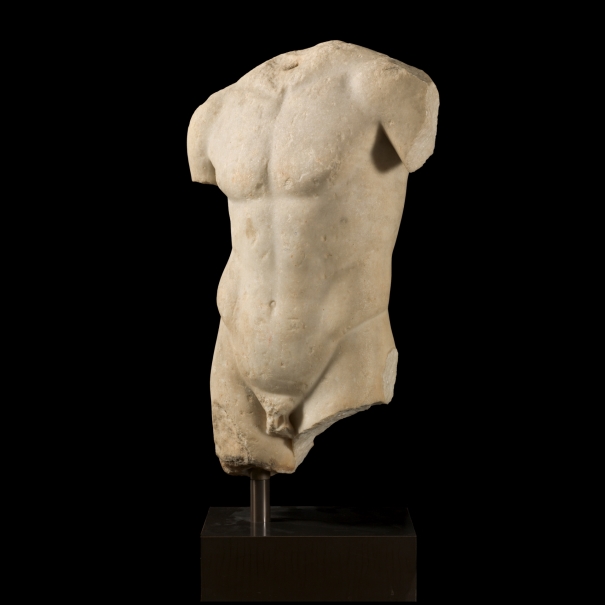
Discophoros
Sculpted . 130 - 140
This work is a Roman copy of the Discophoros ("the discus-bearer"), the first creation of the sculptor Polyclitus (active 460-420 B. C.). As is typical of Polyclitus’s art, the modelling of the body is clearly defined by the tense muscles and by the movement caused by his posture. The head, not preserved, was a little tilted and looked at an object he held in his right hand. In the best-known copy it is a discus, although in the Greek original it could have been a sword. If so it would have repr
ARTWORK
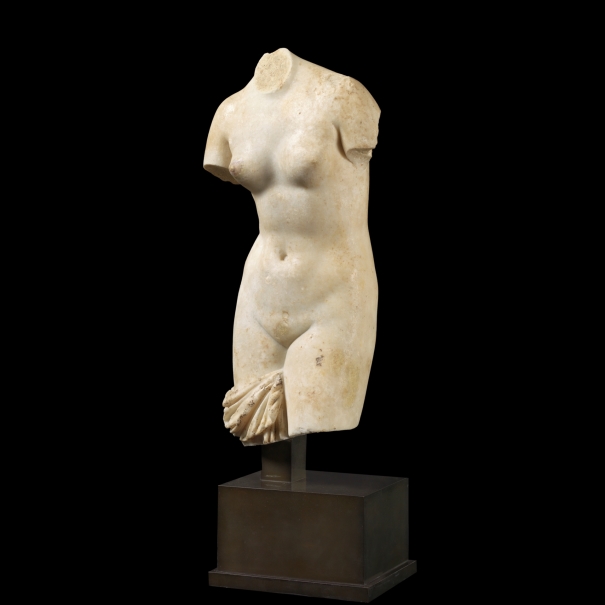
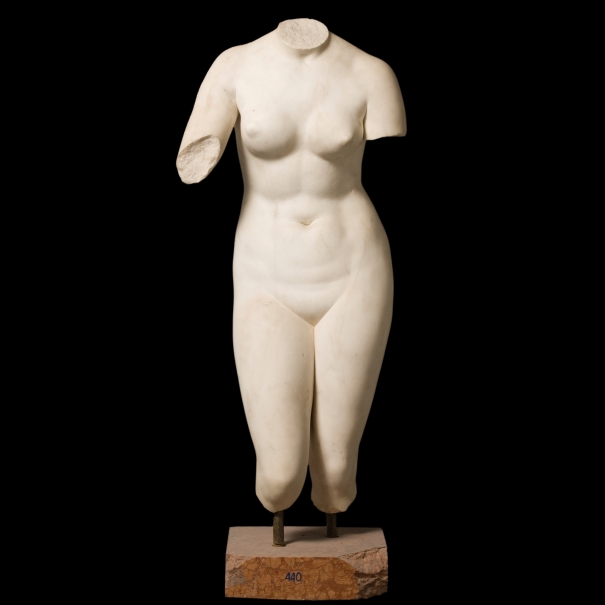
Torso of Aphrodite
Sculpted . 50 - 75
In order to emphasise Aphrodite’s nudity and arouse interest Hellenistic artists rarely depicted her entirely without clothes. Here the goddess’s mantle is held up between her legs. This sculpture follows a model of the second century BC in which Aphrodite looked into a mirror held in her left hand while covering her pubis with her right.
ARTWORK
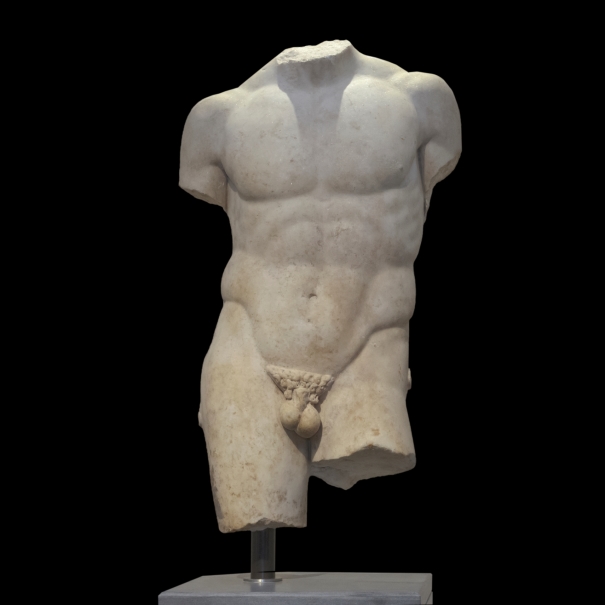
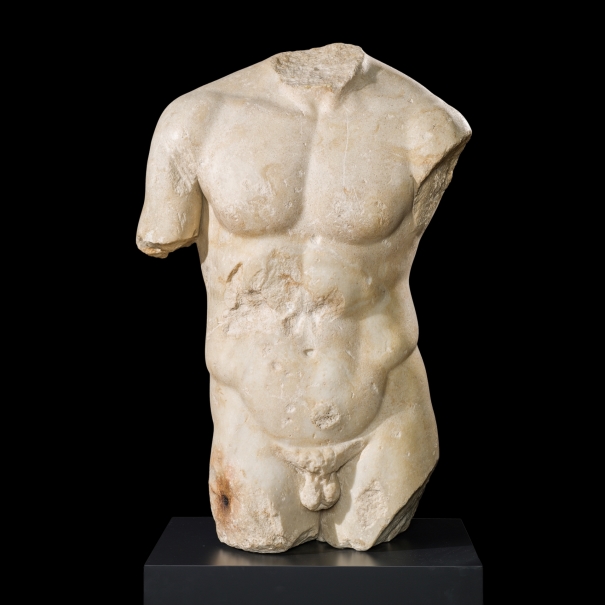
Torso of a Youth
Sculpted . Ca. 150
This sculpture reproduces a Greek original of around 410 BC by a follower of Polyclitus. There are numerous copies of that work, known as the "Dresden Youth type" in reference to the best and most complete surviving example, now in the Albertinum in Dresden. From that work it is known that the young athlete was looking pensively at his left hand in which he held a now unknown object.
ARTWORK
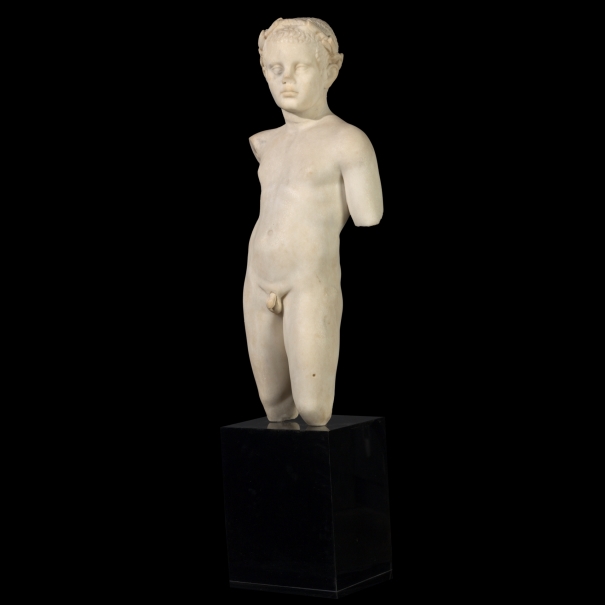
Heroic Funerary Sculpture of a Boy
Sculpted . 80 - 110
The boy is depicted as a victorious athlete, with a foliate wreath on his head. His right arm was originally bent, his hand touching the wreath. He has individualised features and a hairstyle typical of the late first century AD. His parents intended this image to reflect an image of their son as one of the famous athletes of the past, happy in the other world.
ARTWORK
Venus of the ''Medici'' type
Sculpted . 75 - 100
This Venus is of the same type as the one in the Medici collection (Florence, Uffizi, c. 100BC), which allows us to know that she originally covered her pubis and breasts with her arms. With her small head turned towards her left shoulder, Venus’s hair was gathered up with a bun at the neck. Her left thigh shows the trace of a dolphin’s tail, indicating that this torso represented the divine apparition of the goddess rising from the waves.The loss of Venus’s head and in particular her arms, whic
ARTWORK
Boxer
Sculpted . 50 - 70
This is a Roman copy of an athlete, made in about 370 B. C. by one of Policlytus’s pupils, perhaps Daedalus of Sikion (act. 400-360 B. C.). From a version of the sculpture in Berlin, we know that he is tying a strap around his right wrist, with both forearms outstretched. The sensual appearance of the muscular and well-built body was achieved by smooth undulations on the surface.
ARTWORK
Dacian of the type from Trajan's Forum
Sculpted . 120 - 130
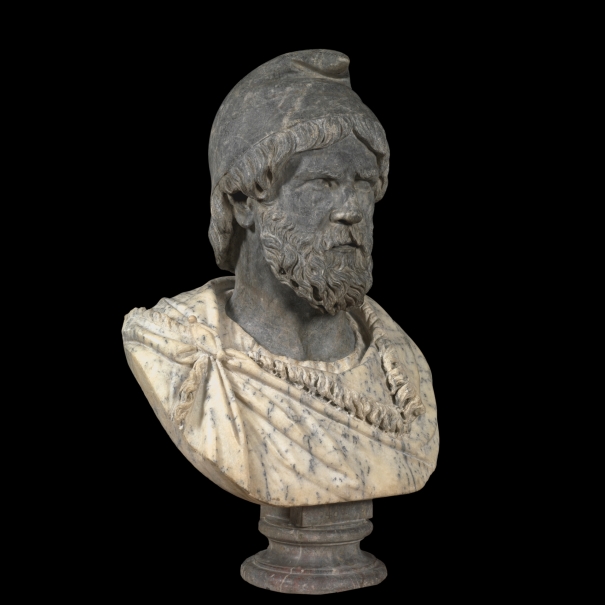
Following the conquest of Dacia (essentially modern-day Romania and Moldova) by Trajan (AD 53-117), the image of its inhabitants, shown as captives wearing their distinctive clothing, was introduced into public sculpture to symbolise the triumph of Rome. Works of this type, possibly including the present example, were installed in the forum built on the emperor’s orders.
ARTWORK
Prince Gaius Caesar
Sculpted . Ca. 13 a.C.
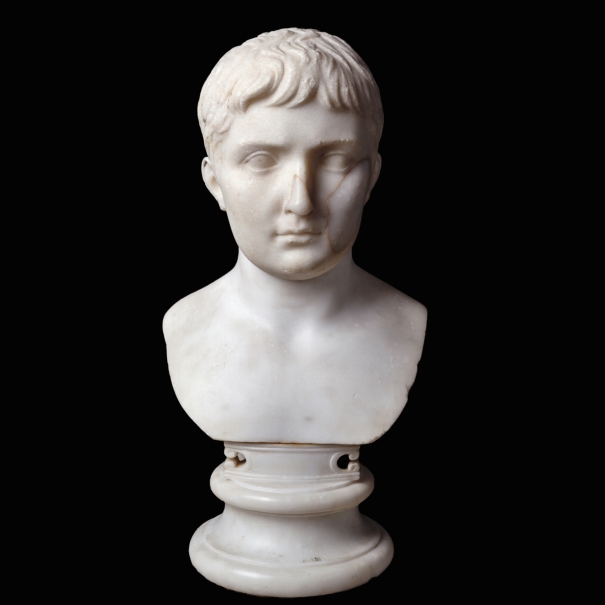
Gaius Caesar (20 B. C.- 4 A. D.) was adopted, together with his brother Lucius Caesar, in the year 16 B.C. by his grandfather the emperor Augustus, with a view to possibly having him succeed him. This portrait, created when the boy was seven years old, was conceived to be like a young version of the portrait of Augustus with a hairstyle very similar to that of the emperor.
ARTWORK
Dionysus with a Panther
Sculpted . Ca. 135
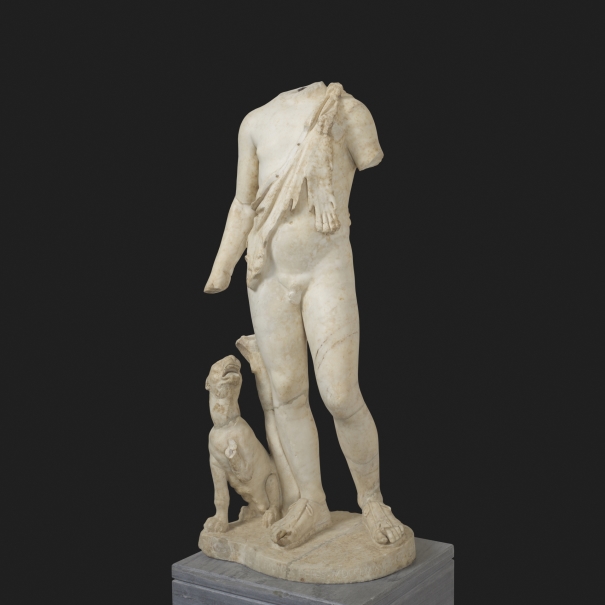
A work from the period of the emperor Hadrian which combines stylistic elements from the early classical period (490-470 B. C.) with others from the end of the fourth century B. C. Currently missing are the thyrsus, supported like a lance with the left hand, the head with its long hair tied back and crowned with ivy, and the cantharus of wine which Dionysus held in his right hand. According to the inscription on the base, the statue was found in 1779 by José Nicolás de Azara at the
ARTWORK
Homer
Sculpted . II century
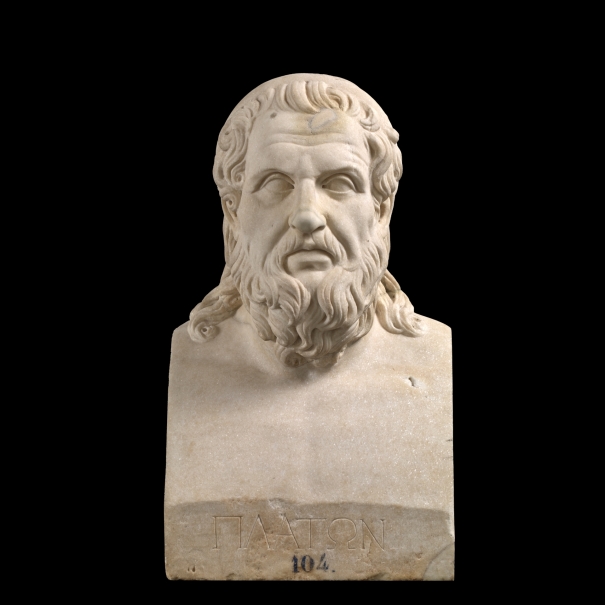
This idealised portrait of the blind poet, author of the Iliad and the Odyssey, depicts him as an old, bearded man, a typology established in the 3rd century BC. In the 18th century the interest in establishing the appearance of figures from Antiquity led the bust’s owner, José Nicolás de Azara, to identify it as the philosopher Plato, whose name he had inscribed on it.
ARTWORK
Loading...

Loading...

Up