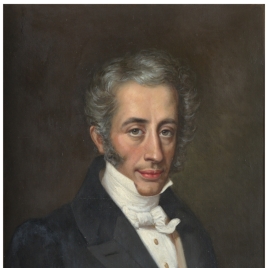
Ángel de Saavedra, Duke of Rivas (copy)
Ca. 1881. Oil on canvas.On display elsewhere
This copy drew its inspiration from the original lithograph by Federico de Madrazo (G04612) that El Artista published in 1835 (issue 15, first edition).
This half-length portrait by Maureta depicts the writer at the age of 44, facing three-quarters left and leaning his left arm on the back of a chair. His abundant and wavy hair ends in large sideburns. He is well-dressed, as his origin and social status demand, with a black shirt and tie fastened with a brooch, a triple-breasted waistcoat, and a black frock coat with a velvet collar. His gloved hand holds a cane. Maruete faithfully executed this portrait in accordance with the Romantic aesthetic of Madrazo. However, his approach to the painting reveals features that distance him from the virtuoso draughtsmanship of the original, giving way to an interest in the artistic and dimensional elements that the painting itself demands. Madrazo himself might have advised and commissioned Maureta to make the copy, since Maureta was both a friend and Pupil of Madrazo. The painting was destined for the Museo Iconográfico. Given the inverted position of the canvas compared to the lithograph, we can reasonably suppose that Maureta made the copy either from a preparatory drawing or from Madrazo´s own lithographic stone.
Ángel Saavedra Ramírez de Baquedano was born in Córdoba in 1791. He was a writer, painter, military man and politician. He distinguished himself in the War of Independence for his heroism. In Cadiz he met Manuel José Quintana (P02904), whose advice would influence his literary vocation. One of his most famous plays is "Don Álvaro o la Fuerza del Sino", which he wrote in 1835. This work represents an era and a school of thought, not only in playwriting but also in national literature as a whole. In terms of patriotic lyrical poetry, his poems "El desterrado", "El sueño del proscrito" and "El faro de Malta" are particularly significant. As for historical poetry, his "Romances históricos" (1841), which draw their inspiration from medieval chronicles and popular legends, are par excellence "the happy manifestation of the best forms of Romanticism".
El mundo literario en la pintura del siglo XIX del Museo del, Madrid, Centro Nacional de Exposiciones y Promoción Artística, 1994, p.192, nº35