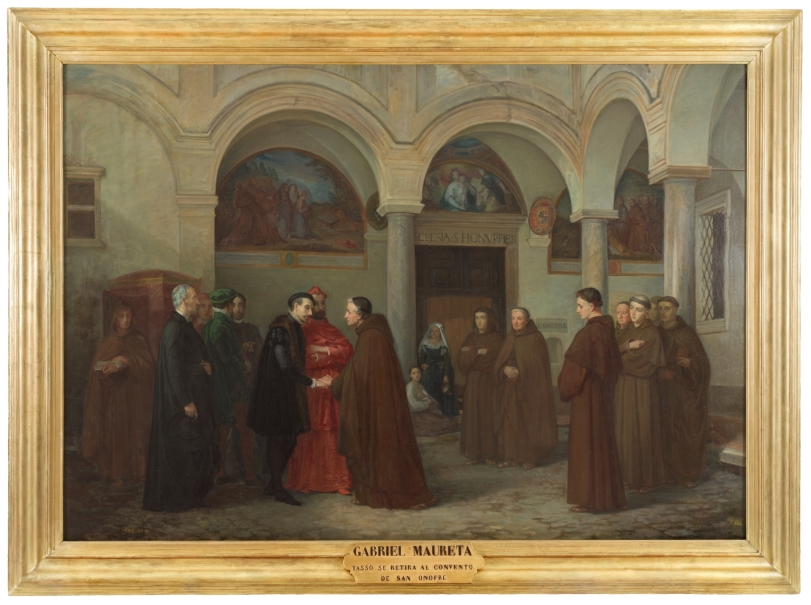
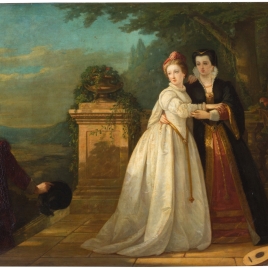
Torcuato Tasso retreats to the convent of San Onofre at the Janiculum
1864. Oil on canvas.On display elsewhere
Torcuato Tasso, Italian poet (Sorrento, 1544–Rome, 1595). His work marked the culmination of Italian Renaissance poetry and heralded its later development, on which he had an enormous influence. He entered the service of Cardinal Louis d´Este, whom he accompanied to Paris (1570–1571), and of Duke Alfonso II (1572). In 1559, the author started writing his masterpiece, the epic poem ´Jerusalem Delivered´. In 1575, when he considered the poem finished, the writing seemed to him unorthodox, and he sent it to Scipio de Gonzaga for examination. This was the beginning of a critical period for the poet, in which he tried to maintain the freedom of his literary instincts from the limitations imposed on him by the classical Aristotelian critics. From this moment on he alternated between periods of madness and moments of lucidity. As his mental health worsened, his violence, insults and extravagances forced Duke Alfonso II to have him imprisoned in the asylum of Santa Ana, where he remained for seven years (1579–1586). After residing in Mantua, Rome and Naples, he was called by Pope Clement VII to be crowned as a poet on the Capitol. However, before this could happen, he died in the monastery of San Onofre, of the order of ermitaños of St. Jerome, founded in 1434 and erected on the Janiculum, a famous Roman hill on the right bank of the Tiber.
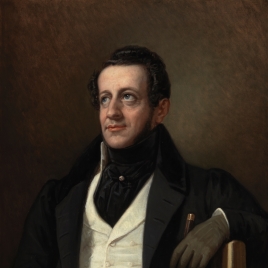
In this canvas, Maureta treats the moment when Tasso arrived at the convent, as described in the catalogue of the National Exhibition of 1864 at which it was presented: ‘Sad, dejected and feeling his illness worsening, he begged Cardinal Cinzio to take him to the Monastery of San Onofrio. When they arrived, the Prior and the monks came out to meet them’. In front of the Renaissance arcades leading to the convent, Tasso, accompanied by his friends and by Cardinal Cinzio Aldobrandini, his protector, greets the Prior who has come out to meet him. Behind him, separated at a respectful distance, the monks attend the ceremonious meeting, humble in their attitude. Despite the fact that the episode depicts the scene with the veracity that the historical genre requires in terms of the setting and the costumes worn by the figures, the artist is unintentionally anachronistic in depicting the frescoes in the convent´s gallery. These were in fact painted years after Tasso´s death. These paintings, dedicated to the life of Saint Jerome, were executed from 1600 onwards by Domenichino, Claudio Ridolfi and Sebastiano Strada. The scene consists of two well-differentiated groups and the medium-sized figures, especially the protagonists, Tasso and the Prior, show great dignity. The artist has produced a magnificent study of the figures, some of which are authentic portraits. The painter Eduardo Rosales, a great friend of Maureta´s, served as a model for the figure of the sick Torcuato Tasso. In the countenance of Rosales, Maureta effectively reflects the shadow of the deadly tuberculosis that would lead the great painter to his grave a few years later. Despite the customary use of large sizes in paintings on historical subjects, Maureta produced this work in a small format.
El mundo literario en la pintura del siglo XIX del Museo del, Madrid, Centro Nacional de Exposiciones y Promoción Artística, 1994, p.184 nº31