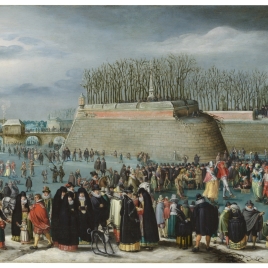
Celebration of the Ommegang in Brussels: Procession of the Guilds
1616. Oil on canvas.Room 080
In a display of skilled shooting accompanied by consider able good luck, on 15 May 1615 sabel Clara Eugenia fired her crossbow and hit the wooden bird that topped the spire of the church of Notre-Dame du Sablon in Brussels. The infanta thus became the ‘queen’ of the annual competition organised by the Grand Serment des Arbalétriers or guild of crossbowmen, the oldest and most prestigious of the capital’s urban militia. The infanta’s participation in 1615 reflected a long-standing dynastic tradition; indeed, the archduke and archduchess had previously participated in 1604, 1608, 1613 and 1614.
The competition of 1615 and the succeeding events, including the procession of Our Lady of the Sablon on 31 May and the celebrations organised at the Vivier d’Oie (or Goose Pond) in the forest of Soignes after the visit to Our Lady of the Forest 138 (depicted in two other paintings in the Prado) all reflect the strategies implemented by Albert and Isabel Clara Eugenia to legitimise and reinforce their rule following their accession in 1598. Assuring the loyalty of the local elites and guilds was one of their principal concerns after thirty years of war and uprisings.
The reason for this ‘triumph of the infanta’ and the unu sual commission awarded to the landscape painter Denis van Alsloot and his collaborators (Antoon Sallaert and David Noveliers) lies in the swearing of Philip III as successor to the Southern Netherlands and the Franche-Comté, a process negotiated between 1614 and 1616. Long before that, in June 1549, Charles V had presented his son Philip in Brussels as the successor to the Flemish-Burgundian domains, endowing the festival of the Ommegang with a particular significance.
Van Alsloot and his collaborators must have made sketches during the shooting competition, the procession of the Ommegang and the celebrations in the forest of Soignes, but work on the creation of this series of eight large-format canvases actually started in October 1615, concluding in December 1616. Seven of the paintings from the original series were sent to the Spanish court in the spring of 1617 but copies were made beforehand and hung in the palace of Tervuren. The eighth scene, depicting the celebrations at the Vivier d’Oie, was sent to Spain in 1620. Philip III decided to display the series in the Salón Grande, the most important ceremonial space in the Alcázar in Madrid, located on the first floor next to the state bedroom known as the Room of the Furies after the series by Titian that hung in it, of which Sisyphus and Tityus are included in this itinerary.
The canvases of the celebrations in Brussels represent the continuity of the Habsburg dynasty in the Southern Netherlands. Those present in the Salón Grande in Madrid would thus see celebrations that emphasised the affection in which the infanta was held in the Spanish Netherlands but also Philip III’s swearing of the oath of loyalty as her successor. Hence the importance of displaying these scenes alongside other joyous entries and famous military exploits that maintained and expanded the Spanish monarchy across the globe.
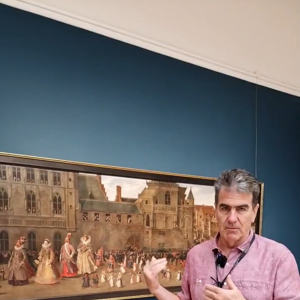
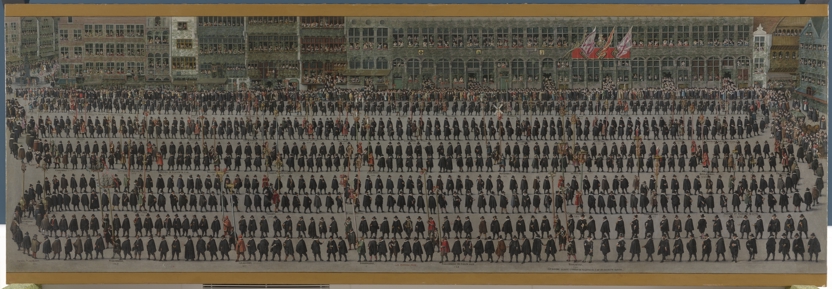
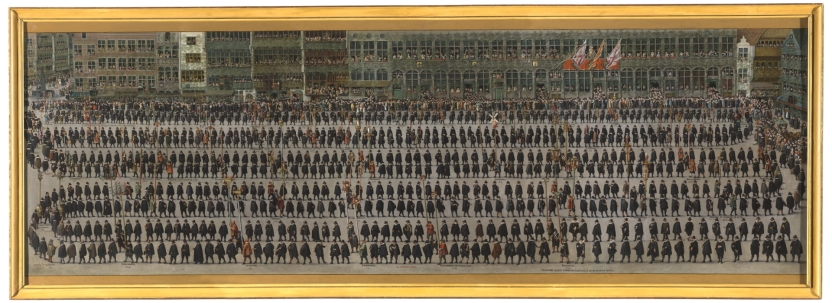
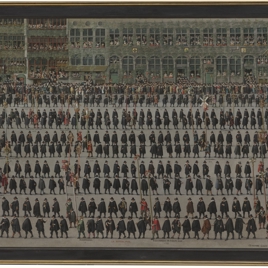
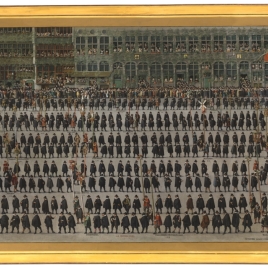
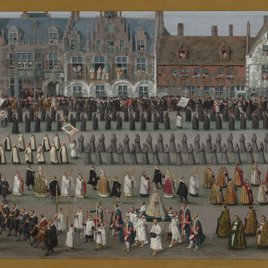
The Ommegang began with a procession of the fortyeight principal corporations or guilds of Brussels. They are shown here moving in a random formation that simply adheres to pictorial convention, as this type of snaking line was not followed in the real procession as it passed through the Grand-Place. The name of the trade and number of craftsmen registered in each guild is recorded in French on the painting, with a translation in Spanish added in pen. Most of the guild members wear short black cloaks. Each delegation was preceded by a messager, flanked by standard bearers with the emblem and coat-of-arms of their trade.
Visible in the middle-ground are the façades of buildings decorated with beech branches, symbol of Our Lady of the Forest. One striking building is the so-called House of the Dukes of Brabant (1441–43), which occupied the east side of the Grand-Place and was the headquarters of the petit serment of Saint George and of other guilds. On the left are the first two houses on the rue des Chapeliers, the street giving access to the procession, while on the far right of the canvas is the house known as Mont Thabor on the south side of the square. The procession left the Grand-Place via the rue de la Colline. (García García, B. J. (2021) en El Prado en Femenino. Promotoras artísticas de las colecciones del Museo (1451-1633), Museo del Prado)