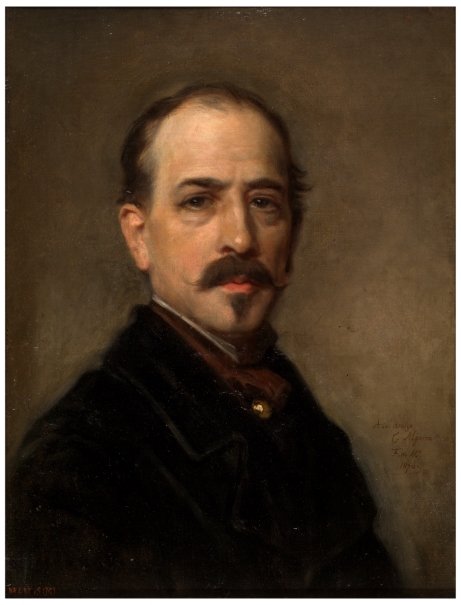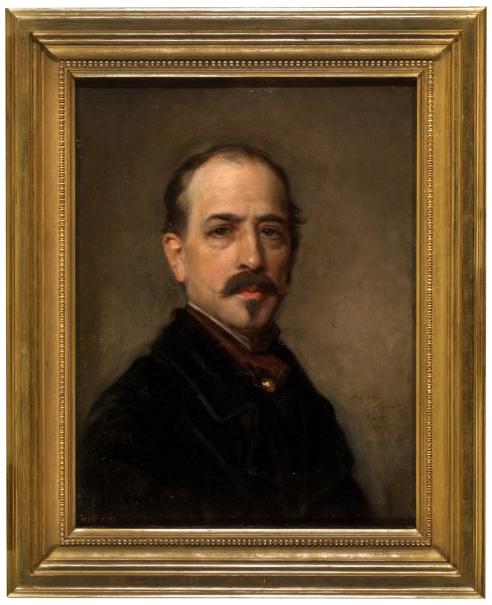
Cosme Algarra
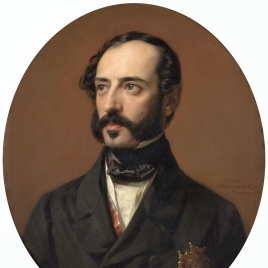
1870. Oil on canvas.Room 062A
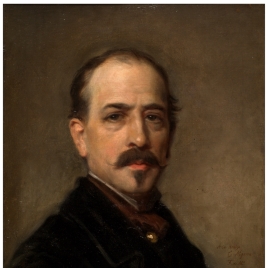
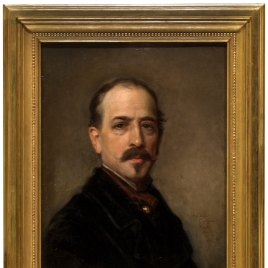
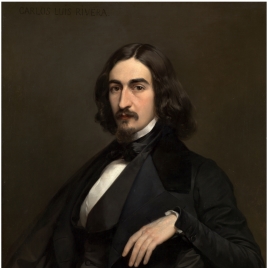
Portrayed at the age of 54, bust-length and against a neutral background, he is dressed in domestic clothes, fastening his tie with a pin and wearing a thick overcoat. With an energetic and temperamental gesture, his thinning hair, with incipient grey hair at the temples, leaves his forehead clear, sporting a Van Dyke beard. He looks at the spectator with his mouth tight and his eyebrows slightly furrowed. Born in Caudete (Albacete, Spain) in 1816, Cosme Algarra y Hurtado began his artistic training as a pupil of the neoclassical painter José Aparicio (1773–1838). He soon turned to landscape painting, even though his first steps were in the direction of other genres.
The painter submitted two portraits to the San Fernando Academy Exhibition of 1840 when he was only 16. Between 1858 and 1867, he took part in the National Exhibitions of Fine Arts with portraits and landscapes, and even implemented some religious works, such as the Crucifix painted for the church in the Salamanca district of Madrid. He also worked as an illustrator for publications such as La Conquista de Méjico de Escosura and the newspaper Los Sucesos, among others. This is one of the most eloquent and direct portraits of artists in Federico de Madrazo´s entire work. This is due both to the personality of his model and, above all, to the freedom with which his effigy is executed, with a wealth of nuances, which Madrazo used in these years to catch up with the new realism in vogue and which, once again, has its roots in the art of Velázquez, both in his chromatic intonation and in his handling of the light, blurring the contours and applying brief touches of brightness to the painter´s nose and lower lip. Madrazo began to sketch this portrait on 2 August 1868, as recorded in his diary of that year, as a sign of sincere friendship with the landscape painter. The friendship faded a few months later when Isabella II, Queen of Spain was dethroned and Algarra became appointed Director of Museo Nacional de Pintura y Escultura, shortly before its merger with the Prado, prompting indignant comments from Federico de Madrazo to his son Raimundo in their confidential letters. The portrait is mentioned in Madrazo´s handwritten inventory, among his portraits given as gifts: 143. Bust portrait of Cosme Algarra (1870)
Artistas pintados: retratos de pintores y escultores del siglo XIX en el Museo del Prado, Madrid, Ministerio de Educación y Cultura, Dirección General de Bellas Artes y Bienes Culturales, 1997, p.130 nº31