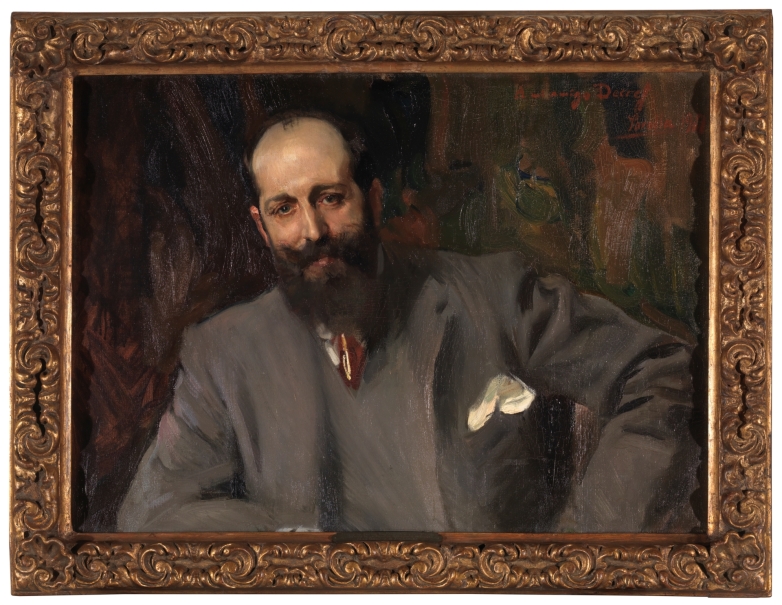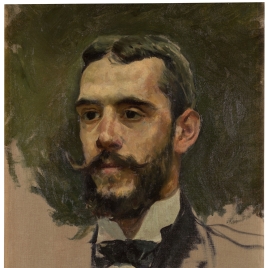
Doctor Joaquín Decref y Ruiz
1907. Oil on canvas.Not on display
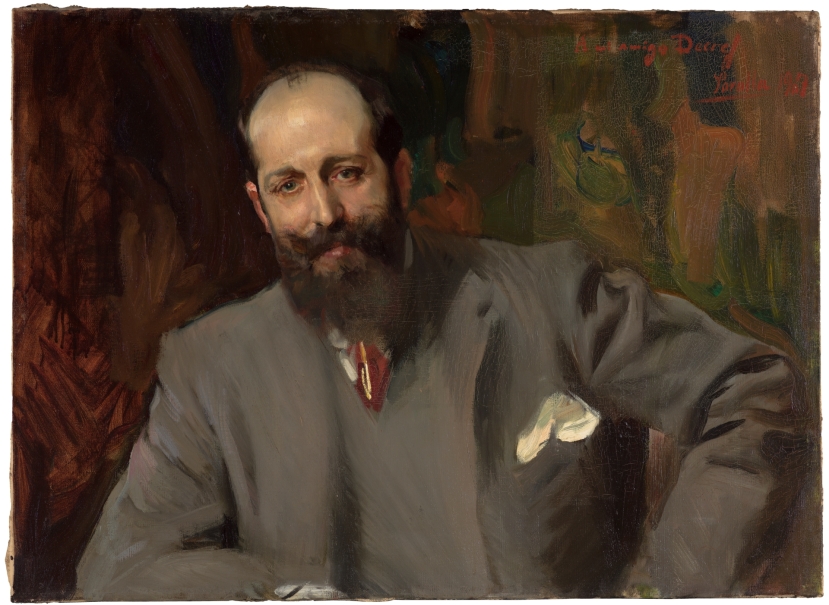
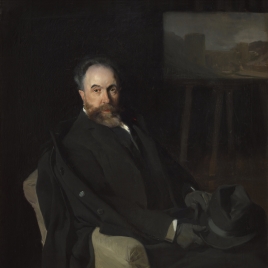
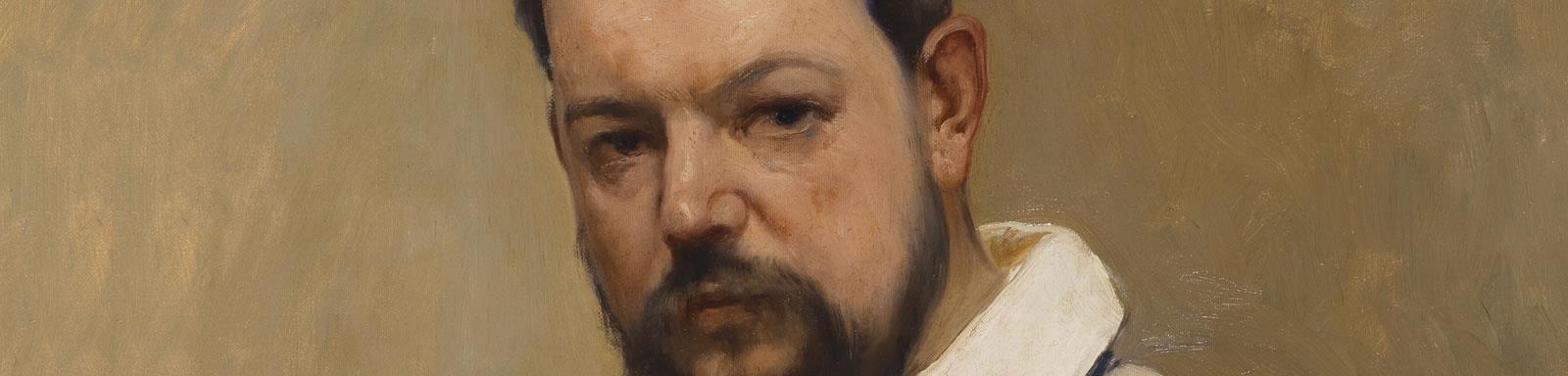
This work belongs to the group of paintings in which Sorolla portrayed his close circle of friends. This is an absolutely characteristic typology of which the Museo del Prado has interesting examples, such as the portraits of Jacinto Felipe Picón (P4654), The painter Antonio Gomar (P4653) and Doctor Francisco Rodríguez de Sandoval (P3095). In them, he turned to markedly landscape supports that were well suited to photographic framing, a new technique of which the artist was very fond, and which concentrated on the psychological characterisation of his model. This is undoubtedly one of the most brilliant examples of his production in this modality. Aged forty-three, the figure poses bust-length, seated and with a confident gesture. The proximity with which Sorolla captures Decref denotes the intimate, daily contact he had with him. This differs from the relationships the painter reveals in his portraits of other of his friends, such as Aureliano de Beruete (P4646). The Valencian master concentrated particularly on the execution of the doctor´s face, whose strong features clearly define his bold personality. The painter depicts Decref´s elegant grey suit with waistcoat and tie with expert draughtsmanship. He gives the background an extraordinary degree of abstraction, using very diluted oil brushstrokes. The lighting, effectively directed on the portrayed figure´s face, concentrates all the attention on his melancholy gaze, which undoubtedly emphasises his magnetic attractiveness. Doctor Joaquín Decref y Ruiz (1864–1939) was a medical celebrity who achieved great national fame. Born in Havana (Cuba), he soon lost his father and moved to Seville and then to Madrid. There he completed High School in 1878 and subsequently began his medical studies. He read his thesis on the treatment of joint injuries in 1894 and devoted much of his professional activity to the diagnosis and treatment of mechanical diseases. In the field of diagnosis, along with Antonio Espina y Capo, brother of the well-known landscape painter who was also portrayed by Sorolla (P004651), Decref contributed enormously to the development of radiology in Spain, becoming the founder and first president of the Spanish Society of Electro-Radiology. From the 1880s he devoted himself to therapies with water currents, founding the Institute of Medical Mechanics in Madrid, where modern hygienist approaches were applied. He also founded the Spanish Anti-Alcoholic League, a Protestant-inspired association that enforced total abstinence from all kinds of alcoholic beverages under a firm oath, mainly for therapeutic purposes, but also for moral persuasion. He continued throughout his life studying physical disability and devoted special attention to physiotherapy, in which he was also a pioneer in our country. He was particularly interested in physical deformities and developed an extensive didactic work related to this subject. This led him to publish works such as To mothers: children´s deformities (A las madres: las deformidades de los niños) (Madrid, 1908) o Scoliosis in schools (La escoliosis en los colegios) (Madrid, 1911). These publications disseminated his scientific conclusions with a preventive intention. In this sense, this portrait is a valuable testimony to the intimacy of two friends, both keenly aware of hygienist trends, both successful at the end of the century in Spain, and both approaching physical disabilities with a clear moral interpretation. Dr. Decref studied the medical aspects of deformities in children, which, at the time, were susceptible to an immediate moral reading attributing their origin in the vices of the parents, a reading to which Decref also subscribed. For his part, Sorolla had painted his successful work Sad Inheritance (Valencia, Bancaja Collection) for the Universal Exhibition in Paris in 1900, based on the same moral perspective. A shared ideology between the doctor and the Valencian artist is clearly present in this painting, an ideology which, according to the artist’s own confession to the children at the Hospital of San Juan de Dios, depicted the deprived people of society as blind, insane, weak and leprous.