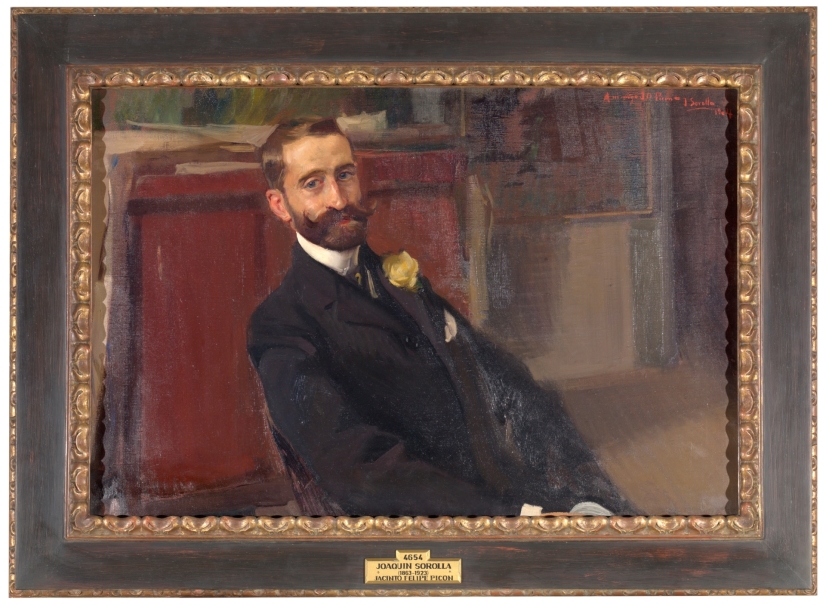
Jacinto Felipe Picón y Pardiñas
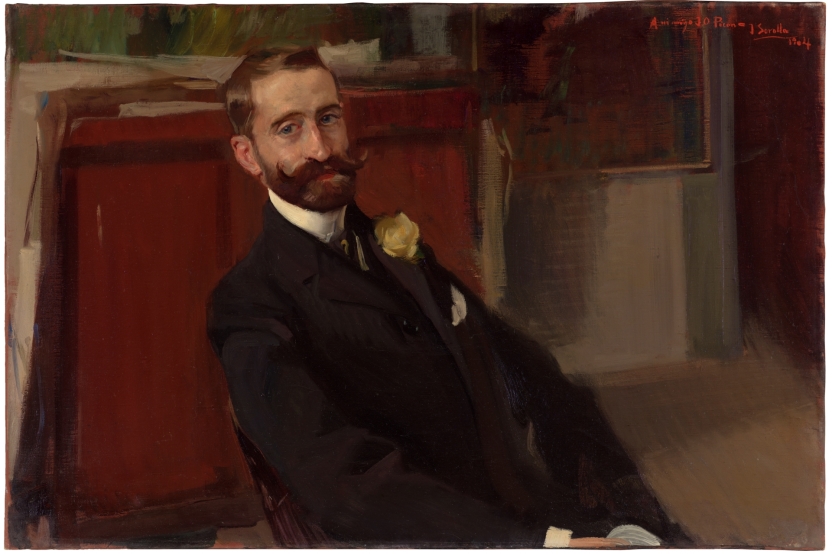
1904. Oil on canvas.Not on display
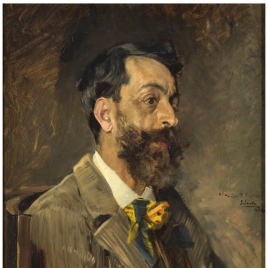
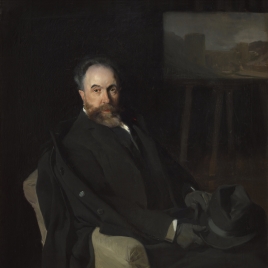
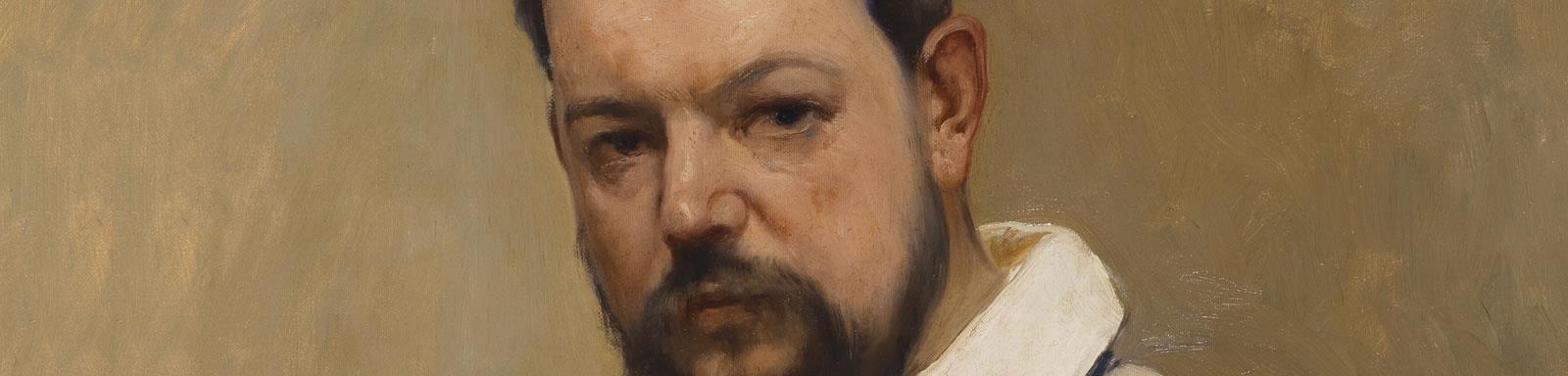
The artist depicts him almost knee-length, seated and leaning back in a chair. He is concealing hands, barely visible through the white cuffs of his shirt at the lower edge of the canvas. He is dressed impeccably in dark clothes, with a stiff-collared shirt, a yellow rose on the lapel of his jacket and the peak of a white handkerchief sticking out of his pocket. It is difficult to discern the model´s youth, perhaps because of his serious appearance, the elegant attire he wears and the thick beard with large moustaches framing his face. He was only twenty-six when Sorolla portrayed him, probably in his new studio in Madrid, in Calle Miguel Ángel, where the painter had moved at the end of 1903. In the background of the portrait there are stretcher frames and sketched canvases hanging or leaning against the wall. They reveal the brushstrokes, luminous stains and unique tones of the painter. By this time, Sorolla already enjoyed the acclaim of his many triumphs and had won the Grand Prix at the Universal Exhibition in Paris in 1900 and the medal of honour at the National Exhibition of Fine Arts in 1901. The same studio background appears in the sober and magnificent self-portrait in the Museo Sorolla, also painted in 1904.
In the first decade of the 20th century, Sorolla widely used this type of three-quarter or half-length portrait, marked by a diagonal line, with a very direct foreground, in very landscape formats against neglected backgrounds that suggest the informal and natural atmosphere of the workplace. He used these portraits precisely to depict his immediate world associated with family, professional or friendship. These include the portrait of Gomar and that of Doctor Decref in the Museo del Prado, that of José Artal in the Museo de Bellas Artes in Valencia, that of Luis López Ballesteros in the Museo de Álava, that of his sister Concha in the Museo Sorolla and the splendid portrait of Raimundo de Madrazo painted in 1906. In that last, Madrazo is portrayed seated in a rocking chair against a luminous landscape background, and the painting is now in the Hispanic Society in New York.
Jacinto Felipe Picón y Pardiñas was born in Madrid in 1878. He was the son of the famous writer and critic Jacinto Octavio Picón y Bouchet. The author dedicated the painting to him, in correspondence with the friendship and admiration that united painter and novelist. In the midst of the turn-of-the-century pessimism, Picón wrote one of the most forceful sentences in reference to Sorolla´s art: A village of rich merchants has defeated us by force of arms, we are poor and we keep repeating that we are devoured by corruption and ignorance. From the shipwreck of our glory, we have only saved Art. He was educated in a cultured and elitist environment; he obtained his doctorate as a lawyer and was a magistrate of the Madrid Court. He also took part in national politics, being elected deputy for the conservative party in the elections of 1907 and 1914. He collaborated in the Scientific, Literary and Artistic Athenaeum, which he joined as an active member in 1897, under the direction of the politician and financier Segismundo Moret. He was also the secretary of the Plastic Arts Section. From 1894 until his death on the 18th of January 1917, he was involved with the Museo de Arte Moderno, participating on the commission responsible for its creation and playing an active role in its development as a member of its board of trustees from 1915. The painting was always in the collection of Jacinto Octavio Picón. On his death in 1922, he left the usufruct of the work to María, his daughter and the younger sister of the portrayed man. The following year she honoured her father´s bequest, handing it over, along with a fine collection of family portraits, to the Museo de Arte Moderno.
Gutiérrez Márquez, A., Jacinto Felipe Picón y Pardiñas (1904). En Barón, J.: El retrato español en el Prado. De Goya a Sorolla, Madrid, Museo Nacional del Prado, 2007, p.186, n. 66