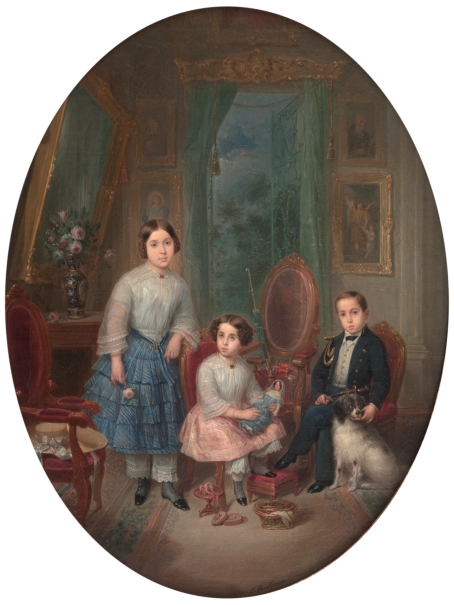
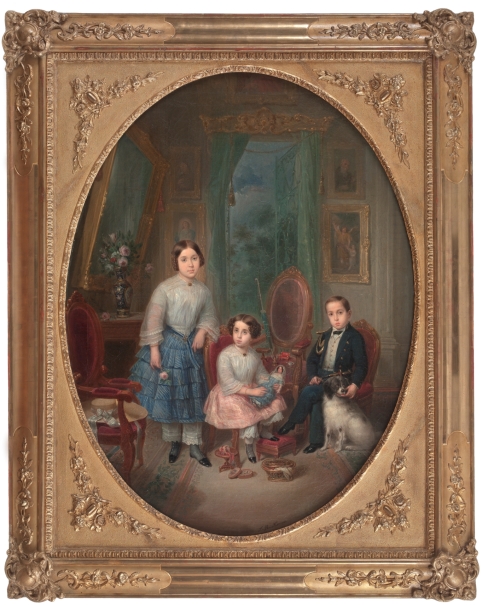
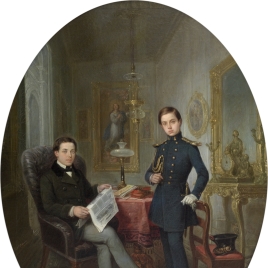
Enrique, Concepción and Salud Santaló
Ca. 1850. Oil on canvas.Not on display
The pair of family portraits in two indoor seetings, consisting of this work and P004607, is highly representative of the artist´s work. It also reflects the popularity of the genre in Seville in the mid-19th century, when both works were executed. Furthermore, probably due to British influence, family portraits were more common there than in the rest of Spain, with children playing a prominent role. The artist depicts them in two pictures designed to form a pair, both painted in an oval, with the spandrels, in the pink colour of the preparation, hidden by the frame. This work depicts the three youngest children in the family: Salud, holding a rose next to her siblings; Concepción, seated with a doll in her hands and surrounded by toys; and Enrique, in uniform, who here also foreshadows his later career in the navy. Enrique would go on to become an officer on the warship Neptuno, which in 1866 embarked on an expedition led by Commander Pedro Díaz de Herrera against the slave trade in Cuba. Later, between the 24th of July 1879 and the 3rd of September 1880, he became governor of Equatorial Guinea. He then devoted himself to teaching and became Chief of the Defence Staff of the training squadron. In 1905, he became Commandant General of the Naval Training Division. In 1910, he was Captain General of the Department of Cadiz. The domestic interior opens at the back onto a garden, visible behind curtains but not very detailed and treated without any realism whatsoever, almost like a set. Two paintings flank the opening on either side, and there is another one over the lintel. On the left, Our Lady of Sorrows appears above an Immaculate Conception of the same type as the one in the companion painting. On the right there is an apostle, probably Saint Peter, above a new representation of Saint Raphael and Tobias. It is attributed to the artist, who sent a painting of the same subject to the Cadiz exhibition of 1860. On the left, there is also a mirror over a console table, but there is a porcelain vase with roses and lilies on it. The objects are of particular interest, some of them toys, scattered in the centre on the floor, where there is a tiny pedestal table, a jewellery box and a sewing box. On the chair there is a parasol, a small settee, a sewing kit, a female figurine and a teapot. All this shows an interest in the domestic interior, which appears in other paintings by the artist, such as the portrait of the boy Eugenio de la Borbolla. He also appears wearing a midshipman´s uniform and in a similar pose to that of Enrique Santaló. In this painting, the colour is more varied, enlivened mainly by the blues and yellows of the girls´ skirts and the bright chromaticism of the porcelain of the vase and the flowers. The artist executed them with great quality, as befits an artist who also cultivated this genre. A soft half-light, with a measured gradation of transitions between light and shade, shows, as in the companion piece, a thorough knowledge of the Spanish pictorial tradition, with great proximity to the paintings of Murillo´s last period. The artist copied works by this artist on numerous occasions, and it is the clearest stylistic reference of his extensive religious production.
Barón, Javier, Enrique, Concepción y Salud Santaló (h. 1850). En Barón, J.: El retrato español en el Prado. De Goya a Sorolla, Madrid, Museo Nacional del Prado, 2007, p.118-120, n. 33