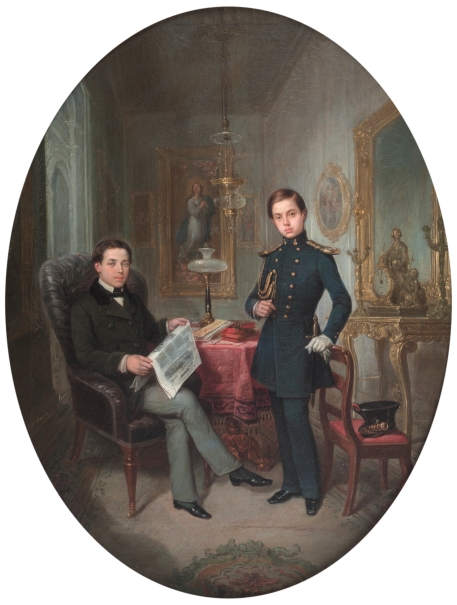
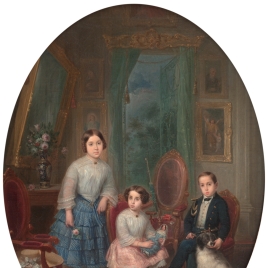
Ricardo and Federico Santaló
Ca. 1850. Oil on canvas.Not on display
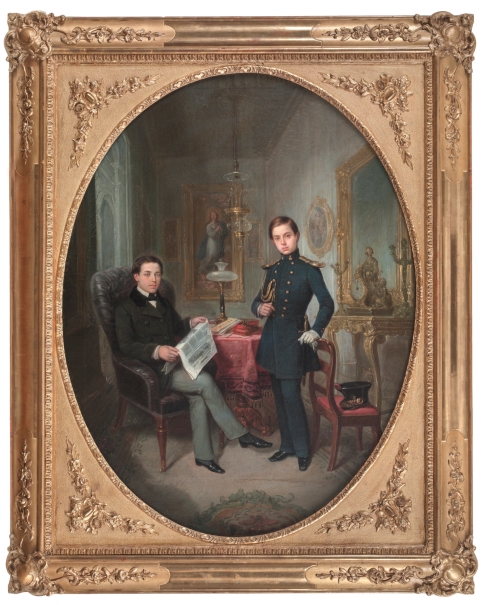
The pair of family portraits in two indoor settings, consisting of this work and P04607, is highly representative of the artist´s work. It also reflects the popularity of the genre in Seville in the mid-19th century, when both works were created. Furthermore, probably due to British influence, family portraits were more common there than in the rest of Spain, with children playing a prominent role. The artist depicts them in two pictures designed to form a pair. He painted both in an oval, with the spandrels, in the pink colour of the preparation, hidden by the frame. The one depicting Ricardo and Felipe Santaló Sáenz de Tejada hangs on the right. The first-born of the family appears on one side. He is reading an illustrated journal with a woodcut heading. The boy, who appears to be about fifteen years old, crosses one leg over the other, in an attitude that is intended to denote naturalness and which the artist repeated in other portraits of children. He wears street clothes with a fur-lined collar, a bow tie and exhibits a self-assurance that is also evident in the attitude of his brother Federico. His brother wears an artillery cadet´s suit and places his gloved hand on the back of a chair, on which his military cap rests. Between them, a table with a red tablecloth and a glass lamp is covered with publications. Between the curtains on the left, there is a large portico with semi-circular arches on slender columns. An Immaculate Conception presides over the background wall, directly inspired by Murillo, like those painted by the artist himself, marking the axis of the composition, and highlighted by the lamps. Two other paintings flank it, and in the one on the right, which would form a pair with a similar subject in the one on the left, the figure of a saint seems to be visible. On the right, an oval painting depicts Saint Raphael and Tobias, a motif related to pedagogy and therefore appropriate to the scene. Next to it, there is a console table with its setting under an Isabelline mirror. In the echoes of the symbolic significance of the mirror and the clock, the artist may be alluding to prudence and the art of good government and self-control. In any case, some of these objects are repeated in other of his portraits. In the companion portrait of María Dolores González, he depicted the same golden clock, with bronze allegories and a similar scenario of architectures with semi-circular arches. This is also present, as if it were a convention, in the portrait of Ramón González (both paintings, in the collection of the Count of Ybarra, in Seville). The cold colours of the bluish-grey walls contrast with the warm tones of the red of the carpet and the golds of the frames and console table. They also contrast with the bronzes of the setting and the lamp, as well as the set of buttons, the cord and the pommel of Frederick´s sabre. The latter brother would indeed follow have a career as naval artilleryman, in which he reached the rank of general. As an officer, he strove to disseminate the best instruction for his troops. Thus, he published a Manual of the corporal of cannon: very brief notions of theoretical artillery and regulatory material of our Navy (San Fernando, 1880). When he was already a brigadier of the Navy Artillery, he published a Manual of the Marine Artilleryman: light notions of artillery and military service record of the regulatory material in the Navy (Madrid, 1895), which had been entrusted to him by Royal Order of 8th of October, 1895. Given his competence, he was part of the Technical Board that had to report on Isaac Peral´s submarine.
Barón, Javier, Ricardo y Federico Santaló (h. 1850). En Barón, J.: El retrato español en el Prado. De Goya a Sorolla, Madrid, Museo Nacional del Prado, 2007, p.118-120, n. 32