Francisco Antonio González
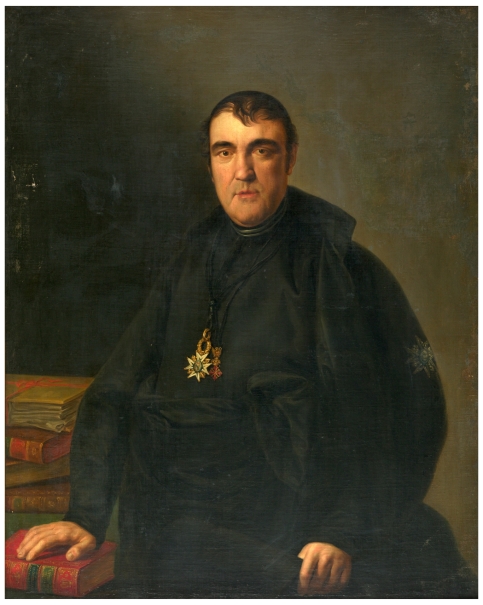
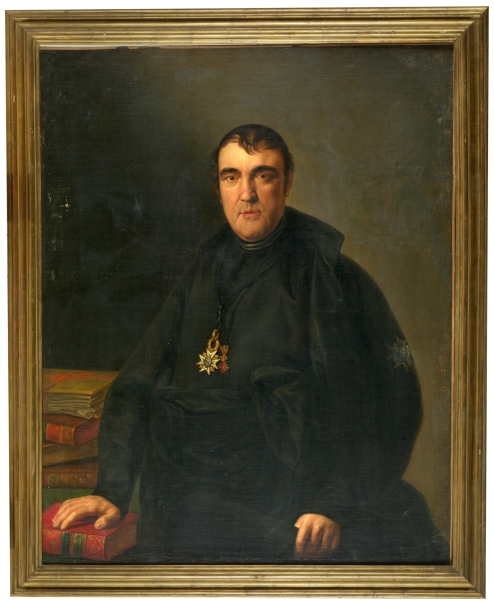
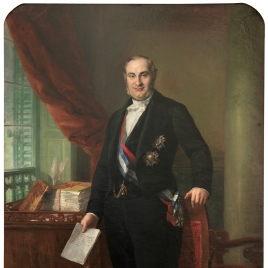
Ca. 1830. Oil on canvas.Not on display
Francisco Antonio González Oña (Casar de Talamanca, Guadalajara, 5 February 1773–Madrid, 23 October 1833) was Doctor of Theology, chaplain of the Royal Regiment of Guards de Corps, confessor of Queen Maria Christina, Professor of Arabic and Hebrew at Alcalá University, rector of the hospital de la Concepción in La Latina, senior librarian at the Biblioteca Real (Royal Library), lifetime secretary of the Real Academia Española (Royal Spanish Academy) since 1814 and treasurer of the Real Academia de la Historia (Royal Academy of History).
The figure wears upon his habit the crosses of Sacred Military Constantinian Order of Saint George and the Order of Charles III, which he also wears sewn to his cape. The latter was granted to him by Decree on 8 January 1830, according to the file held at the National Historical Archive. Therefore, this painting must have been finished afterwards. He is depicted dressed in priest habits, standing and holding his black cappello romano with his left hand. He appears besides a table, where several books and a documents folder allude not only to his intellectual status and his vocation as a librarian, but also to his studies as a theologian, since the only readable title says, ‘old and new testaments in Spanish’, on which he leans his right hand.
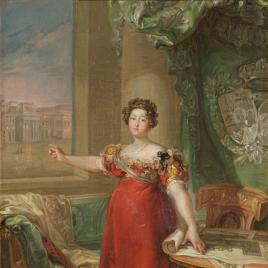
The painting is of a certain quality, as is the work of Bernardo López Piquer, who was trained in the style of his father, Vicente López Portaña. It was carried out shortly after his most important painting: the portrait of Queen María Isabel of Braganza as founder of the Museo del Prado in the Museum (P000863). This work – as is the case in most of the author’s portraits – makes use of a much more restrained colour scheme. This can be observed in the delicate variations portrayed in the tones of the figure’s complexion. The accuracy of the drawing and the special care in the modelling of the features – which ultimately renders the head with utter preciseness – are also typical characteristics of the artist’s work. At the same time that he uses longer, smoother brushstrokes in the bundle of papers in the folder and in the clergyman’s neck, he also uses shorter brushstrokes to highlight the brightness in the crosses and the gold in the book’s sinews, spines and raised bands.
Barón, Javier, "Francisco Antonio González" en Memoria de actividades 2016, Madrid, Ministerio de Educación, Cultura y Deporte, 2017, p.74-76