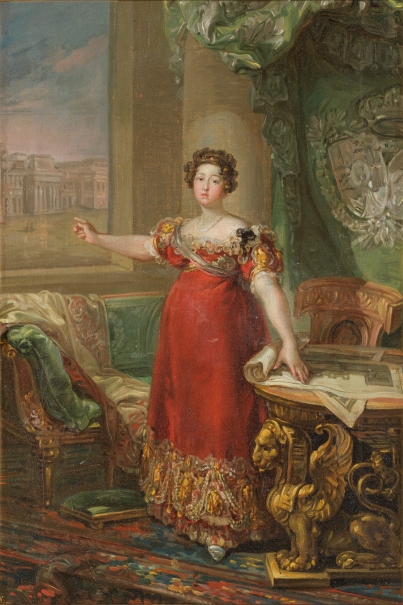
Maria Isabel of Braganza as Founder of the Museo del Prado (sketch)
Ca. 1829. Oil on canvas.Room C
This is the preparatory sketch for the painting posthumously depicting the second wife of King Ferdinand VII, Maria Isabel de Braganza (Lisbon, 1797–Aranjuez, 1818), as founding queen of the Real Museo de Pinturas (Royal Museum of Paintings). It commemorates the involvement of the Portuguese-born queen in the reconditioning of the Real Museo de Pinturas and depicts her as if approving the proposals for the installation of its galleries.
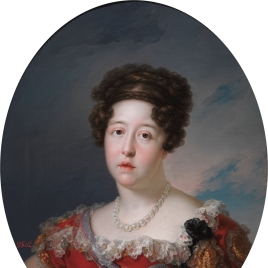
Concerning the final painting, the oil sketch anticipates and completely resolves the composition. The queen’s attitude remains the same. Nevertheless, there are some interesting differences. The museum building to which the queen points does not appear in almost its entirety, as in the final painting; instead, only a part of its west façade is shown. The sheets of paper under her left hand do not represent the elevation of the rooms with the distribution of the paintings in them as clearly as in the final canvas. The structure of the pedestal table is different, and the character of the winged lion with the kalf is more specifically neo-Egyptian, as if the artist – who was active at the end of the second decade – had endeavoured to give this piece of furniture a distinctly Empire nature, closer to the queen’s dress and time period (1816–8). Instead of the sumptuous armchair with the queen’s embroidered initials on the fabric of its curved back, there is a simpler Fernandine chair. The dress has golden hues that do not appear in the final painting. The greens of the upholstery and drapery are lighter and closer to the chromaticism of his father and master, Vicente López Portaña Valencia (1772–Madrid, 1850), than those of the final painting. The execution demonstrates a notable quality, in the style of very broad, exquisite brushstrokes typical of the sketches of his father, whose most faithful follower he was, and whom he approaches in this work, the most important of Bernardo López’s output. It is possible that, given the importance of the commission, Vicente López himself advised his son. Conversely, the effigy of the queen, painted in oval by López Portaña himself around 1816 (Museo del Prado, P000869), and drawn by him in the same way (Museo del Prado, D002187), was used by his son in the execution of her head and bust.
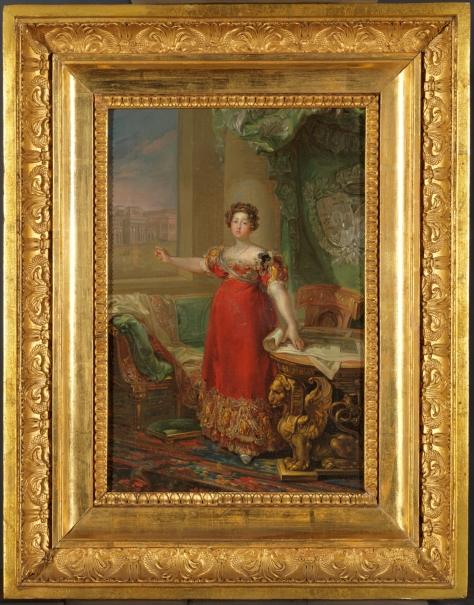
The work conserves its original moulded casetta frame, water-gilt with alternating burnished gold and matte gold.
We also know of a watercolour with this motif, signed by the painter and dated 1828, in the collection of Guillermo de Osma in Madrid.
Barón, Javier, 'Bernardo López Piquer. María Isabel de Braganza como fundadora del Museo del Prado (boceto)'. en: Memoria de actividades 2021 Museo Nacional del Prado, Ministerio de Cultura y Deporte, 2022, p.50-51