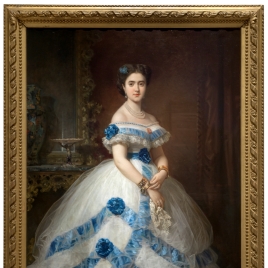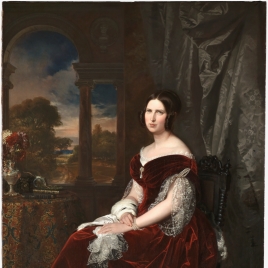
Isabel Álvarez Montes, 2nd Marchioness of Valderas and 2nd Duchess of Castro Enríquez
1868. Oil on canvas.Room 061
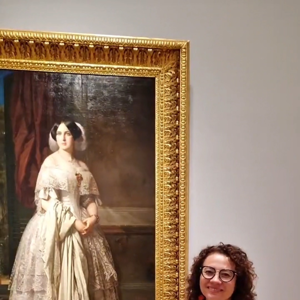
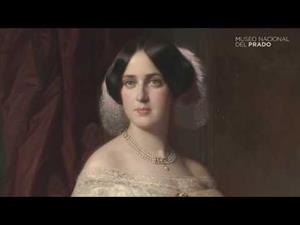
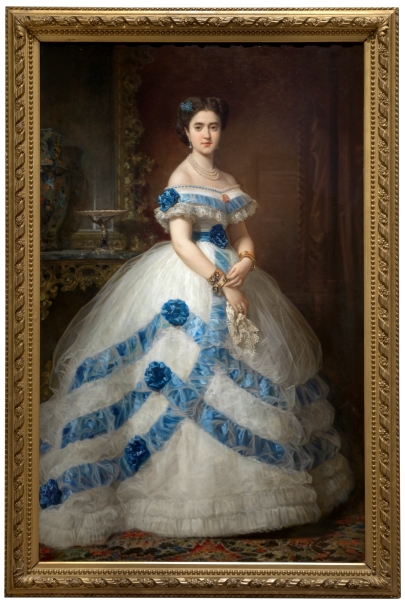
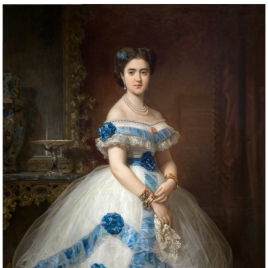
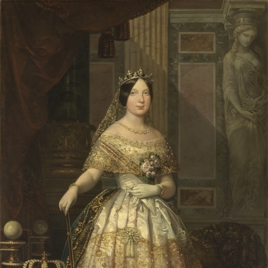
The numerous formal portraits painted by Federico over the course of his career -large-format works generally intended to hang in the capacious homes of Elizabethan aristocrats- include some of his most spectacular canvases. The present splendid work from the Museo del Prado dates from the artist’s fully mature period and is marked by a freer touch, a deep and rich use of paint and an attentively realistic approach to this genre at a time when it was fully integrated into Spanish painting. Shown full-length, the young woman wears a magnificent white tulle dress with blue silk adornments and a wide neck that leaves her shoulders uncovered. Her figure stands out in the semi-darkness of a luxurious room. Depicted at the age of twenty, she presents a rounded face with wide eyebrows and large features. Her adornments include a flower in her hair, pearl earrings and necklace, and thick, sumptuous bracelets, one of which has a medallion with the crowned initial of her title as Duchess of Castro Enríquez. This matches the oval brooch on her bosom. With one hand, she plays with one of her bracelets, while the other holds a lace handkerchief.
Despite the extraordinary delicacy with which the artist treats the tactile qualities of the model’s dress -the transparency of the tulle that drapes with abundant folds over her skirt, or the silk rosettes that adorn it- this portrait is resolved with a lively and summary technique that is almost sketchy in certain areas. This painterly effect may respond, at least in some parts, to the participation of the artist’s son, Raimundo, which is mentioned in Federico’s diary-datebook from 1868. There, he clearly records the progress of this portrait, which he painted in nine sessions between January 30 and April 9 of that year. In the first entries, he calls the model Señorita de Gaviria, due to her relation to Manuel de Gaviria y Alcoba, Marquis of Casa Gaviria and Count of Buena Esperanza. This nobleman was married to the model’s aunt, from whom she would later inherit the title of Duchess of Castro Enríquez.
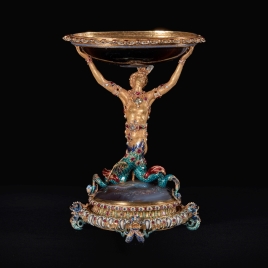
Curiously, among the luxurious furnishings that adorn the setting and thus enhance the portrait’s appeal, Federico included, on a sumptuous console table in the background, the most famous piece of decorative metalwork from the Dauphin’s Treasure, a group of pieces that have been at the Museo del Prado since it was founded. The one visible here is an exquisite inlayed onyx and gold salt cellar, a French work from the first half of the 16th century that Madrazo may have copied from life, as he became director of the Museo del Prado in 1860 and thus had special access to its collections (Text drawn from Díez, J. L.: El siglo XIX en el Prado, Museo Nacional del Prado, 2007, pp. 182-184).