Isabella II of Spain
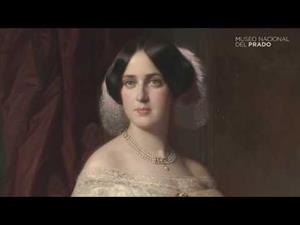
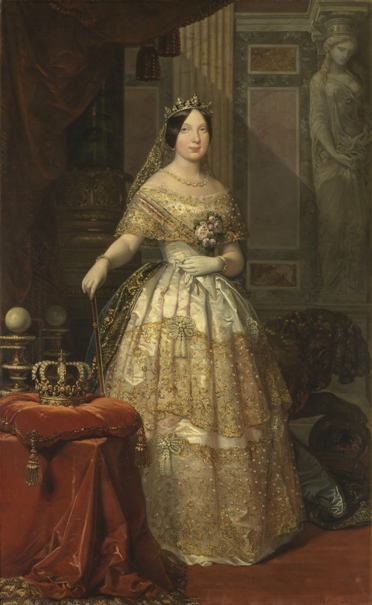
1848. Oil on canvas.Not on display
Federico de Madrazo was undoubtedly responsible for the best official portraits of Queen Isabella II, whose physiognomy was ennobled by the delicacy and adornment of a very rich costume and precious stones, especially described and resolved with exquisite quality. To these decorative resources Madrazo would add the sweetening of her features and the distinction of a pose, humanized in a certain way by the almost adolescent image of the queen, with a clean and serene look that was very popular among her subjects, with whom, as Galdós would say, she established an egalitarian feeling from which emanated reciprocal trust. There was never a more beloved queen, nor a people whose sovereign was more imprinted on the fabrics of her heart.
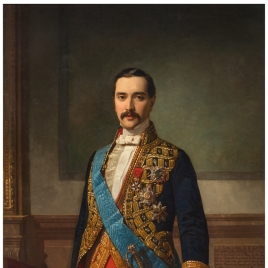
To this model responds this portrait of apparatus of the sovereign realized in 1848, two years after having contracted marriage with her cousin Francisco de Asís, whom also the same Madrazo portrayed of order for the Ministry of the War in an identical format that emphasized the union of the couple, precisely when the chronicles put of manifest the difficult understanding of the spouses in these first years of coexistence, mediated by the palace intrigues and the political interests that took to the marriage to interrupt their relation in many periods of that same year.
On an aulic background of pilasters, marbles and caryatids, already used in other previous portraits and worked in several drawings and studies, represents Queen Isabella enhancing her royal dignity with the attributes of her sovereignty, characterized by the scepter she holds in her hand and rests on the cushion where the emblematic royal crown rests. Dressed in an elegant gala dress of white moiré with chiffon flounces adorned with several bows of pearls joined in the center forming a flower and two hanging tassels, she wears on it a blue velvet tail trimmed with gold that she drags to her feet, underlining the dignity of the represented woman whose slender waist differs quite a lot from the natural physiognomy of the sovereign tending to obesity. She is decorated with the bands of the Spanish Order of Noble Ladies of Queen Maria Luisa and the Portuguese Orders of Queen Saint Isabel of Portugal and Our Lady of the Conception of Villaviciosa, and adorned with a bouquet of flowers on her chest. On her skin, she wears a riviére necklace made of diamonds and two bracelets of diamonds and rubies that support the beautiful and delicate diadem of gold and diamonds in the shape of fleurs-de-lis that she wears on her hair, combed in the fashion of the moment in two sides that hide the short diamond earrings.
Isabel II was born in Madrid on October 10, 1830. Firstborn of King Ferdinand VII and his fourth wife, Maria Cristina de Bourbon, she assumed the Crown at the age of thirteen and ruled during one of the most turbulent periods of Spanish politics in the nineteenth century, characterized by the succession of the Carlist wars and the continuous mutinies and pronunciamientos of military order that supposed an endless dance of conservatives and progressives in the government of the nation, until the liberal revolution of September 1868, that forced her to the exile in Paris until her abdication in 1870 in her son Alfonso XII, in whose person the monarchy would be restored in 1874. In Paris, she lived in the Palace of Castile, under the protection of Napoleon III and Eugenia de Montijo, and died on April 9, 1904.
Gutiérrez Márquez, A., La reina Isabel II (1848). En Barón, J.: El retrato español en el Prado. De Goya a Sorolla, Madrid, Museo Nacional del Prado, 2007, p.128, n. 37