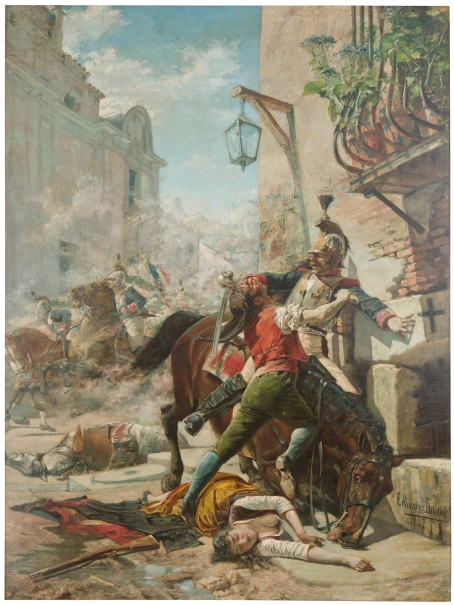
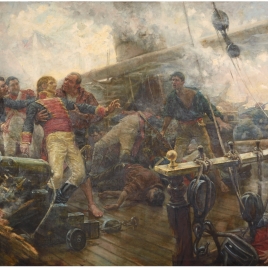
Malasaña and his daughter fight against the French in one of the streets leading down from the park to San Bernardo. The Second of May 1808
1887. Oil on canvas.On display elsewhere
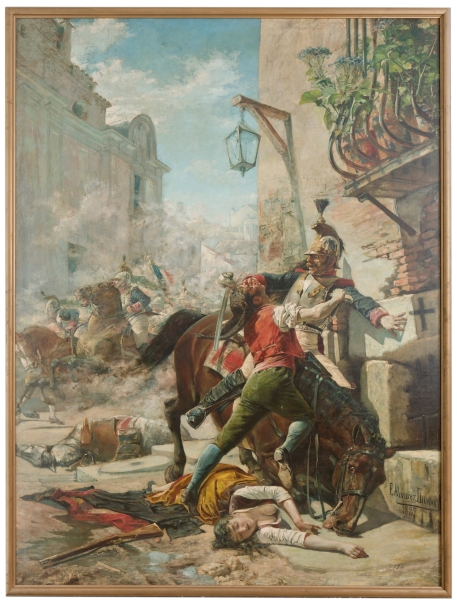
Awarded a “Third Class” medal at the National Exhibition of Fine Arts in 1887, the painting pays tribute to two of the heroes who died in the defence of Madrid and achieved more legendary glory in the struggle of the people of Madrid against the French troops during the War of Independence (1808–1814). Thus, it illustrates the moment when the guerrilla Juan Manuel Malasaña Pérez (1759–1808) kills the French dragoon who has just murdered his daughter, the embroiderer Manuela Malasaña Oñoro (1793– 1808), who was supplying her father with rifle cartridges to fight the French troops from her house during the assault on Monteleón Park. The scene takes place on the corner of the current Calle Daoíz and Calle San Bernardo, in front of the church of Montserrat, under a balcony full of flowerpots, where the hero from Madrid pounces on the French soldier on horseback, stabbing him in the side. With his eyes wide open and the terror of death reflected on his face, the French tries in vain to pull the guerrillero apart by digging his nails into his face. At the feet of the horse lies dead Manuela Malasaña next to her rifle, while amidst the smoke of combat and the dust a dead horse can be seen next to a manhole cover. Behind them, there is a charge of French cavalry, galloping down the wide street of San Bernardo in front of the facade of the church of Montserrat.
This painting is probably the best testimony of the most characteristic facet of Eugenio Álvarez Dumont´s production, who, together with his brother César, became true specialists in painting war and military scenes, particularly those related to the War of Independence, to which they dedicated their best art. Eugenio Álvarez Dumont here demonstrates his best qualities for this type of scene, both in his mastery of composition, –which is attractively original compared to the usual format of the genre– and in his instantaneous capture of the frenetic movement of the characters and animals in the fight, as well as in the dramatic tension of their attitudes, on this occasion concentrating all the expressive intensity of the plot on the two main characters. In addition, the artist displays a compositional daring of great modernity by giving such a prominent role to the figure of the fallen horse. He places it to the forefront with its appalling head projected towards the viewer: eye wide open and tongue hanging out - signs of its agony.
Álvarez Dumont´s technical mastery is evident in this painting in its broad, impastoed execution, with a fiery but precise touch, with fragments of beautiful transparencies alongside energetic brushstrokes. Although the artist does indeed give less importance to colour, conditioned moreover by the nature of the scene, the clothing of the figures, the severity of the setting and the dusty atmosphere, which are not exactly conducive to great chromatic displays. In addition, the composition is resolved with impeccable draughtsmanship and a singular skill in the use of highly effective elements, such as the dead horse in the background, the cloud of smoke and dust enveloping the French troops riding in the background and the confusion of legs and feet under which the lifeless body of the young heroine lies. The composition is resolved with an impeccable security of the drawing and a unique skill in the use of elements of great effect, such as the dead horse in the second term, the cloud of smoke and dust that envelops the French troops riding in the background or the confusion of legs and legs under which the lifeless body of the young heroine lies. All these aspects are evidence of the success achieved by the artist in this work, with pieces of astonishing pictorial modernity, such as the background of the sky or, above all, the wall in the corner with the remains of posters stuck on it, splendidly suggested with just a few strokes of the brush. The painting was reproduced in a beautiful engraving in the magazine La Ilustración española y Americana, which also published another engraving on a drawing by Manuel Alcázar, entitled El público de los miércoles (The Wednesday Public), which depicts a view of one of the halls of the National Exhibition of Fine Arts, where this painting can be seen in the background, next to a door.