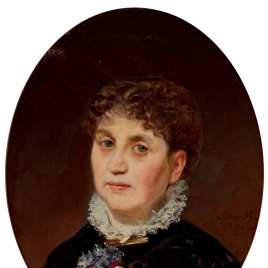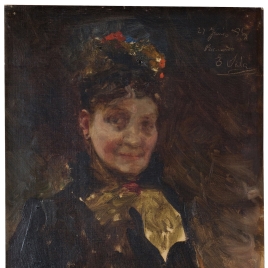
María Semprún y Pombo
1900 - 1905. Oil on canvas.On display elsewhere
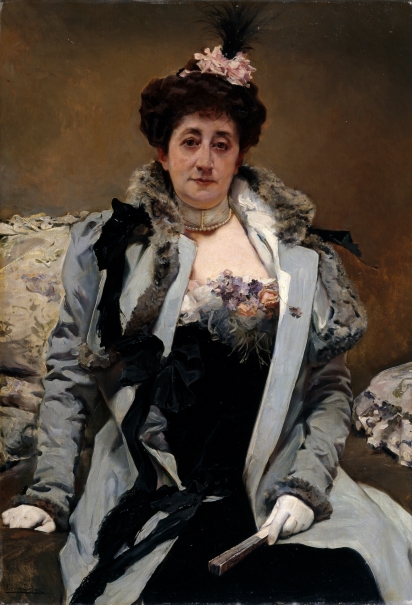
The portrait subject occupies most of the surface of the canvas and is frontally depicted only up to her knees. On a neutral, slightly lightened background, Sala has painted an older lady seated on a sofa decorated with cushions. She is looking towards the viewer and her face reveals an energetic disposition, both in the rather dismissive expression of her gaze and in the rictus of her lips. Her hair is tied back in a bun at the top of her head, revealing her ears, which are depicted without earrings. Moreover, the hair is adorned with a colourful and elegant headdress made of pink flowers and a dark-coloured feather. She wears a choker with pearls and diamonds around her neck and a low-cut dress accessorized with a large brooch made of flowers and tulle that perfectly matches the ornament of her hair. On top of that, she wears a blue coat that covers the dress and that trims the collar and sleeves with fur. Her hands are sheathed in white gloves and are resting, one on the arm of the armchair and the other on her lap, while she indolently holds a closed fan. This commissioned portrait is a clear example of the depiction of the bourgeois portrait, which the artist learned during his time in Paris. The model stands in a slightly stiff, tense pose, looking at the viewer with an air of superiority, aware of her high social class.
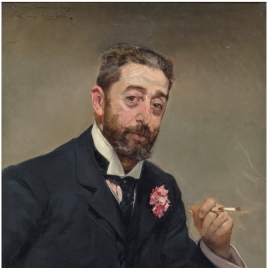
Emilio Sala has used a precise technique to draw the character’s features and clothing, seeking greater detail in the description of the model in order to imbue her with an elegant, mundane air, yet with a certain degree of affectation. The painter achieved great success by offering his Spanish clients the innovations in bourgeois portraiture that were in vogue in Parisian society at the end of the century. He thus gave his portraits a touch of cosmopolitan elegance through the pictorial refinement in the execution, enhanced by a palette rich in colours, genuinely Levantine and Mediterranean. This canvas can be dated from the early years of the 20th century, probably between 1900 and 1905, given the firm and confident technique of the painter as well as his great decorative sense of colour. It is therefore a representative example of Sala’s mature portraiture, which evolved from the sobriety of his early works towards a decorative and precious style very much to the taste of his regular clientele, namely the wealthy bourgeoisie of the time. The portrayed lady is probably related to José María Semprún, also depicted by Emilio Sala around 1900 in a painting in the Museo del Prado (P7582), which is slightly smaller in size. Both were included in the 1947 bequest by the widow of Vargas, Carmen González Álvarez, to the now defunct Museo de Arte Moderno.