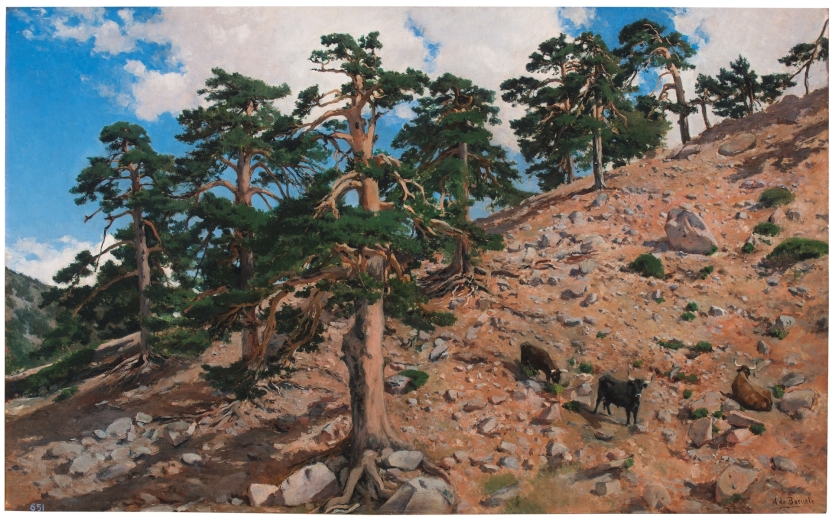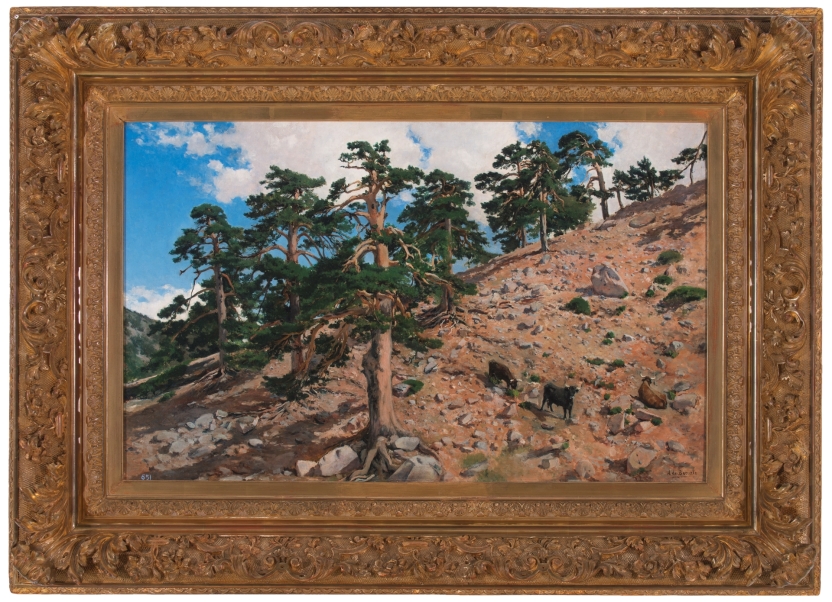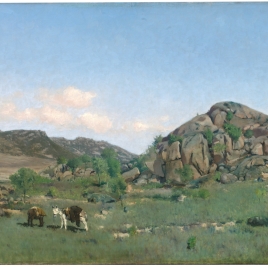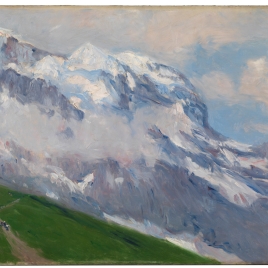
On the heights of Fuenfría (Sierra de Guadarrama)
1891. Oil on canvas.On display elsewhere
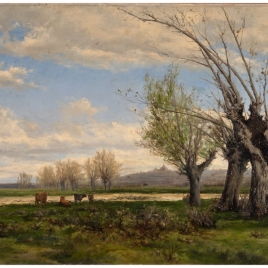
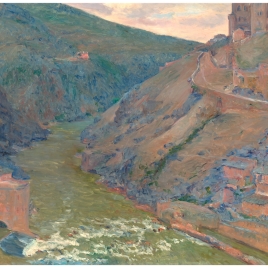
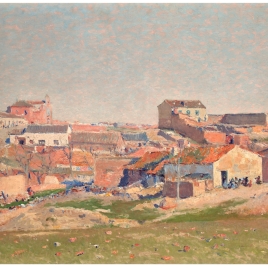
Aureliano de Beruete painted the Pyrenees, the Cantabrian Mountains, the Alps and, above all, Guadarrama. The artist knew how to analyse and view Guadarrama’s mountain landscapes with the rigour of a naturalist and geologist. This interest was aroused in 1874 when Beruete accompanied Charles de Haes, who had established landscape painting in Spain, to the Picos de Europa mountain range. In this work, the artist uses a simple diagonal composition borrowed from the geography itself. He depicts a perfectly recognisable fragment of nature in which the rust-coloured bark of the wild pines stripped of branches by the wind at high altitude, the granite blocks rounded by erosion, and the parched pasture where the cows graze, together with the light and brushstrokes, are testimony to the two trends - realism and impressionism - to which the artist remained faithful. In covering a canvas with colour, he did not set out to be either classical or innovative but, as his critic Ramón Faraldo pointed out, "to paint life vividly, feeling involved in a kind of exalted communication with the earth".
Aparicio González, J., Tiempo de Cambios Segovia 1874-1931, Segovia, Caja Segovia. Obra Social, 2002, p.216-217