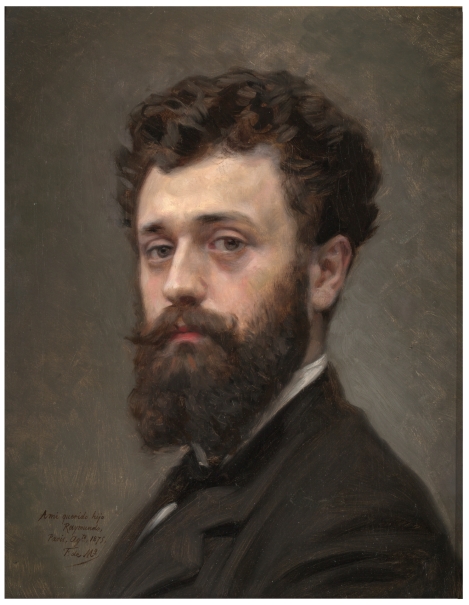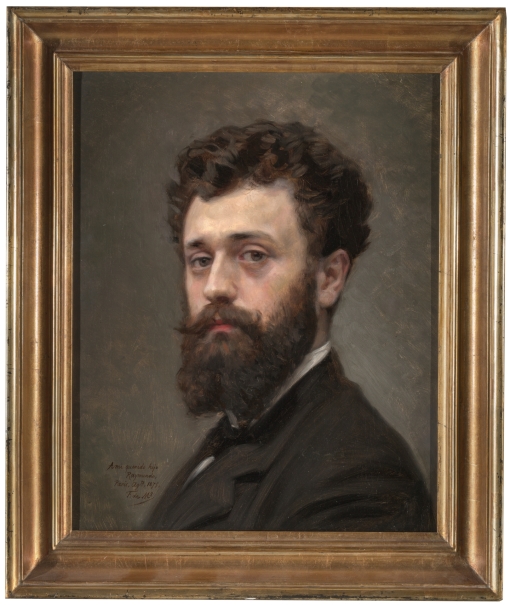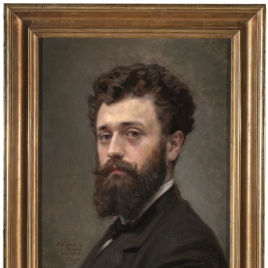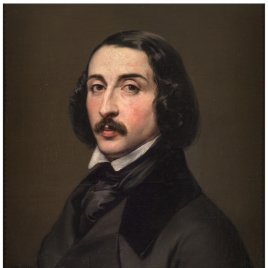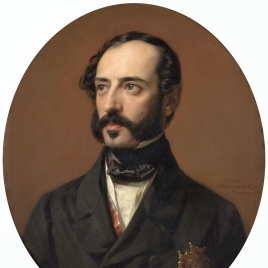
Painter Raimundo de Madrazo y Garreta, the artist's son
1875. Oil on canvas.Room 062A
This splendid portrait is part of the series that Federico de Madrazo painted in August 1875 for the artist’s sons living in Paris, to which he would subsequently add the portraits of Isabel and Cecilia and of Ricardo one year later. This intention to paint his children’s effigies for himself responds to Federico’s most intimate paternal desire at the age of 60, in the solitude of his widowhood: painting them would make up for the loneliness of his children’s family home, since they were now independent adults.
This portrait is by far the best one of them all. Raimundo de Madrazo y Garreta (1841–1920) is depicted at 34 years of age. Throughout his life, Federico would show a special predilection for him. Both his extraordinary talent for painting (far superior to that of his brother, Ricardo) and the enormous fame he soon achieved in the artistic circles in Paris – where he settled – somehow inclined Federico to envision in him a guaranteed continuance of the family’s artistic splendour. The fact that Raimundo was a world-renowned cosmopolitan artist in both European and American art circles as well as the long periods of time he spent outside Spanish borders without seeing his father compelled Federico de Madrazo to feel a special predilection towards his absent son. With this canvas, Federico strived to get closer to the avant-garde Parisian bourgeois portraits, with great success.
His uncluttered workmanship, the cold colour palette, the spontaneous capture of his gesture, and the precise and direct brushstrokes with which the visage is rendered, all achieve a physical presence of the artist with such modernity that, were it unsigned, it would lead one to think that it is a self-portrait by Raimundo himself.
Thus with exquisite mastery, Federico portrays the proud and haughty countenance of his son, who was at the height of his prestige and renown. The painter highlights the distant, natural elegance of his personality by depicting him from a slightly low point of view, hence the viewer’s attention is completely focused on Raimundo’s face, quite vigorous and attractive. This is, without doubt, an outstanding work within Madrazo’s extremely prolific production. The portrait was kept by Federico de Madrazo until his death, numbered 224 in his inventory of assets, and was subsequently passed on to his son.
Artistas pintados: retratos de pintores y escultores del siglo XIX en el Museo del Prado, Madrid, Ministerio de Educación y Cultura, Dirección Gener, 1997, p.140-141 nº36