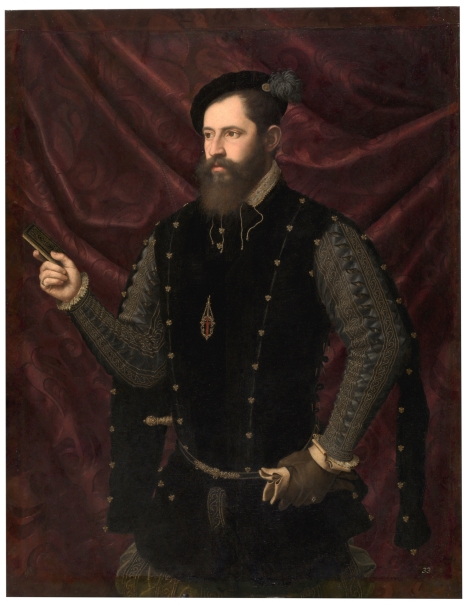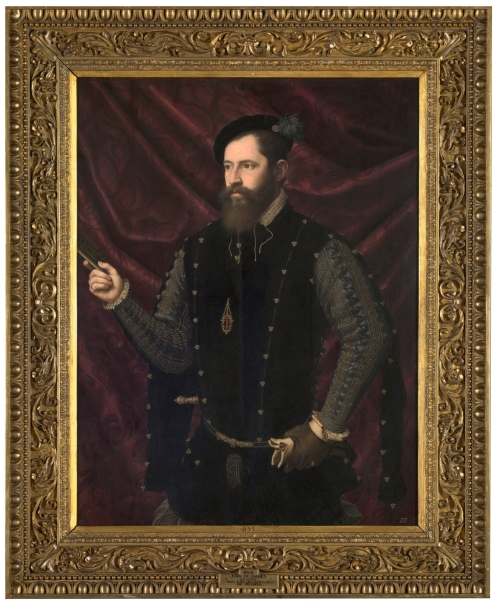
Portrait of a Knight of the Order of Santiago
Ca. 1560. Oil on panel.Room 051
Purchased by Charles IV, this portrait entered the royal collections in 1814 and was already listed in the Museo del Prado’s catalogs in 1854 as a work by Juan de Juanes. The identity of the sitter has varied since José de Madrazo suggested it was Luis Castelví, Lord of Carlet. Today, lacking unanimous agreement, it is generally accepted as a likeness of the Lord of Bicorp y Quera, Luis Castellá de Vilanova, a Valencian humanist to whom Spanish-Portuguese writer Jorge de Montemayor dedicated the pastoral novel, Los siete libros de Diana. Whoever he may be, his aristocratic standing is reflected in the emblematic elements that accompany him, including the scallop of a Knight of Saint James, which takes the form of a small jewel on his chest. His rhetorical gesture, sumptuous clothing, the luxurious damask curtain and other elements that define his dual identity as a knight and a humanist (a dagger and a book), are customary devices in international court portraiture but their presence is surprising in the context of works by Juanes, whose portraits are interesting, but more closely linked to the figure of late Medieval donors. There is, however, an extraordinary exception: the likeness of Alphonse the Magnanimous is an outstanding portrait that necessarily raises doubts about the attribution of this Knight of Saint James. This work reflects a sense of drawing, color and composition completely removed from mid-16th-century Spanish portraits. Its interesting interweaving of Italian and Northern aspects might well support an attribution to Juanes, whom the celebrated treatise writer Antonio Palomino praised for the quality of his drawing and his meticulous details. The polished, tight technique; meticulous drawing and attention to detail in the clothing and jewels is closer to portraiture by Antonio Moro, the Flemish artist who brought international projection to this kind of Renaissance portrait.
Ruiz Gómez, Leticia, El Greco y la pintura española del Renacimiento: guía, Madrid, Museo del Prado, Aldeasa, 2001, p.50