Portrait of a Man
Ca. 1843. Oil on canvas.Not on display
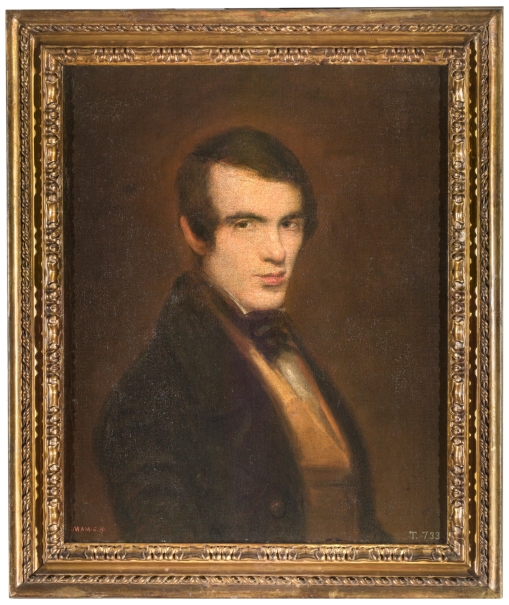
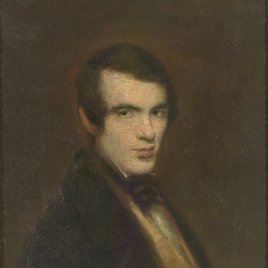
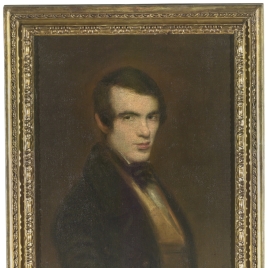
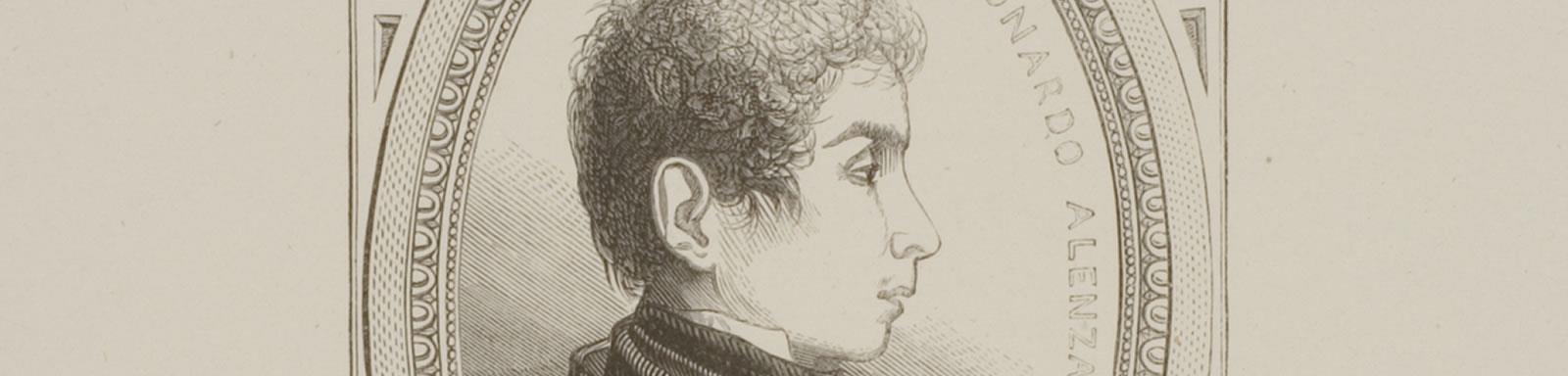
Although the work was believed to be a self-portrait, when the Sevillian painter José Laguna Pérez gave it to the Prado in 1886 it was not considered one. In the acquisition proposal that Federico de Madrazo –the Museum´s director– submitted to the Directorate General of Public Instruction on 2 October 1886, he stated that the painting –whose painter he identified as Alenza– is a portrait of a young man whose identity is still unknown to him. The work was in fact entered as "A Portrait". Madrazo knew the artist, of whom he had been a fellow pupil, as well as his immediate circle, so it would have been strange if he had not identified him. The woodcut portraits of Alenza, one in oval –published in the magazine ´The Renaissance´ on 18 April 1847–, and the other, by Urrabieta based on a drawing by V. Manini –both in the National Library– also exhibit different facial features from that of the artist, as can be seen clearly in the mouth and hair. In 1899 however, when the catalogue of the Museo de Arte Moderno was published, it was listed as a portrait of the artist. The 1900 edition of the catalogue maintained this identification. In the Barcelona exhibition of 1910, it was again presented as a self-portrait and this has been the case ever since. However, the differences in appearance between the portraits known with certainty to be by Alenza and this one at the Prado has already attracted the attention of some authors, such as Valverde. It is the effigy of a person very close to the artist, who depicted him in a half-length protrait, in a three-quarter pose with his head turned to look at the viewer. He wears a bow tie, a golden yellow waistcoat, and a brown frock coat. The warmth of these colours, in harmony with the background, emphasises the pallor of the face and, together with the darkness of the background, gives it an aura of mystery with an intensely romantic spirit. It is also a very truthful portrait, in which the artist depicted a face with slightly asymmetrical features, a nose slightly crooked to the right and lips finely painted in a contained rictus which, together with the gentle melancholy of his gaze, reveal the character of the subject. The extreme simplicity of the composition and the feeling of profound truth that it reveals make it one of the most outstanding examples of Spanish portraiture of its time. The resolute execution of some parts of the painting, especially the ear, the collar and the shirt front and waistcoat –whose workmanship and chromatic play in white and gold are reminiscent of Goya– contrast with the more compact brushstrokes of the face. The face shows a delicacy of features that the painter knew how to convey. The artist´s independence of style in relation to other artists is consistent with the spirit of the painter. The anonymous author of the obituary published in 1848 in the Spanish Pinturesque Weekly, described him as ´isolated by character and illness, poor and forgotten and even disdainful of all favours, and alien to the gangs and cronies, which are usually the basis of reputation among us´. In this sense, and in the search for expressive depth, Goya was the natural reference point for his art.
Barón, Javier, Retrato de caballero (h. 1843). En Barón, J.: El retrato español en el Prado. De Goya a Sorolla, Madrid, Museo Nacional del Prado, 2007, p.100, n. 22