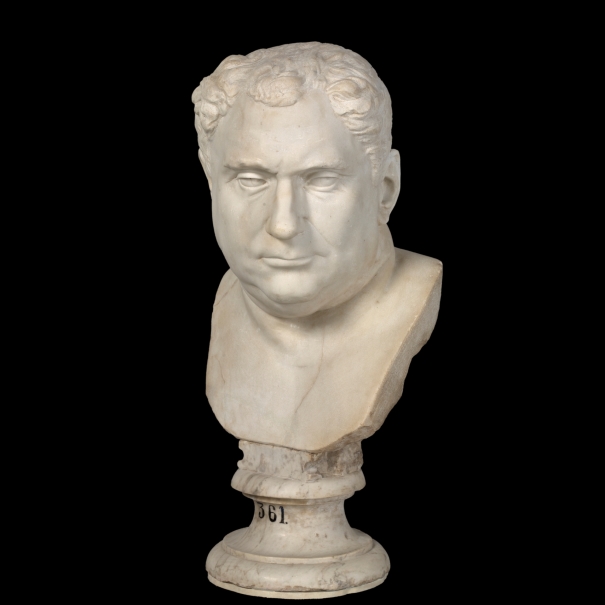
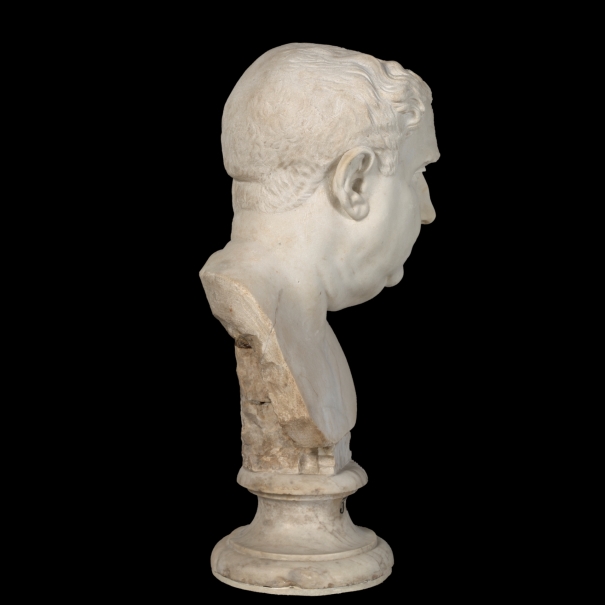
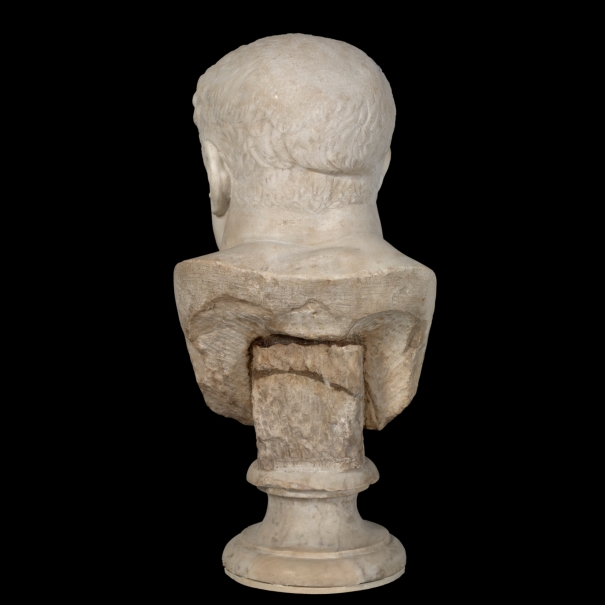
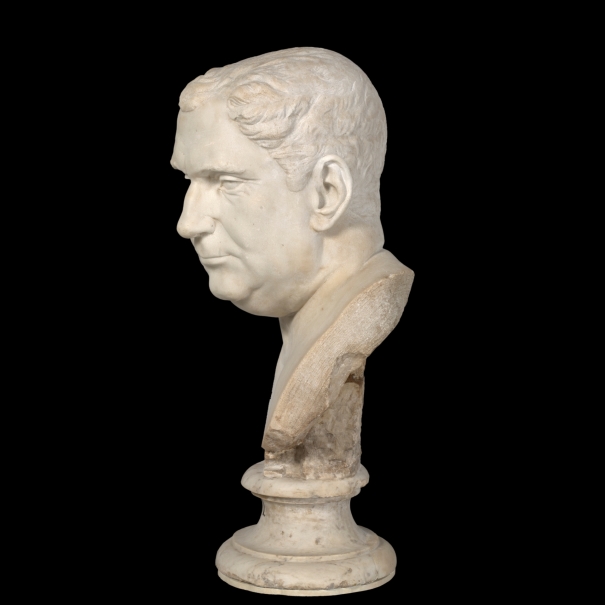
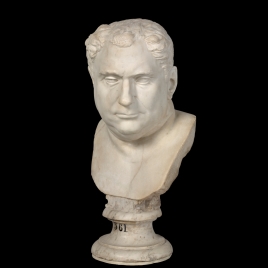
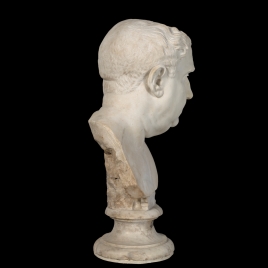
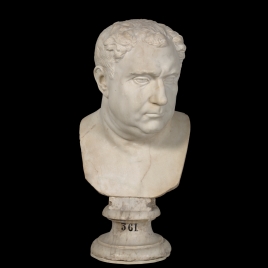
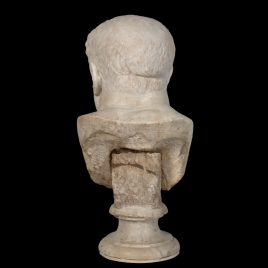
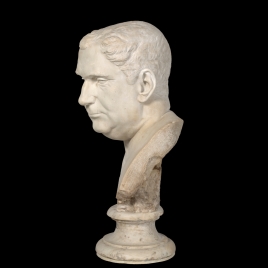
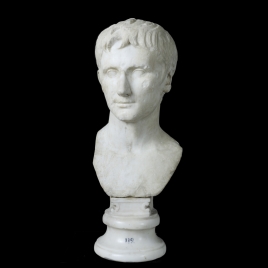
Pseudo-Vitellius
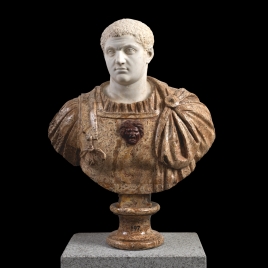
1530 - 1550. Marble.Room 033
The Pseudo-Vitellius was one of the busts most frequently copied and borrowed by Renaissance artists, at a time when it was believed to be a portrait of the Emperor Vitellius, who reigned briefly from 17 April to 22 December 69 AD. In fact, it dates from the period of Hadrian (117–138 AD).The only known Roman copy (Venice, Museo Archeologico) was discovered in 1505 during excavations sponsored by the Venetian cardinal Domenico Grimani (1461–1523) at his residence on the Quirinale in Rome. On the death of Grimani the Pseudo- Vitellius was sent to Venice with his collection as it was one of the fifteen works that he bequeathed to the Republic of Venice, which placed them on display in the Palazzo Ducale between 1525 and 1593. This location explains the sculpture’s influence on Venetian art and its echoes in the work of Titian, Jacopo Bassano and Tintoretto. Using the features of Roman emperors in art, particularly in scenes of the Life of Christ, allowed painters to reveal both their knowledge of classical art and their interest in historical ‘decorum’. Such busts were also used to characterise the figures involved, as we find with Pietro Aretino in I quattro libri de la Humanità di Christo (Venice, 1538) in which he uses classical sculpture (although not Vitellius) to describe the characters in an episode from the Passion in order to help his readers to visualise it. The exemplary nature of these classical images explains why Giovanni Battista della Porta included a bust of Vitellius in De Humanae Physiognomia of 1586 (Book II, chap. I). According to Roman sources and in particular Suetonius,Vitellius was not a paragon of virtue and Della Porta consequently made him represent individuals with very large heads, a physical characteristic which, according to classical physiognomists such as Polemon of Laodicea and Adamantius, indicated pride, coarse wit, ineptitude and troublesomeness, characteristics shared by various animals including the owl, depicted alongside him. The version in the Museo del Prado belonged to Diego Hurtado de Mendoza, who must have acquired it during his stay in Venice from 1539–1546. During this time Mendoza had copies made of Greek manuscripts in the Grimani library and may also have had replicas made of some of the sculptures in that collection.The identity of the sculptor is not, however, known, although Mendoza’s familiarity with the Venetian art scene offers some clues. Mendoza was a friend of the sculptor and architect Jacopo Sansovino, while close to both men was the Florentine sculptor Simone Banco (documented between 1512 and 1553) who was active in Venice. Banco re-worked the Grimani Pseudo-Vitellius, giving it the appearance it has retained to the present day.
Falomir, Miguel (ed.), El retrato del Renacimiento, Madrid, Museo Nacional del Prado, 2008, p.329