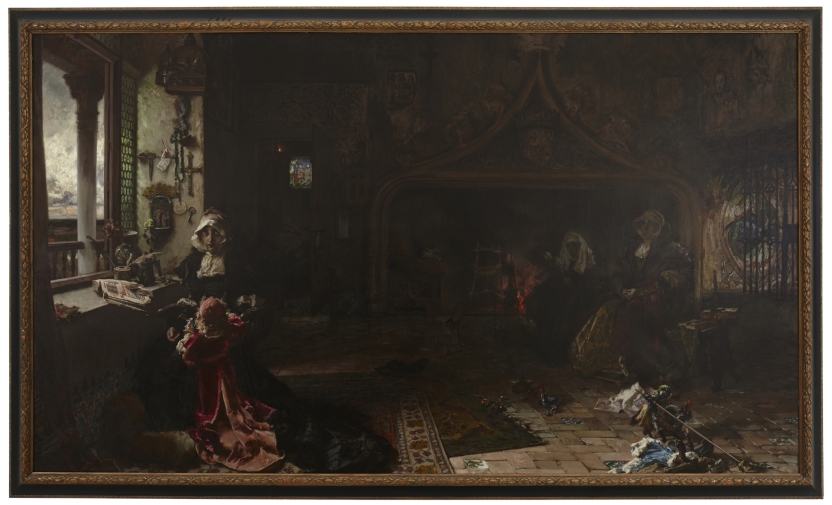
Queen Joanna the Mad secluded in Tordesillas with her daughter, the infanta Catalina
1907. Oil on canvas.On display elsewhere
This is a large replica of the splendid cabinet painting made by Pradilla a year earlier that is also kept in the Prado (P007493). This enlargement was commissioned by Luis de Ocharán – as the inscription on the back attests – and once again bears witness to the painter’s lifelong interest in the tormented figure of Lady Joanna of Castile. His working method – especially in his later years – eventually consisted of repeating his most successful compositions in distinct formats so as to satisfy diverse commissions as well as different types of clients.
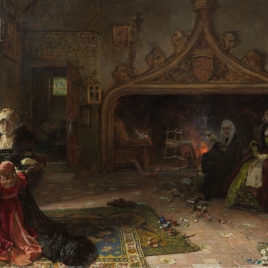
On this occasion, Pradilla chose as the subject of his historical composition the scene of the queen’s seclusion in the castle of Tordesillas (Valladolid), where she wished to be put away for life next to her husband’s corpse. The queen is depicted in the interior of a sober room, seated next to a large window through which the austere landscape of the fields before the town of Valladolid can be glimpsed. Her thoughts are consumed by the memory of her beloved deceased husband. She abandons reading a book that leans on the windowsill and directs her lost gaze towards the viewer without noticing the demands of her daughter, the young Infanta Catalina, who throws herself on her lap to call her attention to her games. Seated by the fireplace as they watch and guard the deranged queen are a richly dressed court lady, holding a rosary in her hands, and a more modestly dressed maid spinning wool on a rustic distaff. On the right, a richly decorated gate separates the room from a chapel with a fresco on its front depicting the figure of the Pantocrator as well as the effigies of various saints on the cornice. At the opposite end, a door ajar on the back wall reveals the coffin containing the mortal remains of Philip the Handsome, from whose company Lady Joanna did not want to leave for even a moment.
In addition to all the romantic and melodramatic intensity provided by the insanity of this ruler (and particularly this episode in her life), Pradilla still integrates new sentimental elements in this composition that reinforce its emotional weight through the affective bonds of the various characters accompanying the queen, such as the resigned and understanding patience of the women in her personal entourage and the naive innocence of the child infanta, attentive only to her games and completely oblivious to the pathetic atmosphere around her. Nevertheless, as is the case in most of the historical scenes painted by this master at the final stage of his life, Pradilla – while not neglecting for a moment the gravitas of the subject – makes the most of his ornamental devices that rely on the accumulation of accessories and superficial elements exquisitely rendered in the old painter’s delightful and skilful technique, which powerfully attract the viewer’s attention, so much to the taste of the clientele who commissioned this type of works from the master.
The precious virtuosity and perfect technical execution of the small canvas (P007493) – of which this one is an enlargement – absolutely dismiss its status as a preparatory sketch. On the contrary, it is the first definitive version and model for the final work, with which it nevertheless shares some differences that demonstrate the restless creative spirit of the artist, who was incapable of mechanically copying himself in these repetitive works. Accordingly, the design of the cage is more luxurious, with a greater number of elements being introduced into the window area, such as the rosary and the scissors, whereas others differ both in design and position. Likewise, the arrangement and appearance of the vase, inkwell, and books have also changed, hence the three small ones in the first painting have been replaced by a large one in this version. The toys are also relocated and fewer in number, with the addition of the stool next to the seated maiden who did not exist in the first painting and the more opulent design of the chapel grille. Additionally, the women who accompany and watch over the queen take on a more attentive and serious expression, whereas Joanna unabashedly directs her disturbing and alienated gaze at the viewer, thus increasing the expressive intensity of her eyes, which in the first version are slightly deviated.
Notwithstanding the fact that all the technical prowess of Pradilla’s masterly hand at the age of 59 is present in the execution of this work, its treatment is much looser and freer than in the first definitive canvas. He achieved a greater plastic exquisiteness appropriate to its size, to the detriment of the thoroughness of the first version.
Posada Kubissa, Teresa, Últimas adquisiciones: 1982-1995, Madrid, Museo del Prado, 1995, p.109-112