Saint Agnes
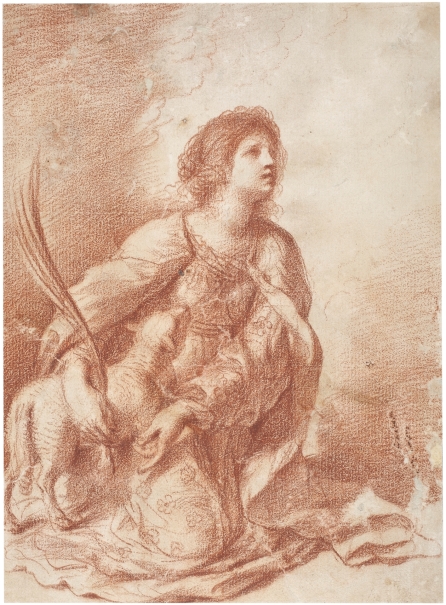
1650 - 1660. Red chalk on dark yellow paper.Not on display
This drawing, formerly in the Spanish Royal Collection, was recognised as an autograph work by Guercino by Manuela Mena Marqués. The suggested date for it is around the 1650-60, when Guercino had attained artistic maturity, a date that stylistically seems correct. Mena Marqués also proposed that the drawing stood alone and was not intended as a preparatory work for a painting, a hypothesis that also seems likely. She also suspected that it was intended as a modello for an engraving, as it is an extremely detailed image with strong contrasts of dark and light, with heavily drawn areas in red chalk and untouched white areas of the paper. But this idea has not been confirmed by Prisco Bagni’s compendium of Gercuino prints (Il Guercino e i suoi incisori, 1988), which does not include any works relating to this saint.
Agnes, a young girl of noble birth, probably died in Rome around 300 AD, at the age of thirteen, a victim of persecution during the reign of the Roman Emperor Diocletian. The story of her violent and complex martyrdom is told by Aurelius Prudentius and Saint Ambrose in The Book of the Virgins in the Golden Legend (c.1250). In traditional iconography the young saint is often depicted naked, covered only by her long hair, and is always portrayed with a lamb, which is also present in Guercino’s drawing, seen climbing onto her lap. The lamb symbolises purity, depicting Agnes’s chastity, while the palm in her hand evokes her martyrdom.
It is also interesting that in Saint Ambrose’s narration, the young saint was singing when she was stabbed in her throat - a method usually used in the sacrifice of a lamb. Guercino’s drawing also emphasises Agnes’s aristocratic origins through her elegant dress, featuring a silk brocade floral design, which was worn by the young model posing for this portrait.
Guercino’s drawings in red pencil show his deep affinity with the work of Annibale Carracci and Pietro Faccini executed in the same medium. During his stay in Rome (1621–23), Guercino’s contact with Florentine masters was equally crucial for the development of this drawing technique, which became more frequent in his oeuvre over time. He usually preferred to use pen and dark ink, enriched with brown or grey wash, but he also demonstrated his incredible talent using red pencil, which he used to create extraordinary drawing effects exploring the subtleties of colour and tone. Examination of this sheet has revealed that Guercino rubbed the red chalk with his fingers and with a sfumino (a tool used to smudge lines), by which he attained the exceptional shading effects (Farina, V.: Italian Masterpieces. From Spain´s Royal Court, Museo del Prado, 2014, p. 162).