formularioRDF
The itinerary <em>TITULORECORRIDO</em> has been successfully created. Now you can add in works from the Collection browser
<em>TITULOOBRA</em> added to <em>TITULORECORRIDO</em> itinerary

Close Continuar a ficha de la obra Continuar a ficha de la obra
17-02-2026
Guercino (Giovanni Francesco Barbieri)

Cento, Ferrara (Italy), 1591 - Bologna (Italy), 1666

See author's file

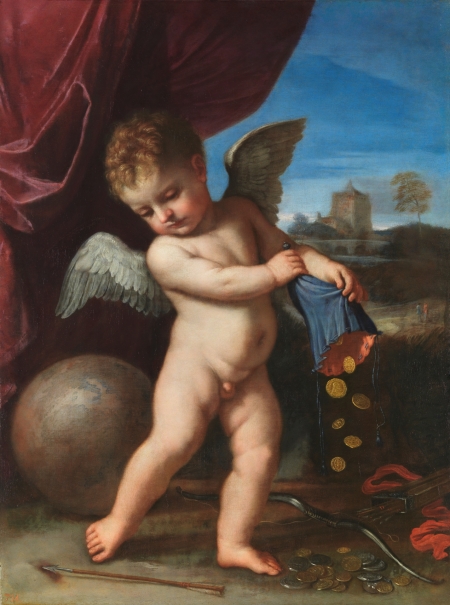
Cupid spurning Riches

Ca. 1653. Oil on canvas.
Room 006

The papal nuncio to Spain, Camillo Massimo (1620–1677), presented Guercino’s Cupid spurning Riches and Guido Reni’s Cupid with a Bow (P150) to King Philip IV as diplomatic gifts in 1655, and the pair are documented in the inventories of the Spanish royal collection from 1666. Guercino’s painting depicts a youthful Cupid emptying a bag of gold coins, which are shown falling to the ground. More gold and silver coins are piled at his feet, and a bow with a loosened string and an abandoned quiver of arrows can be glimpsed behind him. A single arrow lies in the immediate foreground, while on the left is a large globe of the world. Behind his head a red silk curtain is drawn back, revealing a landscape beyond.

The painting has been variously entitled Virtuous Cupid and Cupid spurning Riches. This confusion points to its unusual iconography. Items such as the single arrow and the globe represent the universality of love and are often employed as attributes for Cupid, but the motif of emptying a bag of coins is not. The implication is that Cupid is so intent on spurning riches that he has abandoned his bow and arrows. Its iconography is related to Reni’s Allegory of Fortune of about 1635-36, in which a naked Fortune is shown flying over a globe. She holds a palm and sceptre in her left hand and upturns a purse in her right, from which coins and pearls tumble. As Denis Mahon and Stephen Pepper argued, it is probable that Guercino was consulted with regard to the unfinished state of Reni’s Allegory of Fortune, and so was familiar with its unusual iconography. The upturned purse in Reni’s painting can be interpreted as a representation of the transience of wealth; its message in the Guercino picture is more pointed, as Cupid appears to be openly contemptuous of it. A preparatory figure study of Cupid by Guercino is in the Royal Collection at Windsor.

Spear’s observation that the two paintings are “so complimentary in design and iconography that one wonders if Guercino made his picture as a pendant” to the Reni is almost certainly correct. Massimo must have commissioned the painting from Guercino in order to match Guido’s Cupid, painted several decades earlier, which he already owned, and so chose a complementary theme.

The Guercino painting has been linked to a payment recorded in the artist’s account book (libro dei conti) on 19 June 1654: this refers to the 10 Spanish dobles received for an “Amore Virtuoso” from a certain Padre Don Salvatore of Piacenza, along with the crimson lake and lapis lazuli pigments charged for separately, as was Guercino’s custom. This is the only entry in the account book of the artist from Cento which corresponds to this painting, and the choice of pigments is compatible with its vivid blue sky and red curtain. However, the 16 February 1654 document found by José Luis Colomer, which lists both paintings in Massimo’s possession as he crossed the border four months earlier, suggests that if the payment does refer to this picture, then it was only made some months after the canvas was received.

The painting was damaged, possibly in a fire at the Alcázar in 1734, when it was listed as among the items saved. From 1933 to 2014 it was in deposit at Pontevedra; it was restored in 2014 and has been in the Prado ever since.

Beaven, Lisa, 'Guercino. Cupid spurning riches'. In: Guido Reni, Madrid, Museo Nacional del Prado, 2023, p.326-328 nº65
Multimedia

Technical data

Imagen del carrusel
Imagen del carrusel

Related artworks

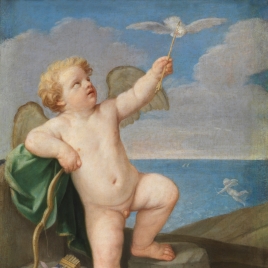
Cupid with a Bow
Oil on canvas, 1637 - 1638
Guido Reni
Inventory number
P000205
Author
Guercino (Giovanni Francesco Barbieri)
Title
Cupid spurning Riches
Date
Ca. 1653
Technique
Oil
Support
Canvas
Dimension
Height: 99 cm; Width: 75 cm
Provenance
Possibly commissioned by Camillo Massimo from the artist in 1653; presented by Camillo Massimo to King Philip IV of Spain, in 1655; Spanish royal collection at the Real Alcázar, Madrid, 1666; lower room, king's summer quarters at the Real Alcázar, 1686 (no. 504) and 1700 (no. 282); queen's new chambers at the Real Alcázar, Madrid, 1703; listed among the paintings saved from the fire in the Alcázar in 1734 (no. 994); antechamber of the infanta at the Palacio Real Nuevo, Madrid, 1772 (no. 993); Infante don Carlos' quarters, sixth room at the Palacio Real, Madrid, 1814–18 (no. 993?).

Bibliography +

Malvasia, Carlo Cesare (1616-1693), Felsina pittrice: vite de pittori bolognesi, II, Per l'Erede di Domenico Barbieri: Ad instanza di, 1678, pp. 300.

Bottineau, Yves, 'L'Alcazar de Madrid et l' inventaire de 1686, aspects de la Cour d' Espagne au XVII siècle', Bulletin Hispanique, LX, 1958, pp. 289-326 [322].

Pérez Sánchez, Alfonso E., Pintura italiana del S. XVII en España, Universidad Fundación Valdecilla, Madrid, 1965, pp. 142 n.º205.

Pérez Sánchez, Alfonso E., Pintura italiana del siglo XVII. Exposición conmemorativa del ciento cincuenta aniversario de la fundación del Museo del Prado, Ministerio de Educación y Ciencia, Madrid, 1970, pp. 318.

Orihuela, Mercedes, El "Prado disperso". Cuadros depositados en las provincias de La Coruña, Lugo, Orense y Pontevedra. Mondoñedo. Palacio Episcopal, Boletín del Museo del Prado, IX, 1988, pp. 139.

Salerno, Luigi, I dipinti del Guercino, Ugo Bozzi editore, Roma, 1988, pp. 372 nº 303.

Mahon, Denis, The Drawings of Guercino in the Collection of Her Majesty the Queen at Windsor Castle, Cambridge University Press, 1989, pp. 72 n 129.

Museo Nacional del Prado, Museo del Prado: inventario general de pinturas (I) La Colección Real, Museo del Prado, Espasa Calpe, Madrid, 1990, pp. nº714.

Stone, David M., Guercino. Catalogo Completo Dei Dipinti, Cantini, Firenze, 1991, pp. 297 nt.289.

Spear, Richard E., The Divine Guido. Religion, Sex, Money and Art in the World, Yale University Press, New Haven,London, 1997, pp. 368-369 nt.75.

Ghelfi, Barbara, Il Libro Dei Conti del Guercino 1629-1666, Nuova Alfa, 1997, pp. 165 nº484.

Pepper, Stephen y Mahon, Denis, 'Guido Reni's Fortuna with a purse rediscovered', The Burlington magazine, CXLI, 1999, pp. 156-163.

Beaven, Lisa, Reni's Cupid with a bow and Guercino's Cupid spurning riches' in the Prado: a gift from Camillo Massimi to Philip IV of Spain, The Burlington magazine, 142, 2000, pp. 437-441.

El Jardín de Melibea, Sociedad Estatal para la Conmemoración de los Centenarios, Madrid, 2000.

González Martínez, Eloy, Un regalo de Felipe IV en el Museo de Pontevedra: el "Amor desinteresado" de Guercino,, El Museo de Pontevedra, 58, 2004, pp. 201-206.

González Martínez, Eloy y Diéguez Rodríguez, Ana, Dos imágenes del amor para Felipe IV: Guido Reni y Guercino, En: César Chaparro, José Julio García, José Roso y Jesús Ureña (eds), Paisajes emblemáticos: construcción de la imagen simbólica en Europa y América, Editorial Regional de Extremadura, Mérida, 2008, pp. 535-552.

Díaz Padrón, Matías, El lienzo de Vertumno y Pomona de Rubens y los cuartos bajos de verano del Alcázar de Madrid, Rubens Picture Ltd., 2009, pp. 77.

Wenley, R, Guercino in Glasgow, Master drawings, 48, 2010, pp. 179-194.

Strinati, C. et al., Guercino e le donne. Il ritratto femminile come veicolo di Grazia, Bononia University Press, Fondazione Sorgente group, Roma, 2014, pp. 118.

Beaven, Lisa, 'Guercino. Cupid', Italian masterpieces from Spain's royal court, Museo del Prado, National Gallery of Victoria Thames & Hudson, 2014, pp. 104-107.

Martínez Leiva, Gloria; Rodríguez Rebollo, Ángel, El inventario del Alcázar de Madrid de 1666. Felipe IV y su colección artística, Consejo Superior de Investigaciones Científicas, Madrid, 2015, pp. 279 nº 173.

Greub, Thierry, Der Platz des Bildes und der 'Platz des Königs', Diego Velázquez 'Las Meninas' im Sommer-Arbeitszimmer Philipps IV, Zeitschrift für Kunstgeschichte, Heft 3-4, 2015, pp. 441-487 [466 f.17].

Francucci, Massimo, 'Giovanni F.B. detto il Guercino. San Mateo e l' angelo' En: Guercino tra sacro e profano, Skira, 2017, pp. 55 f.10.

Turner, Nicholas, The paintings of Guercino: a revised and expanded catalogue raisonné, Ugo Bozzi Editore,, 2017, pp. 712-3 n.423.

Beaven, Lisa; Colomer, José Luis, 'Questo non basta a contentar una donna spagnola' Camillo Massimo as Papal Nuncio in Madrid and his later ties to Spain (1655-1662)', En: Jorge Fernández-Santos y José Luis Colomer (eds.), Ambassadors in Golden-Age Madrid. The Court of Philip IV through Foreign Eyes, Centro de Estudios Europa Hispánica, Madrid, 2020, pp. 201-253.

Beaven, Lisa, 'Guercino. Cupid spurning riches', In: Guido Reni, Museo Nacional del Prado, Madrid, 2023, pp. 326-328 nº65.

Beaven, Lisa, 'Guercino. El amor desinteresado', En: Guido Reni, Museo Nacional del Prado, Madrid, 2023, pp. 326-328 nº65.

Other inventories +

Inv. Testamentaría Carlos II, Alcázar de Madrid, 1701-1703. Núm. 282.
Pieza del despacho de Verano en cuio techo esta pintado Apolo [...] 282 / Ytten Un Cupido del mismo tamaño [una vara de alto y tres cuartas de ancho] de mano del Guarchino Con marco dorado tasado en Cientto y Ueintte Doblones ... 120

Inv. María Luisa Gabriela de Saboya, Alcázar de Madrid, 1703. Núm. s. n..
De la pieza del Despacho del Verano en cuyo techo está pintado Apolo se sacaron las pinturas siguientes. [...] [68] Itt. un Cupido del tamaño de mano de Guarchino con marco dorado colocado en mismo la Galería nueva de la Reyna nra. sra.

Inv. Carlos III, Palacio Nuevo, 1772. Núm. 993.
Antecámara de la Serenísima Infanta [...] {12835-12836} 993-994 / Otros dos [quadros] el vno que representa Cupido con vna palomita en la mano derecha y el otro con vn bolson en la mano vertiendo dinero de vara y quarta de alto y vara de ancho originales de Guido Reno

Inv. Fernando VII, Palacio Nuevo, 1814-1818. Núm. ¿993?.
Habitacion del Señor Infante Don Carlos [...] Sexta pieza [...] {21868-21869} 993 / vara y quarta alto vara de ancho = Cupido con vn pajaro herido de vna flecha = el Amor despreciado de las riquezas = escuela de Murillo

Museo Real de Pinturas a la muerte de Fernando VII, 1834. Núm. [fº 425].
DEPÓSITO GRANDE / ESCUELA ITALIANA [...] Depósito de entresuelo [...] Un Genio o amor derramando monedas de una bolsa / / Lº / 5.080

Catálogo Museo del Prado, 1854-1858. Núm. 714.

Inv. Real Museo, 1857. Núm. 714.
Guercino. / 714. Un Cupido con un bolsillo derramando dinero. / Parece una alegoría del menosprecio que el Amor hace de la riqueza. / Alto 3 pies, 6 pulg, 8 lin; ancho 2 pies, 8 pulg.

Catálogo Museo del Prado, 1872-1907. Núm. 253.

Catálogo Museo del Prado, 1910. Núm. 205.

Catálogo Museo del Prado, 1972. Núm. 205.

Exhibitions +

Guido Reni
Madrid
28.03.2023 - 09.07.2023

Arte y mito. Los dioses del Prado
Barcelona
15.10.2020 - 14.03.2021

Art and Myth. The Gods in the Prado
Barcelona
15.10.2020 - 28.02.2021

Italian Masterpieces from Spain's Royal Court. Museo Nacional del Prado
Melbourne
16.05.2014 - 31.08.2014

Location +

Room 006 (On Display)

Expuesto
Update date: 17-02-2026 | Registry created on 02-12-2015

Visor 360

Drag with the cursor to rotate the piece

Other works by Guercino (Giovanni Francesco Barbieri)

Print on demand

Print artworks available in our catalogue in high quality and your preferred size and finish.

Image archive

Request artworks available in our catalogue in digital format.

Up