Cupid with a Bow
1637 - 1638. Oil on canvas.Room 006
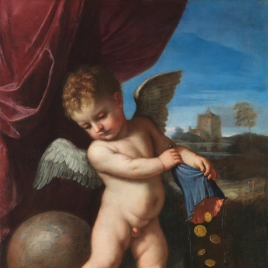
In a letter to his friend Giovan Pietro Bellori (1613–1696) dated 30 August 1660, Cardinal Camillo Massimo (1620–1677), papal nuncio to Spain from 1654 to 1658, mentioned two paintings (quadretti) by Guido Reni and Guercino (1591–1666) which he had presented to King Philip IV as diplomatic gifts. In 2000 they were identified by Lisa Beaven as this painting and Guercino’s Cupid spurning Riches, also at the Prado (P205). This finding was confirmed by a customs document dating to 16 February 1654 found by José Luis Colomer in Munich, which describes the goods that Massimo brought into Spain from Italy.
Reni’s painting is first mentioned in the 1666 inventory of the Madrid Alcázar as autograph, and is listed again as a secure work by Guido in the inventory of 1686. From its first mention it was paired with Guercino’s Cupid spurning Riches. Its status as an original painting by the artist dating to 1637–38 has the consensus of scholars, and was only challenged in some Prado catalogues, most notably when it was re-attributed to Giovanni Francesco Gessi (1588–1649) in the catalogue of 1963. The two paintings appear in the inventory of the Alcázar, six years after Massimo’s letter, and are of similar dimensions. The Guercino measured 99 × 75 centimetres and the Reni, which had already been slightly enlarged on all sides, 105 × 80 centimetres. In the 1686 inventory they were listed as hanging near Diego Velázquez’s (1599–1660) Las Meninas in a room in the summer quarters of the Alcázar reserved for the king’s personal use (“pieza del despacho de verano”). The location of this study has been identified as the most northerly room in a suite of chambers on the ground floor of the north side of the Alcázar. There has been much discussion about how the paintings in this room might have originally been arranged, as the inventory only itemises them. The Reni is listed seventh, the Guercino eighth, and Las Meninas thirteenth. In the reconstructions of the display in this “despacho de verano” by Thierry Greub and Juan María Cruz Yábar it is argued that the two Cupid paintings hung on the east wall among flower paintings, with Las Meninas on the opposite, west wall.
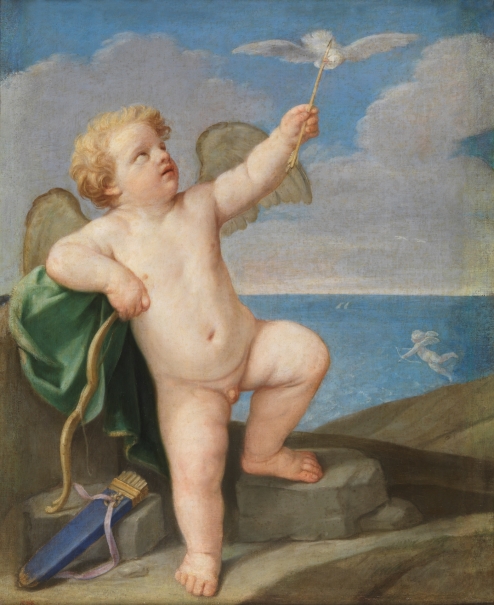
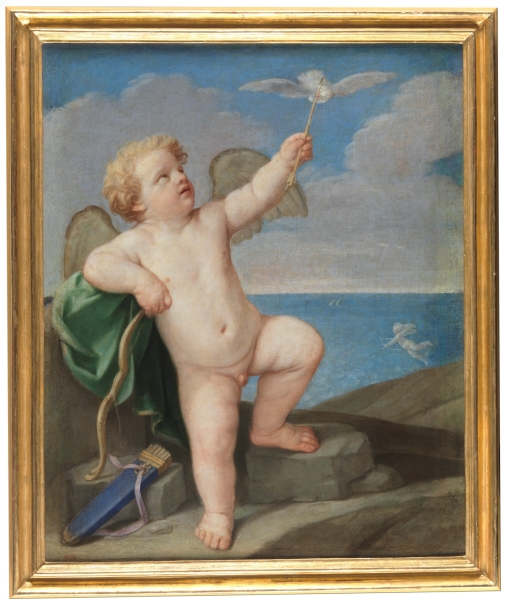
The iconography of this painting, entitled Cupid with a Bow from the outset, is unusual. A young, blond Cupid stands in the foreground, his back to the sea. His left leg is bent, his foot awkwardly stepped up on a slab of rock, and his right hand grasps the tip of a large bow, its string loosened. A blue and gold quiver full of arrows lies at his feet. It is as if Cupid has ceased his activities, perhaps tamed. He reaches up with his left arm to receive a golden arrow from a dove suspended above him. The dove is a traditional attribute of Venus, and it conveys the arrow to Cupid as a sign from the goddess that he should recommence his activities. That he will do so is signaled by the presence of another Cupid in the distance, running along the seashore in the act of firing his bow. In his role as papal nuncio, Massimo was the representative in Spain of the Pamphilj pope, Innocent X, whose family arms included a dove with an olive branch. In such a combination the dove is a symbol of peace, a connotation here undermined by the presence of the arrow.
Reni’s painting is reminiscent of several Dutch compositions that show Cupid standing and holding his bow, such as Jacob Huysman’s (c. 1633–1696) Cupid preparing his Bow in Wimborne Minster, based on a lost original by Anthony van Dyck (1599–1641). As Richard Spear noted, the Prado painting is also related iconographically to Guido’s lost composition of Cupid by the Sea, now known only through copies. The source of this current imagery may be traced to a version of the rape of Proserpina in Ovid’s Metamorphoses, where Venus instructs Cupid on the seashore to fire a golden arrow at Pluto, a scene depicted by Hendrik Goltzius (1558–1617), among others.
Beaven, Lisa, 'Guido Reni. Cupid with a bow'. In: Guido Reni, Madrid, Museo Nacional del Prado, 2023, p.324-326 nº 64