Lucretia killing herself
First half of the XVII century. Oil on canvas.On display elsewhere
The story of Lucretia, written by Titus Livy during the reign of Augustus, was used to explain the end of the monarchy and the establishment of the Roman Republic. The heroism described by the historian in the comportment of this lady, who was faced with an unfair and dishonourable situation, made her an example of civic pride in Rome. The wife of consul Colatinus, Lucretia was raped in her husband’s absence by Sextus Tarquinius, son of King Lucius Tarquinius Superbus. Although she tried to resist, Sextus threatened to present her corpse with that of a slave in order to make it appear that the two were having an affair and thus tarnish the public image of her family. He achieved his objective, but the next day Lucretia took her own life in front of her father and her husband, demanding revenge and shouting: ‘No woman shall be allowed to survive her dishonour by Lucretia’s example’.
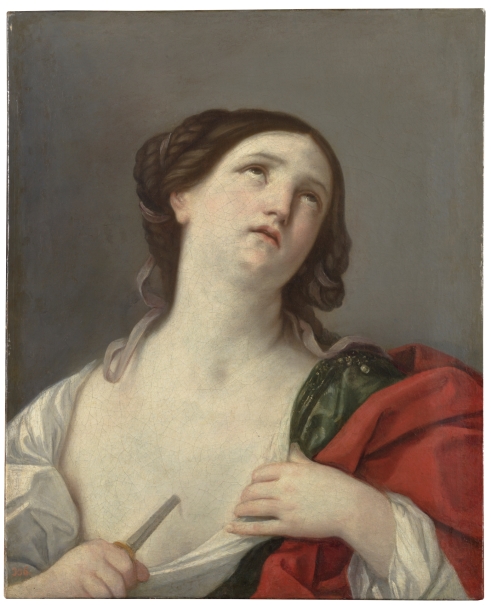
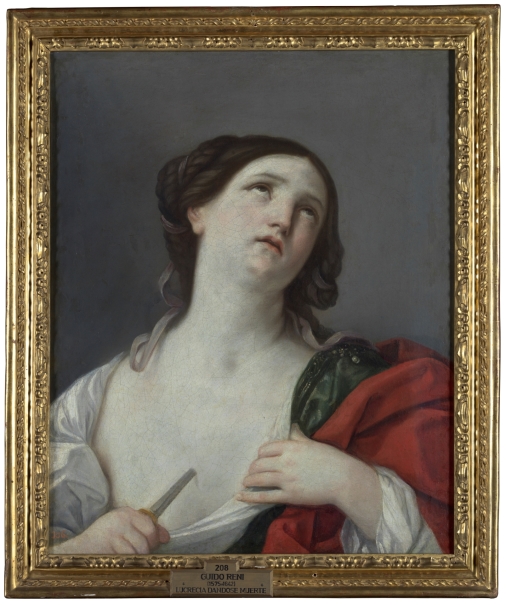
Widely disseminated since it was first told, this story has been included in numerous literary and artistic works up until the Modern Era and has been praised as a paradigm of virtue. In a Christian context, it was only questioned by Saint Augustine – who would blame her for killing her innocence as well – but this was not enough to prevent her portraits from being included in collections of Catholic monarchies as exempla virtutis of faithfulness and honesty. This is demonstrated by the present canvas, hitherto attributed to Guido Reni’s workshop in which Lucretia is depicted at the moment of her suicide, plunging the dagger into her chest. The painting used to belong to Gaspar de Haro y Guzmán, 7th Marquess of Carpio and Eliche, who showed a certain predilection for the style of this Bolognese artist, as the inventories of his assets include more than 18 works. It was later acquired by Isabella Farnese for the royal collections, for which it was kept in the palace of La Granja de San Ildefonso beginning in 1746 and in the palace of Aranjuez beginning in 1794.
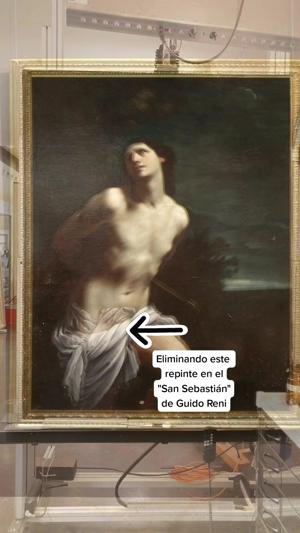
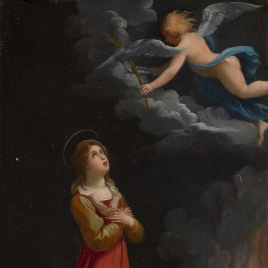
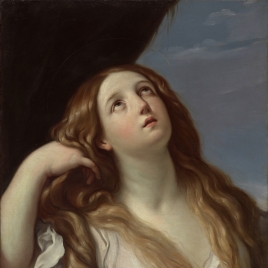
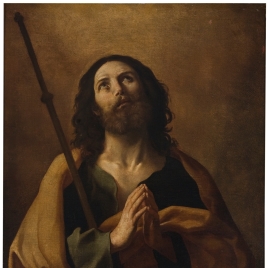
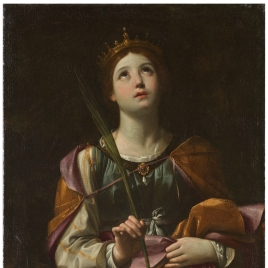
A neutral background of greyish tones emphasises the paleness of Lucretia’s skin. Her hands are particularly striking: one of them forcefully plunges the dagger into the centre of her chest, unveiling it with her other hand by pulling her dress aside. The result is a very attractive contradiction between the young woman’s delicacy and the terrible act she is carrying out. The erotic charge of this gesture is diluted by the fact that her breasts are not bare, as is usual in other versions of this iconography. It also seems to imitate the expression of the sacred characters popularised by Reni. In this sense, she looks up to the sky stoically, with a grimace that was particularly well established in Reni’s oeuvre as an acceptance of an unhappy fate in the style of the Christian martyrs. The Museo del Prado keeps other works by Reni that illustrate this comparison, including Saint Sebastian (P000211). These images perfectly align with Counter-Reformation thought.
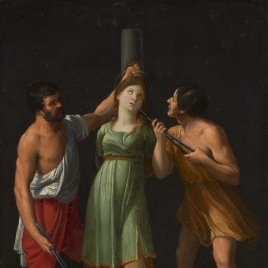
Although this canvas is currently considered to be a workshop copy, the inventories of the royal collections indicate it was deemed an original work by Guido Reni when it first entered the collections. So much so that in the time of Isabella Farnese, it was valued at 1500 ducats, an important figure that increased up to 6000 reals when it entered the Royal Museum in 1834. Even though it includes certain features that are inconsistent with Reni’s style, it presents similarities with other canvases from the final stage of his career. Furthermore, this painting could only be considered a simplified version of other works by Reni – as is the one in a private collection in Switzerland – since there is no record of any original work with this model that would allow it to be defined as a copy. In particular, it was during his last years that he produced several paintings based on his own compositions, executing them more quickly and aided by his workshop. It can be considered one of the canvases executed at that time, probably completed by one of his pupils. It is worth noting that in the 17th century there was another larger Lucretia by Reni in the royal collections, which disappeared as a consequence of the damage suffered in the fire of 1734. The king’s painters made a copy of it (P000225).
Japón, Rafael, 'Guido Reni (con la colaboración de taller). Lucrecia dándose muerte' En: El factor Prado: los depósitos del Museo Nacional del Prado., Museo de Bellas Artes de Asturias,, 2022, p.30-33 nº 3