The Martyrdom of Saint Apollonia
1600 - 1603. Oil on copperplate.Room 004
Saint Apollonia lived in Alexandria in the first half of the third century AD. As the daughter of a civil servant, she received a broad intellectual education. She is thought to have converted to Christianity as a child, on learning that her mother, anxious to conceive, had besought the assistance of the Virgin Mary. According to Dionysius, Bishop of Alexandria, Apollonia devoted herself from an early age to preaching the Christian faith, and was even appointed parthénos presbytis, a post probably equivalent to that of deaconess. During festivities held in the reign of Emperor Philip the Arab to commemorate the millennium of the founding of Rome, a series of popular revolts took place against the Christians, which the authorities made no attempt to subdue. In the course of one such uprising, Apollonia was seized by the mob and beaten on the face until all her teeth were broken; she was then taken to a place beyond the city gates and ordered to blaspheme and renounce her faith in Jesus Christ. Though aware that failure to do so would lead to her being burnt alive, Apollonia refused to recant, preferring to throw herself into the flames and thus end her life.
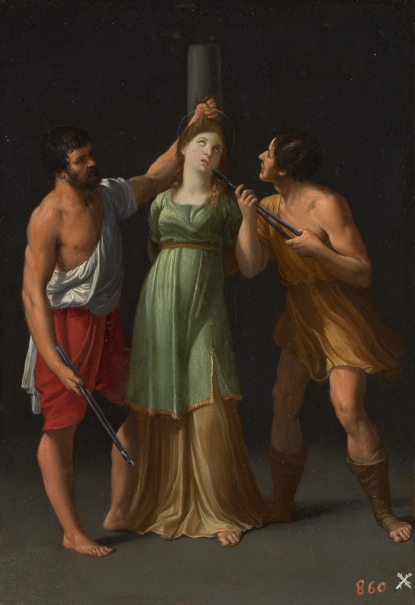
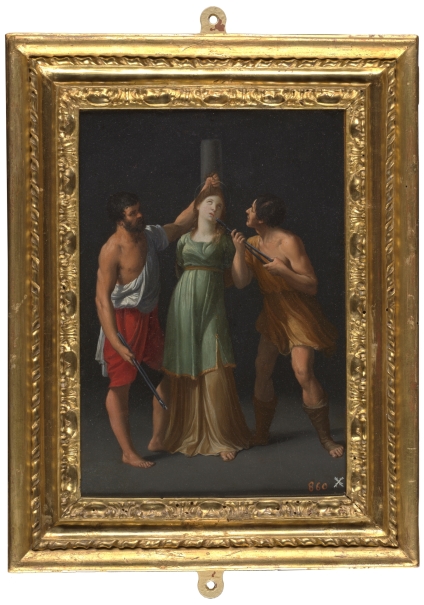
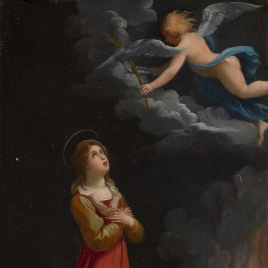
The heirs of Carlo Maratta (1625–1713) sold part of his collection of paintings to the Spanish crown in 1722, offering Philip V three original works by Guido Reni: a Saint Catherine, this Martyrdom of Saint Apollonia, and a Saint Apollonia at Prayer. The latter two formed a pair, for in addition to addressing the same theme, they were both painted on copper and were exactly the same size. Here, the saint is shown with her hands tied to a tall stake which rises up behind her, flanked by two tormentors. One uses his left hand to pull her head back by her hair, brandishing in his right hand a pair of pincers holding a tooth, while the other uses both hands to lift his pliers towards Apollonia’s mouth with the intention of pulling out more teeth.
Jacobus de Voragine wrote in some detail about the torture of Apollonia, testifying to the widespread popularity of her story in the Middle Ages, when prayers addressed to her were thought to cure toothache. The best-known accounts of her martyrdom, including the biography in Voragine’s Golden Legend compiled around 1260, report that her teeth were knocked out rather than extracted in an attempt to silence her, both literally and symbolically, and thus stop her from actively spreading Christianity in her community. Here, however, the two executioners wield pliers, indicating that Reni drew on the iconographic tradition rather than on literary sources. The pincers had long been the attribute by which Saint Apollonia was identified, appearing in numerous paintings even before the fourteenth century. Guido’s picture is similar, in terms of composition, to a miniature painted by Simon Marmion (c. 1425–1489) in the mid-fifteenth century, which features the same elements, including the stake.
This is by no means the only difference between the painting and the written sources. Reni, again following the visual cultural tradition, portrays Apollonia as a young virgin with a pale, smooth complexion, wearing a flowing, figure-hugging dress; in fact, at the time of her death she was an old woman. Guido’s treatment of the saint’s body may well have been based on the central figure in the Ecstasy of Saint Cecilia by Raphael (1483–1520), with which he would have been familiar since his youth in Bologna. Apart from the position of the hands, the posture of the two saints is identical; they have the same facial expression, and their garments are very similar in design. According to Carlo Cesare Malvasia in his Felsina Pittrice (1678), Guido even copied Raphael’s painting, which hung at the time in the church of San Giovanni in Monte in Bologna; some historians believe that Reni’s copy is the Ecstasy in the church of San Luigi dei Francesi in Rome, while others identify it as the version in the National Gallery of Ireland. The two paintings display a similar compositional balance: Raphael’s Saint Cecilia is flanked by two pairs of saints, those nearest to her being depicted in profile, like the two tormentors in Reni’s picture.
Guido addressed this episode in at least one other painting, which was in the Barberini collection in Rome until the eighteenth century, when it was purchased by the Duke of Orléans. Though its whereabouts is now unknown, a surviving copy that had also hung in the Palazzo Barberini – and is regarded as an autograph version too – can now be seen at the Dresden Gemäldegalerie. The original, probably painted in around 1606–, differs considerably from this Prado Martyrdom with regard to both the placing of the saint and the background – which in the later painting features a highly-elaborate landscape with ruins – while the style has also become noticeably brighter. By contrast, the Prado Martyrdom displays a certain technical naiveté and a greater reliance on the impact of the Caravaggio-like use of chiaroscuro, suggesting that it must have been painted some years earlier, probably around 1600.
Japón, Rafael, 'Guido Reni. The martyrdom of Saint Apollonia'. In: Guido Reni, Madrid, Museo Nacional del Prado, 2023, p.180-181 nº 13