Saint Mary Magdalene
First half of the XVII century. Oil on canvas.On display elsewhere
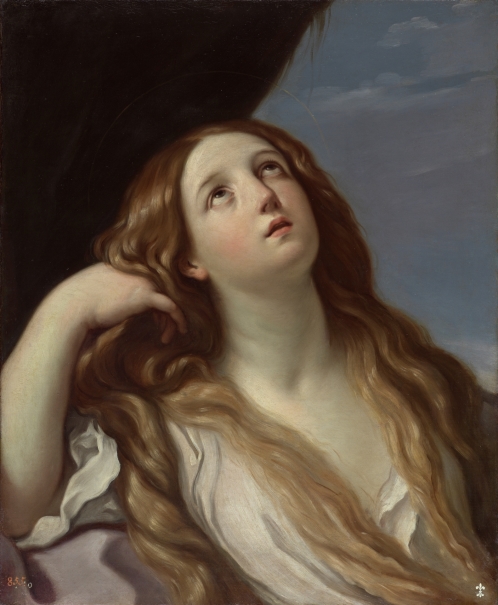
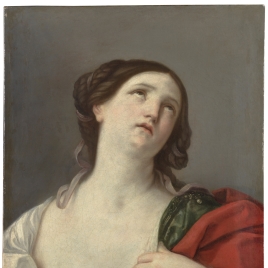
This work depicts Saint Mary Magdalene. It is a partial copy of a painting by Guido Reni in the Galleria Nazionale d’Arte Antica di Palazzo Corsini in Rome (inv. 1437). The comparison between the two paintings has made it possible to identify the character, as none of the saint’s attributes – such as the skull or the jar of ointment – appear in the painting in Madrid. This may indicate that the canvas might have been cropped, thus altering its dimensions, or that it was simply an instantiation of a composition that was well known from the 17th century onwards, as evidenced by the existence of several reproductions carried out since then.
Pérez Sánchez suggested that it was a case of self-repetition, albeit with some reluctance, that gives it inferior technical qualities to the original; for this reason, Pepper subsequently considered it to be a work created by a painter from the Bolognese master’s workshop. This is also inferred by comparing it with other original versions, such as the one in the Micheli Collection in Milan, which used to belong to the Barberini family and is accepted by critics as the main painting of the series, dated 1627. It shows subtle compositional differences that tend to emphasise female sensuality. Nonetheless, it is unusual in Reni’s production to find such liberties that are far removed from Counter-Reformation propriety. Thus, in his later works, the painter would provide his Magdalenes with a halo of purity and chastity, as can be seen amongst others in the aforementioned Roman work.
Conversely, the existence of another version in which the saint is depicted in a similar half-length format – kept in the National Gallery in London (inv. NG177) and dated around 1635 – confirms that this master could not have carried out a partial copy of his own work without achieving similar results. It reveals several features of the style of the Bolognese artist’s final period, such as the brushstrokes that highlight certain volumes naturally, which are anyhow not found in the canvas in Madrid. The thorough attention paid by the copyist by imitating all the compositional details of the original work is an attempt to conceal an inferior handling of the technique, a very common practice in workshops.
Regardless, it appears recorded as an original work in royal inventories since its acquisition in the time of Isabella Farnese, as well as in all the Museum’s catalogues up to the present day, when it began to be accepted as a workshop work. Furthermore, between the 19th and 20th centuries, it was the second most copied painting by Reni in the Museo del Prado, with a total of 30 requests recorded in the copyists’ books. Two years in which this work was particularly in demand were 1899 and 1902, each with five requests.
Japón, Rafael, 'Taller de Guido Reni. Santa Maria Magdalena' En: El factor Prado: los depósitos del Museo Nacional del Prado., Museo de Bellas Artes de Asturias,, 2022, p.34-37 nº 4