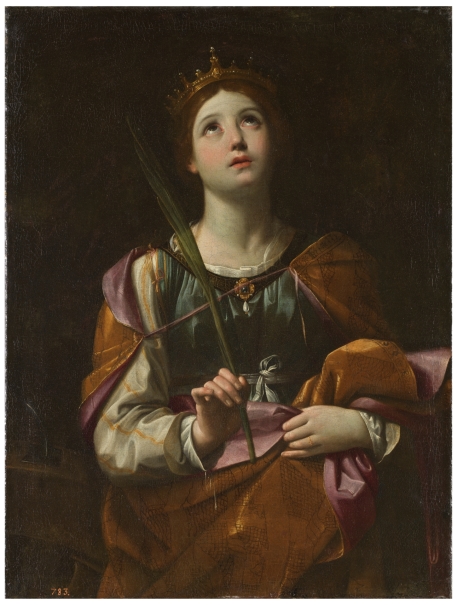
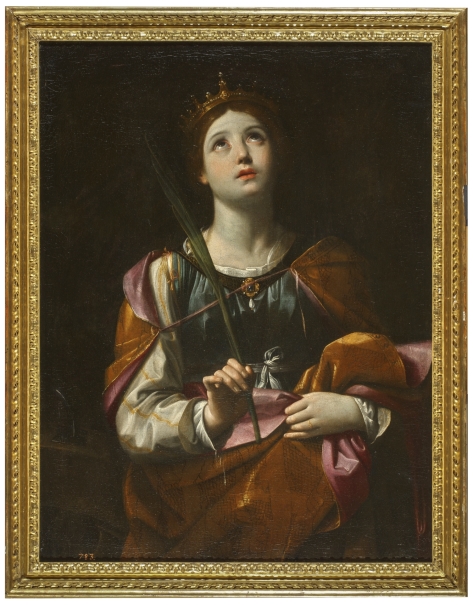
Saint Catherine of Alexandria
Ca. 1606. Oil on canvas.Room 004
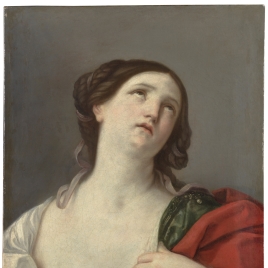
Saint Catherine, a third century martyr, belonged to a noble family in Alexandria. Driven by her Christian faith to disobey the Roman emperor, she was ordered to oppose him in a philosophical symposium. As a result of her debating skills, which led to the conversion of several highly placed figures at court including the empress herself, she was put to death. Given her social status and the fact that she was held to embody the virtues of wisdom, strength, and eloquence, she was hailed as a model for aristocratic ladies in early modern Spain. It is hardly surprising, therefore, that the Spanish royal collection should boast several works of art displaying this iconography, including the two canvas painted by Guido Reni.
In the late eighteenth century, Antonio Ponz and Antonio Conca both reported seeing one of these canvases – though mistakenly attributing it to Domenico Zampieri, Domenichino (1581–1641) – in the Casita del Príncipe at El Escorial. The art historian Alfonso E. Pérez Sánchez assumed that they had also seen the other version in the royal palace of La Granja de San Ildefonso, though they made no specific reference to its iconography. Pérez Sánchez based his hypothesis on a reference by Antonio Ponz to ‘a half-length female martyr thought to be by Guido Reni’, whereas in fact the early editions of Ponz’s Viage refer to a ‘Holy Martyr’ in the masculine. Although Conca later noted that the painting in question was ‘a half-length Female Martyr by Guido Reni’, it seems unlikely that Ponz – having recognised the Escorial canvas as a Saint Catherine by Domenichino – would be unable to correctly identify the theme, or that he would fail to link the two paintings. Indeed, Ponz noted that the same palace boasted a copy of Reni’s Saint Cecilia made by Andrea Vaccaro (1604–1670); it would therefore be surprising if he could not recognise the other with any certainty.
Comparison of this painting with the Escorial version, which was enlarged at some stage, suggests that the lower and right edges of the Prado canvas must have been cut off, removing part of the saint’s mantle. By contrast, the mantle is complete both in the Escorial canvas and in a seventeenth-century copy, mistakenly attributed to a follower of Caravaggio, sold at auction in 2016. Given this possible reduction in size, and the fact that the inventory number matches that given by the Real Museo in 1857, it may well be that the picture was trimmed then, and that it had been in the Spanish royal collection for a long time. There is no reason why the painting seen by Ponz and Conca in El Escorial should not be the one now in the Prado; it could have been switched with the copy then at La Granja de San Ildefonso during the reorganization and selection of works for the Museum. In compositional terms, the two canvases differ in just a few details: the martyr’s wheel is placed lower down in the Escorial version, and the saint’s right hand is more centrally positioned. However, recent X-ray examination has revealed that Reni traced the composition of the Prado picture, but made certain improvements to the position of the head and the fingers. These changes were replicated in the Escorial canvas, thus confirming that it was produced at a later date, using the Prado version as a model. The technical quality of the Prado painting is much closer to that of other originals produced by Guido during his sojourn in Rome in the early seventeenth century, in which the influence of Caravaggio (1571–1610) and Raphael (1483–1520) is clearly discernible. Several elements in the Prado canvas – the precise flow of the ornamental motifs on the saint’s mantle and the rendering of the folds in the upper part of the tunic and the sleeve – are missing from the Escorial version, suggesting the possible participation of a painter at Reni’s workshop. Up until the nineteenth century, inventory compilers believed that the alleged original was at El Escorial, which may account for the unexpected shift in the perceived quality of the Prado canvas, from ‘Reni original’ through ‘school of Reni’ to ‘copy’. In fact, the La Granja painting – which had come from the Maratta collection – had adorned important rooms in the royal residence, including the king’s private chapel, study, and bedchamber, suggesting that the monarchs held it in high esteem. After all, the composition depicts a member of the nobility whose martyrdom led to her canonisation, thus setting an edifying example to the royal family.
Japón, Rafael, 'Guido Reni. Saint Catherine of Alexandria'. In: Guido Reni, Madrid, Museo Nacional del Prado, 2023, p.372-374 nº 83