Saint Apollonia in Prayer
1600 - 1603. Oil on copperplate.Room 004
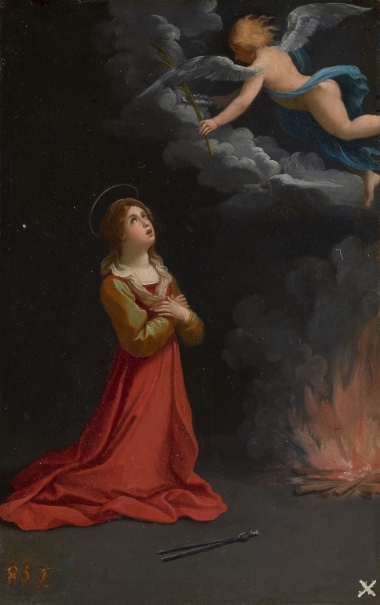
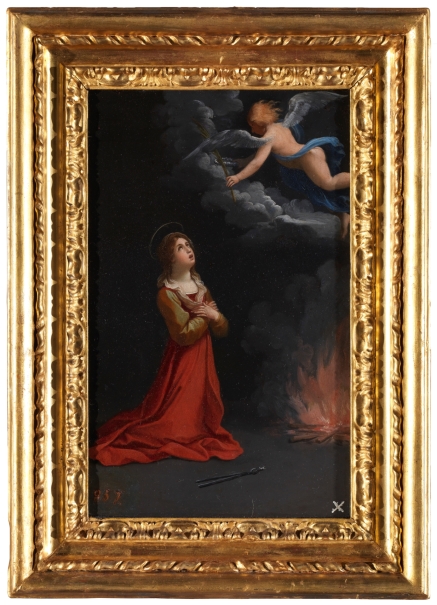
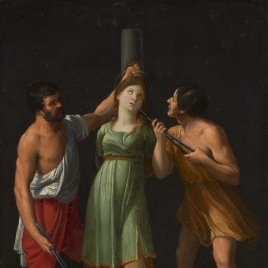
This painting, a pendant to the Martyrdom of Saint Apollonia also in the Museo del Prado, depicts an episode immediately following the beating during which the saint’s teeth were knocked out. The young woman kneels in prayer, her hands folded on her breast and her mouth half open to display the consequences of her torture; her upward gaze rests on an angel, emerging from the clouds to present her with the martyr’s palm and the saint’s crown. Prominently placed in the foreground are the pincers with which she was tortured and the fire that alludes to the manner of her death, whose rising smoke merges into the burst of glory.
By including these objects, Guido Reni recreates the moment, just before the saint’s death, when she accepts God’s will, thus resigning herself to her tragic destiny. The scene exudes a serenity somewhat at odds with the violence described in the literary sources, for at that very moment the torturers were threatening to cast her into the flames if she refused to blaspheme against Jesus Christ. Unintimidated by their threats, Apollonia chose instead to throw herself onto the fire, thus meeting her death without losing her faith. Here, by contrast, Guido depicts a young woman fearful at the thought of dying, being comforted by the angel. The sombre atmosphere, enhanced by the dark background, conveys a sense of contemplation, the idea that the saint is captured in a moment of introspection, in direct dialogue with God. This device is found in other works from this period attributed to Reni, such as the Martyrdom of Saint Cecilia in the Museo della Certosa, and was widely used by other seventeenth-century artists as an ideal resource for visually translating miracles and mystical visions. Nowhere is this more apparent than in the work of Francisco deZurbarán (1598–1664), a good example of which is the Prado Vision of Saint Peter Nolasco.
Interestingly, the saint’s attire differs in each picture: in the Martyrdom she is dressed in a green and yellow robe, whereas here she wears a red gown with orange-tinted sleeves and a delicate white scarf around her neck. With this change, Guido may have sought to draw a parallel between her gown and the colour of the flames which were to bring to an end her earthly existence. In depicting scenes from the lives of saints, artists often used clothing to identify the central figure in different situations; these two paintings may therefore have formed part of a larger series on the life of Apollonia, which was subsequently dispersed.
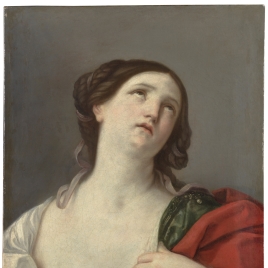
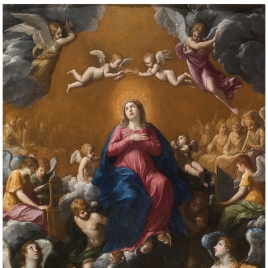
Although both pictures were confidently attributed to Reni by Alfonso E. Pérez Sánchez – albeit classed as minor works produced in his youth – Stephen Pepper later dismissed them as copies of lost originals. At present, however, critics agree that they are autograph paintings executed around 1600, when the young Guido, who had just arrived in Rome, was discovering the naturalism practiced by Caravaggio and his followers. While not displaying the flawless technique evident in Reni’s work from 1605 onwards, these pictures are regarded as providing rare evidence of the experimental phase – and the stylistic transition – through which the artist was going at that time. Indeed, some critics even see similarities between this Saint Apollonia and the nymph in Landscape with Cupids playing painted during the same period. Another work displaying an undeniable resemblance, in terms of composition and technique, is the Assumption and Coronation of the Virgin in the Museo del Prado, where the positioning of the main figures and of the angels hovering above is very similar. The Assumption dates from around 1602–3, suggesting that the two Saint Apollonia paintings may have been produced slightly earlier.
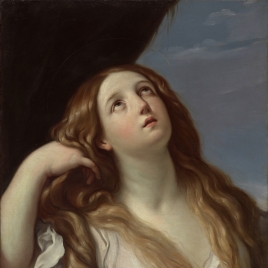
These two pictures confirm that, at an early stage in his career, Guido had already begun to shape his own highly personal image of saintliness, one which was to prove highly successful because it perfectly reflected post-Tridentine thought. Once in Rome, he was involved in several commissions for images of martyrs, whose veneration had spread due to the discovery, among other things, of the incorrupt remains of Saint Cecilia. In works of this kind, Reni liked to portray saints with their eyes raised towards heaven, an expression that would come to be associated with the triumph of Christian heroes, and of which he would make use throughout his career.
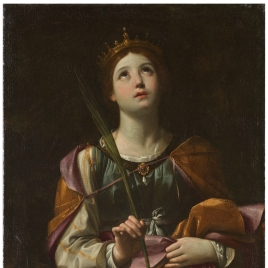
The Spanish monarchs thought very highly of these paintings from the moment they were acquired in 1722, as attested by their placing in the oratory at the royal palace at La Granja de San Ildefonso in Segovia together with a Saint Catherine by the same artist. There they would remain until 1794, when they were recorded in a chapel at the royal palace of Aranjuez.
Japón, Rafael, 'Guido Reni. Saint Apollonia in prayer'. In: Guido Reni, Madrid, Museo Nacional del Prado, 2023, p.182-184 nº 14