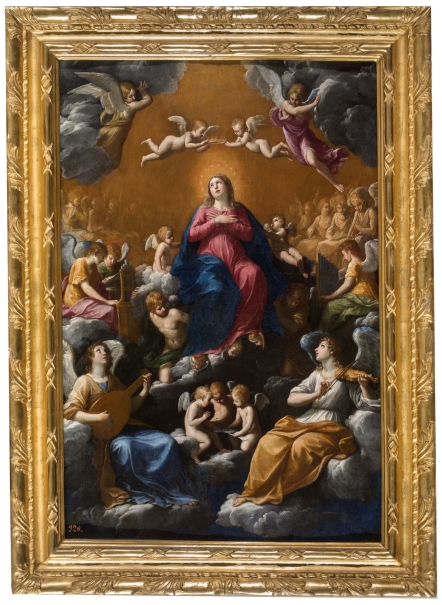
The Assumption and Coronation of the Virgin
1602 - 1603. Oil on panel.Room 004
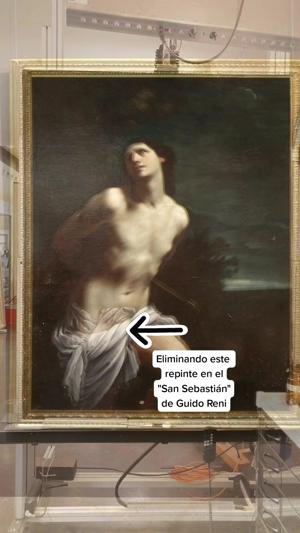
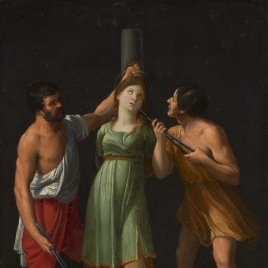
This was one of the first paintings by Guido Reni to enter the Spanish royal collections during the reign of Philip III. It is widely thought to have been sent to Madrid from Rome in the early seventeenth century – together with an Agony in the Garden by the same artist – as a gift from Cardinal Camillo Borghese, the future Pope Paul V, to Empress Maria of Austria. More recently, however, Stefano Pierguidi has suggested that both paintings were entrusted to his nephew Cardinal Scipione Borghese, who gave them to Juan Alonso Pimentel de Herrera, 5th Duke of Benavente and Viceroy of Naples from 1603 to 1610, to deliver to the king. In 1615, Philip III arranged for the remains of the empress – who had died in 1603 – to be transferred to the choir in the convent church of the Descalzas Reales in Madrid; since then, the Agony in the Garden, painted on copper, has hung above her tomb. While the two paintings may have been intended as a pair – being similar in terms of size, composition, and style – they were to have different destinies. There is no record of the Assumption until a 1666 inventory of the Alcázar in Madrid, where it is listed as hanging in an upstairs room of the Tower. It remained there until the end of the seventeenth century, when it was inventoried in the court painters’ workshop, alongside Reni’s Saint Sebastian, in 1700. It was then listed in the Cuarto Nuevo de la Reina (Queen’s New Apartments) in 1703 and 1734. Saved from the fire that destroyed the Alcázar in 1734, the panel was taken to the Casas Arzobispales (Archbishop’s Residence) and from there to the Buen Retiro palace; it was later transferred to the newly-completed Royal Palace, where it remained – hanging in the ‘first room’ of the new building and elsewhere – until it entered the Museo del Prado in 1854.
Alfonso E. Pérez Sánchez identified this Assumption as the Madonna which, according to Carlo Cesare Malvasia in his Felsina pittrice (1678), was given to the King of Spain and was expressly requested by Queen Margaret of Austria for her bedchamber. Other scholars later claimed that Malvasia’s Madonna was in fact the Virgin of the Chair, which was among the works sent to decorate the monastery of El Escorial in the seventeenth century. José Luis Colomer rejected both hypotheses, suggesting that Malvasia was referring to the Raleigh Virgin and Child, which was recorded in El Escorial prior to being looted during the French invasion.
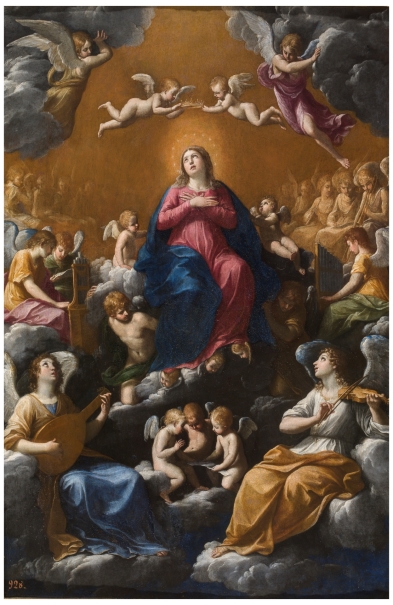
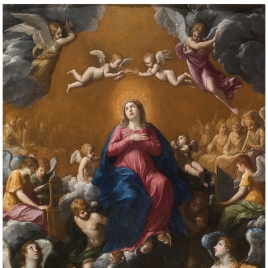
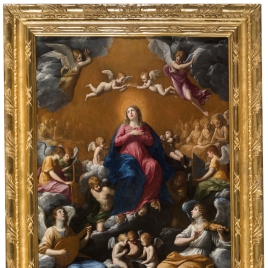
Critics agree that the panel was painted during Guido’s first sojourn in Rome, between 1602 and 1603, since it displays a number of formal features found only in his early works. Echoes of compositions by one of his masters, Ludovico Carracci (1555–1619), are readily discernible, together with the first fruits of techniques with which he experimented in Rome, stirred by the artistic trends then in vogue. The complex, carefully designed composition is divided into three sections, whose figurative elements lead the viewer’s eye towards the central area. The gazes of the four angels in the corners – two playing instruments in the lower section, and two parting the clouds above – converge on the seated figure of Mary, her arms crossed over her breast and her eyes raised towards heaven. It is at this point where the X-ray study conducted by the Museo del Prado reveals a major change in the proportions of the figure of the Virgin. While Reni certainly achieved a powerful devotional image, it is somewhat marred by its excessive frontality and lacks the lightness of touch characteristic of later versions. Nowhere is this more apparent than in the upper section of the Assumption at the church of Gesù e dei Santi Ambrogio e Andrea in Genoa. Reni’s style gradually evolved towards simpler, less cluttered compositions, thus making it easier to appreciate the idea of ascension associated with this iconography; here, the sense of upward motion is impeded by the inclusion of the two putti bearing the crown. In technical terms, too, Guido is still clearly dependent on the approach favoured by his masters, a trait shared by other painters – among them Giovanni Lanfranco (1582–1647)6 – who followed a similar path after leaving the Accademia degli Incamminati.
At least two other autograph versions are known, both painted on copper: one, which probably also came from Spain, in the National Gallery, London, and the other, which originally belonged to the Sampieri collection in Bologna, in the Städel Museum, Frankfurt, since 2019.
Japón, Rafael, 'Guido Reni. The Assumption and Coronation of the Virgin'. In: Guido Reni, Madrid, Museo Nacional del Prado, 2023, p.164-166 nº 8