formularioRDF
The itinerary <em>TITULORECORRIDO</em> has been successfully created. Now you can add in works from the Collection browser
<em>TITULOOBRA</em> added to <em>TITULORECORRIDO</em> itinerary

Close Continuar a ficha de la obra Continuar a ficha de la obra
26-06-2026
Guercino (Giovanni Francesco Barbieri)

Cento, Ferrara (Italy), 1591 - Bologna (Italy), 1666

See author's file

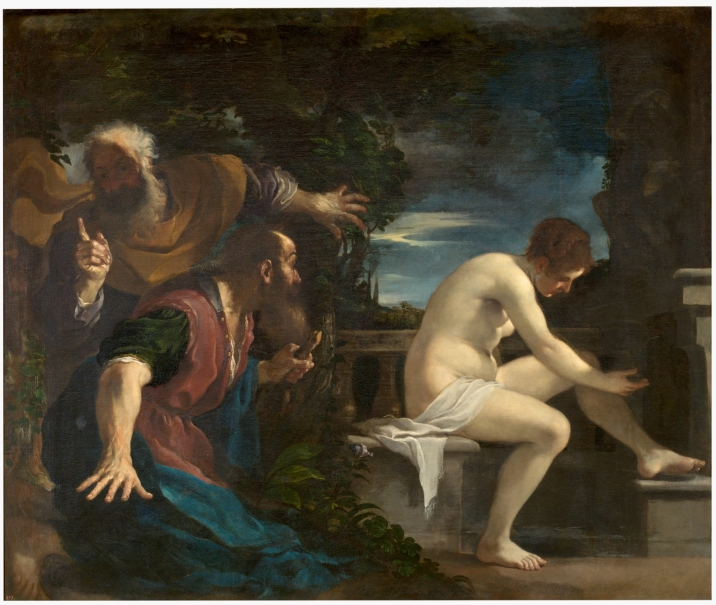
Susannah and the Elders

1617. Oil on canvas.
Not on display

Historian Denis Mahon has masterfully shown that this painting and two other famous works by Guercino -Lot and his daughters (Monastery of El Escorial, Madrid) and The return of the Prodigal Son (Galleria Sabauda, Turin-) were painted for Cardinal Alessandro Ludovisi in 1617 and 1618, while the artist was in Bologna.

According to the Old Testament (Daniel:13), Archian and Sedechia were two elderly judges who regularly visited the home of a rich man named Joachim to discuss certain cases. One hot day, Joachim’s wife, Susanna, was bathing in one of the fountains at her house without noticing that the old men were watching her from a hiding place. They had desired her for quite some time, and on this occasion tried to molest her. After Susanna resisted them, they accused her of adultery. Judge Daniel demonstrated her innocence and the death sentence was handed down to the two old men. This legend was a favourite of sixteenth and seventeenth-century artists, as it offered them an opportunity to depict a scene charged with eroticism and to display their skills at representing nudes.

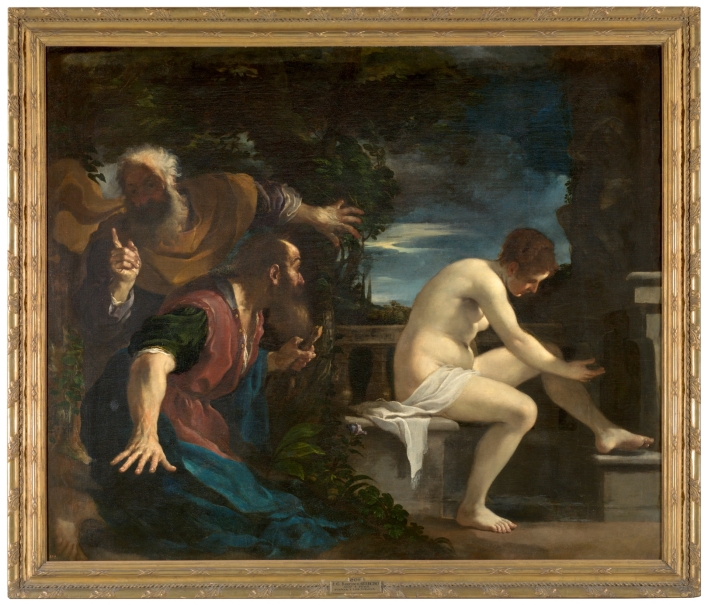
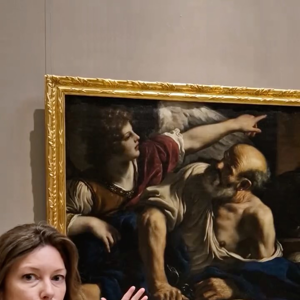
In a later work, Guercino portrayed the moment when the old men actually molest the young woman as she fights them off, but here he shows them observing her from their hiding place, capturing a moment of great physical and psychological tension. That tension is also present in the composition, which divides the canvas into two parts. The left is dominated by a naturalistic depiction of the old men, with a dramatic chiaroscuro that accentuates the violent affetti (movements of their souls) derived, in this case, from their libidinous desires. The contrasting colours of their clothing, and its movement as they gesture, reinforce the violence. All of this contrasts with the classicism of Susanna’s body, to the right, which stands out for its gentle monochromatic appearance. The roughness of the old men is superseded by the idealised nude of the young woman, whose full illumination makes her movements seem even slower in comparison to the frenzy of the old men in the shadows. Moreover, the latter are dressed, while she is not, which leads the viewer to behave like another voyeur, fixing his or her gaze on Susanna’s nude body. The flowers (probably lillies) in the middle of the composition have always been linked to candour and purity, which are also the young woman’s virtues.

One of the old men leans into the viewer’s space, extending his hand to warn us to keep still, so as not to alert Susanna to our presence. Thus, Guercino makes us participants in this sinful moment. With these two gestures -one directed at our soul and the other at our body- Guercino draws us into the story while simultaneously placing us outside the shadow that shelters the old men. Both the old men and viewers alike are thereby free to contemplate Susanna’s nudity as they please. The artist’s inspiration for her pose and form was the sculpture Crouching Aphrodite, apparently created by Greek sculptor Doidalsas in the second half of the third century BC and known in the modern era through numerous copies and replicas. This fact is enough to indicate that, notwithstanding traditional belief, the essentially intuitive nature of this painter’s training may be purely visual.

Riello, José, 'Guercino. Susanna and the Elders'. Italian masterpieces from Spain's royal court, Museo del Prado, National Gallery of Victoria Thames & Hudson, 2014, p.158
Multimedia

Technical data

Imagen del carrusel
Imagen del carrusel
Inventory number
P000201
Author
Guercino (Giovanni Francesco Barbieri)
Title
Susannah and the Elders
Date
1617
Technique
Oil
Support
Canvas
Dimension
Height: 176 cm; Width: 208 cm
Provenance
Painted for Alessandro Ludovisi, 1617; Ludovisi Collection, Rome, until 1664; Royal Collection (Collection of Philip IV, 1664; Royal Monastery of El Escorial, Madrid, 1667; New Royal Palace, Madrid, 1814).

Bibliography +

Inventario de las Pinturas del Museo Hecho a la Muerte del Rey Fernado VII, Madrid, 1834, pp. 44.

Maragoni, M, Il Guercino, Fratelli Alinari, Florencia, 1920, pp. lám.10.

Allgemeines Künstlerlexikon : die bildenden Künstler aller Z, Saur, 1922, pp. 220.

Mahon, Denis, Notes on the young Guercino II - Cento and Ferrara, The burlington magazine, 70/71, 1937, pp. 178.

Camón Aznar, José, Velázquez, I, Espasa-Calpe, Madrid, 1964, pp. 404.

Pérez Sánchez, Alfonso E., Pintura italiana del S. XVII en España, Universidad Fundación Valdecilla, Madrid, 1965, pp. 140-141.

Mahon, Denis, Il Guercino Giovanni Francesco Barbieri,1591-1666. Catálogo crítico dei dipinti, VII Mostra biennale d' arte antica, Edizioni alfa, Bolonia, 1968, pp. 53-55.

Barbanti Grimaldi, Nefta, Il Guercino. Gian Francesco Barbieri. 1591-1666, Edizioni G.R., Bolonia, 1968, pp. lám.99.

The Eric Young collection, The Bowes Museum Barnard Castle, Durham, 1969.

Pérez Sánchez, Alfonso E., Pintura italiana del siglo XVII. Exposición conmemorativa del ciento cincuenta aniversario de la fundación del Museo del Prado, Ministerio de Educación y Ciencia, Madrid, 1970, pp. 314 nº100.

Sánchez Cantón, Francisco Javier, Museo del Prado. Catálogo de las pinturas, Museo del Prado, Madrid, 1972.

Ponz, Antonio, Viage de España, VI, Madrid, 1972, pp. 41.

Cera, Adriano, La pittura emiliana del' 600., Conganesi, Miilan, 1982.

Ximenez, Andrés, Descripción del Real Monasterio de San Lorenzo de El Escorial: su magnifico Templo, Panteón y Palacio...Facs.1764., Patrimonio nacional, Madrid, 1984, pp. 175.

Museo Nacional del Prado, Catálogo de las pinturas, Museo del Prado, Madrid, 1985, pp. 323.

Salerno, Luigi, I dipinti del Guercino, Ugo Bozzi editore, Roma, 1988, pp. 115 nº34.

Museo Nacional del Prado, Museo del Prado. Inventario general de pinturas (I) La Colección Real, Museo del Prado, Espasa Calpe, Madrid, 1990, pp. nº895.

Stone, David M., Guercino. Catalogo Completo Dei Dipinti, Cantini, Firenze, 1991, pp. 54 lám.33.

Ebert-Schifferer, S., Giovanni Francesco Barbieri Il Guercino 1591-1666, Nuova Alfa Editoriale, Bolonia, 1991, pp. 76 nº23.

Buendía, José Rogelio, El Prado. Colecciones de Pintura, Lunwerg Editores, Barcelona, 1994, pp. 310.

Bettagno, Alessandro, El Museo del Prado, Fonds Mercator Fundación Amigos del Museo del Prado, Madrid, 1996, pp. 281.

Museo Nacional del Prado, Velázquez, Rubens, Lorrain: Malerei am Hof Philipps IV, Kunst-und Ausstellungshalle der Bundesrepublik Deu, Bonn, 1999, pp. 194.

Colomer, José Luis, Arte y diplomacia de la monarquía hispánica en el siglo XVII, Fernando Villaverde Ediciones, Madrid, 2003, pp. 391.

Mahon, Denis, Guercino. Poesia e Sentimento Nella Pittura del 600, De Agostini, Milan, 2003.

Papi, Gianni, ' Giovan Francesco Barbieri, 'Guercino'. Susana y los viejos' En:, Caravaggio y la pintura realista europea, Museu Nacional D'Art de Catalunya, Barcelona, 2005, pp. 180-183 n.39.

Enciclopedia del Museo del Prado, VI, T.F. Editores: Fundación Amigos, Madrid, 2006, pp. 2047.

Doval Trueba, M, Sobre dos viajes a Italia: el de Maria de Hungría y el primero de Velázquez, Boletin del Museo e Instituto Camón Aznar, 105, 2010, pp. 69-95.

Mahon, Denis, Il Guercino.Giovanni Francesco Barbieri, 1591-1666., Minerva, Bolonia, 2013, pp. 46,53-55, n.21.

Mena, Manuela B., 'Guercino: el mito olvidado'. En: Maestros en la sombra, Fundación Amigos Museo del Prado, Madrid, 2013, pp. 263-289 [273-274, 283].

Strinati, C. et al., Guercino e le donne. Il ritratto femminile come veicolo di Grazia, Bononia University Press, Fondazione Sorgente group, Roma, 2014, pp. 118.

Riello, José, 'Guercino. Susanna and the Elders', Italian masterpieces from Spain's royal court, Museo del Prado, National Gallery of Victoria Thames & Hudson, 2014, pp. 158.

Volpi, Caterina, La collezione Ludovisi come 'Scuola del mondo' Il ruolo di Agucchi, Marino, Valesio, Guercino e Domenichino, Storia dell'arte, 141, 2015, pp. 119-133 [121 fg.4].

Kilian, Joanna, Beltá crudele Milósc u Guercina, Rocznik Muzeum Narodowego w Warszawie. Nowa seria..., 4, 2015, pp. 170-207 [176-179].

Weston-Lewis, A, 'Guercino.Susannah and the elders" En:, Splendor, Myth, and Vision : Nudes from the Prado, Clark Art Institute ; Museo Nacional del Prado,, 2016, pp. 164-167 n.24.

Burke, Jill, The European Nude 1400-1650, en: Splendor, Myth, and Vision: Nudes from the Prado, Clark Art Institute ; Museo Nacional del Prado, 2016, pp. 16-49 [41].

Turner, Nicholas, The paintings of Guercino: a revised and expanded catalogue raisonné, Ugo Bozzi Editore,, 2017, pp. 301 n.42.

García Cueto, David, 'Francesco Barbiere detto Guercino. Susanna e i vechioni', Guercino: L´era Ludovisi a Roma, Arte,m,, 2024, pp. 102-103 nº10.

Mosso, Valerio, 'Guercino. Susana e i vecchioni', Guercino: il mestiere del pittore, Skira, 2024, pp. 208-209 IV 2b.

Alonso Lorenzo, Jaime, Arte y política. La pintura boloñesa como herramienta diplomática en la corte, Sub umbra alarum: ceremonial y coleccionismo en las cortes hispánicas de la Edad Moderna, Gijón, 2025, pp. 235-242 [244].

Other inventories +

Catálogo Museo del Prado, 1828. Núm. 714.
GUERCINO. SUSANA EN EL BAÑO. / Se ve á esta hermosa muger sentada á la / orilla de una fuente ocupada en bañarse, / y con la mano derecha tomando el agua / del caño para lavarse las piernas. Detras / de ella los dos viejos Jueces del pueblo / la están contemplando, indecisos en entre- /garse á sus criminales deseos. / Hermosa composición, dibujo de gran gus-/ to y correcto, en particular la Susana, / donde se muestra la belleza mas seducto-/ra sin ofender el pudor y la modestia. / Está pintada con un colorido natural y / brillante, y un pincel fácil, fluido y sua-/ve, y muestra una fuerza y efecto de clar-/ ro-oscuro admirable.

Catálogo Museo del Prado, 1843. Núm. 895.
GUERCINO 895—Susana en el baño. Detrás de ella están los dos viejos, jueces del pueblo, contemplándola. Alto 6 pies 3 pulg.; ancho 7 pies 5 pulg.

Catálogo Museo del Prado, 1854-1858. Núm. 895.

Inv. Real Museo, 1857. Núm. 895.
Guercino. / 895. Detras de ella estan dos viejos jueces del pueblo contemplandola. / Alto 6 pies, 3 pulg; Ancho 7 pies, 5 pulg.

Catálogo Museo del Prado, 1872-1907. Núm. 249.
249.-Susana en el baño. / Alto 1,75. Ancho 2,07.-Lienzo. / Sentada la hermosa judía en un banco de piedra, desnuda, y como disponiéndose á entrar en el baño, refrescándose ántes el cuerpo con el agua de la fuente, que vierte en la ancha pila, lléganse á ella por detras, sin ser vistos, los dos disolutos ancianos, penetrando por la enramada que separa del jardin el abalaustrado recinto donde pasa la escena. Uno de ellos, ya próximo á la codiciada hermosura, se agacha y la contempla embelesado. El otro entra con gran sigilo, separando las ramas con la mano izquierda y levantando la derecha en ademan cauteloso. Fondo, arboleda y celaje.-Figuras de tamaño natural. / C.L.

Inscriptions +

895
Inscribed in orange. Front, lower left corner

Exhibitions +

Guercino y sus heroínas bíblicas
Madrid
16.03.2026 - 14.06.2026

Guercino and the Ludovisi Age in Rome. The Triumph of Paintings
Roma
30.10.2024 - 26.01.2025

Guercino. The Painter’s Trade
Turín
22.03.2024 - 15.09.2024

Splendor, Myth and Vision: Nudes from the Prado
Williamstown MA
12.06.2016 - 10.10.2016

Italian Masterpieces from Spain's Royal Court. Museo Nacional del Prado
Melbourne
16.05.2014 - 31.08.2014

Caravaggio y la pintura realista europea
Barcelona
06.10.2005 - 15.01.2006

Velázquez, Rubens, Claudio de Lorena y la pintura en la corte de Felipe IV
Bonn
07.10.1999 - 23.01.2000

Giovan Francesco Barbieri, il Guercino
Washington DC
15.03.1992 - 17.05.1992

Giovan Francesco Barbieri, il Guercino
Frankfurt
30.11.1991 - 17.05.1992

Giovan Francesco Barbieri, il Guercino
Bolonia
06.09.1991 - 10.11.1991

Update date: 26-06-2026 | Registry created on 02-12-2015

Visor 360

Drag with the cursor to rotate the piece

Other works by Guercino (Giovanni Francesco Barbieri)

Print on demand

Print artworks available in our catalogue in high quality and your preferred size and finish.

Image archive

Request artworks available in our catalogue in digital format.

Up