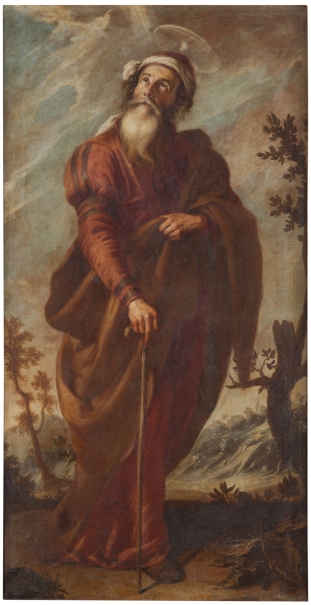
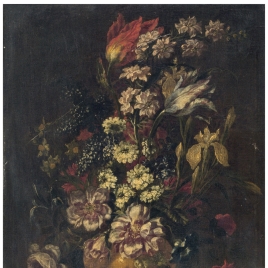
Saint Joachim
XVII century. Oil on canvas.On display elsewhere
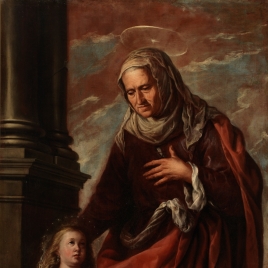
Gómez Nebreda identifies this painting with the one recorded in entry number 96 of the inventory composed by the commission made up of Juan Gálvez (paintings) and Francisco Elías (sculptures), concerning the works in the convent of Our Lady of Angels in Madrid that were collected following the suppression of the nunnery as a consequence of the Ecclesiastical Confiscation: ‘Private chapel, St Michael / 96 Other 4 identical natural size paintings of St Joachim[,] St Anne, St Francis of Assisi and Saint Mary of Egypt / Height 2 1/2 Width 5/4 [de vara]’. This entry corresponds to the ‘copies of the Spagnoletto’ by Francisco Pérez Sierra quoted by Felipe de Castro and Antonio Ponz, as three of the four paintings he mentions are identified, one of which has not been found. These are the paintings of Saint Joachim (P003181) – unsigned although attributed to Pérez Sierra as early as the 1846 inventory of the Trinity due to its relationship to the signed Saint Francis – and Saint Anne leading the Virgin (P003282).
This identification is doubly interesting since this last painting had had several attributions, from Francisco Camilo to the school of Pereda. Traditionally, at least since Ángulo, it has been believed that Cruzada attributed this painting to Camilo (Ángulo, 1959), an attribution denied by Ángulo himself. However, the Cruzada catalogue actually lists it in the ‘anonymous paintings’ section, ‘period: last third of the 17th century’. This data mix-up is what led to doubts regarding the attribution, which is quickly disproved by a simple glance at the painting. Despite the fact that the subject is very much to Camilo’s taste (he depicted it many times), the pictorial execution has nothing to do with this artist.
He was indeed an artist with a much harder, impasto brushstroke, gravitating towards the realist tradition of the first half of the century. Both the model and the looser execution of the child Virgin are somewhat reminiscent of Francisco Camilo, as is the elongated canon of the figures, which would also be used by other contemporary artists such as Pereda. Saint Anne’s features, hand, headdress and fitted striped cloth do not correspond to the traditional gentleness of Camilo: instead, they are much more realistic, almost portrait-like models of an elderly woman and accentuate the contrast with the gentleness and softness of the model of the girl, whose hair and curls on the sleeves and neckline of her dress are more in keeping with the pictorial conventions of the second half of the century.
It can currently be related in documentary and comparative terms to the aforementioned painting of Saint Joachim (P3181), both in the composition and monumentality of the figures with their very low viewpoint and in the execution of sky backgrounds and cloudscapes, even the nimbus. It is also a painting of great quality that combines hard, impasto brushstrokes (perhaps what made Felipe de Castro think of copies by Ribera, when as a matter of fact they are originals) with much looser brushstrokes. Palomino specifies that in the chapel, which he calls the chapel of Diego de la Torre, there are some paintings by Francisco Pérez Sierra which are ‘copies of the Spagnoletto, and others of Don Francisco’s invention’; perhaps those of Saint Joachim and Saint Anne correspond to the latter, whereas those of Saint Francis and Saint Mary of Egypt correspond to the former. He adds that ‘he also painted a monument, which remained until these years, albeit very deteriorated’ for the church of the convent of Angels. According to Palomino, Pérez Sierra worked as a page and later as general agent of the Spanish Penitentiary for Diego de la Torre, who was then secretary of the Council of Saint Clare in Naples. This relationship would also justify the involvement of Neapolitan artists. On the other hand, Palomino’s quote raises the question of the ownership of the chapel, either by Diego or Andrés de la Torre, which is difficult to determine as the assumed kinship between both men is unknown.
Gómez Nebreda, María Luisa, Las pinturas del convento franciscano de los Ángeles de Madrid que pasaron al Museo de la Trinidad. Contribución al catálogo del "Prado Disperso". Boletín del Museo del Prado, 2002, p.37-64 [50]