Francisco Pérez Sierra
Naples (Italy), 1627 - Madrid (Spain), 1709Neapolitan painter, son of the Gibraltarian soldier Martín Pérez and the daughter of the Governor of Calabria. According to Palomino, "he eventually showed inclination towards painting." He trained in battle scenes under the Italian artist Aniello Falcone, an expert in this genre, while also working for Diego de la Torre, Secretary of the Council of Santa Clara in Naples. He moved to Madrid with de la Torre when the latter was appointed Secretary of Italy, and continued his artistic education at court under Juan de Toledo. Due to his success, he dedicated himself fully to painting battles, landscapes, and pastoral scenes.
He worked in fresco, tempera, and oil techniques on both canvas and walls. He married Mónica de los Ríos, and a significant part of his career was devoted to religious commissions, many of which have not survived, such as those he painted for the demolished convents of Victoria and Nuestra Señora de los Ángeles, as well as for the de la Torre’s private chapel at the San Plácido convent, where he copied Ribera artworks brought from Naples by his mentor, along with original pictorical representations of saints.
He designed a triumphal arch for the Convent of San Francisco to celebrate the canonization of Saint Rose of Lima, which Palomino described as executed "with exceptional delicacy and artistry, of which I saw several fragments in his home." He also collaborated with artists such as Matías de Torres, Dionisio Mantuano, or Francisco Rizi and Juan Carreño de Miranda, who greatly admired his skill. on frescoes for the Huerta de Sora, residence of the Marquis of Eliche,
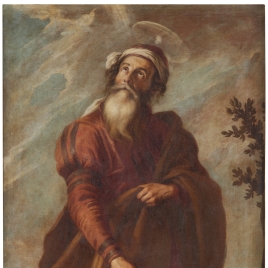
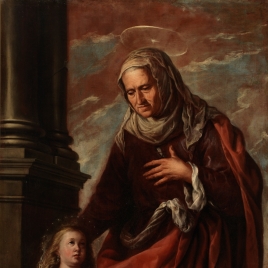
Among his noteworthy works are the “Inmaculada Concepción” (1665) at the Convent of the Trinitarias in Madrid, and two paintings housed at the Museo del Prado: “San Joaquín” (P003181) and “Santa Ana conduciendo a la Virgen”, (P003282), both part of the not preserved Museo de la Trinidad in the past.
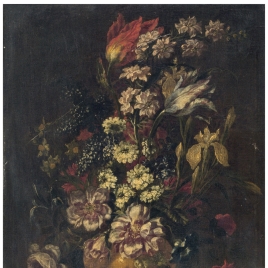
After achieving a respectable social standing, thanks in part to years of service as Agent of the Presidios in Spain, a post secured through de la Torre, he spent his final years painting flowers and still lifes for personal enjoyment, as he lived comfortably with his acquired economy. He took inspiration from his “well polished garden” of his home on Calle de las Infantas.
Diego de Nájera praised him writting a sonnet for the visual effect achieved in his work, drawing a parallel to the legendary competition between Zeuxis and Parrhasius, recounted by Pliny the Elder in his “Natural History”. Art historian Pérez Sánchez, studying the 1701 inventory of royal collections, confirmed the existence of six vases by the artist located in the Palacio del Buen Retiro, something already noted by Ceán Bermúdez, who described them as being "in a corridor leading to the room of the Infants" as well as in various private homes. Antonio Ponz also mentions seeing some of these artworks in a room adjacent to the Casón del Buen Retiro. In addition, Pérez Sánchez points out the mention of Sierra and Juan van der Hamen as the only Spaniards in this inventory, attesting to his prestige.
He died of old age in 1709 at 82, having suffered from palsy, and was buried at the disappeareed Convent of the Capuchins of Patience.