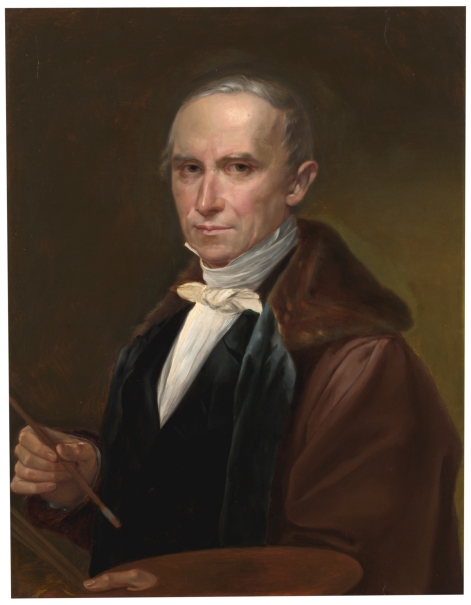
Self-portrait
Ca. 1840. Oil on cardboard.Room 062A
In 1840, José de Madrazo was already one of the most important figures in the cultural scene of the first half of the 19th century. At the age of fifty-nine, he concurrently held the posts of president of the Painting Section at the Artistic and Literary Lyceum of Madrid, director of painting works at the Royal Academy of Fine Arts of San Fernando, director of the Real Museo, secretary to the Queen consort, honourable academician of the Academy of Fine Arts of Salamanca, academician of the Academy of Saint Luke in Rome, and court painter. Among his numerous titles and honours, he was also Knight of the Order of Charles III, Perpetual Alderman of his native city and Commander of the Order of Isabella the Catholic. These titles and honours increased progressively throughout his life. He fathered many children, who were also linked in some way to the country´s most culturally influential circles. At the same time, he was a painter with a large clientele, particularly among the nobility of the Elizabethan court. Although he painted historical, allegorical and religious genres, it was his portraiture that earned him professional prestige both at home and abroad, as well as the highest financial rewards. These incomes were also boosted by his role as a merchant and, in his own words, by his ownership of one of the finest collections of works of art in the world. The weekly correspondence he kept up with his son Federico during the years he spent in Paris and Rome provides timely information on the logistics of his busy work life and the vicissitudes experienced by all these institutions, especially the Academy of Fine Arts and the Museo del Prado: “In the morning I go to the Academy, from there I leave at eleven o´clock to rush to the Museum. From here I leave at one o´clock to have a bite at home and then I rush to the Palace where, as I have already said, I remain until nightfall, when I go back to the Academy, from where I leave at eight o´clock in the evening to start writing official letters and other things relating to the Museum, because so far I have no Secretary appointed and it falls to me to do his job, as Accountant and Administrator” (letter of 12th of January 1839). In the 1840s, the Museo del Prado was experiencing one of the most stimulating moments for Madrazo, as he was immersed in the process of restoring and exhibiting the paintings brought from El Escorial and the Dauphin´s Treasure, which came from the Cabinet of Natural History. In addition to his intense professional career, described in the biography attached to this catalogue, his vehement and firm personality as a father figure is also present. He was totally devoted to the liberal training and education of his children both at home and abroad. These multiple occupations almost completely prevented him from dedicating himself to painting as much as he would have liked. However, Madrazo did not hesitate to paint a self-portrait with a palette and brushes in his hands. The penetrating gaze and the tight light of this superb portrait evoke his classicist training alongside David. The scene is softened by a certain halo of tenderness, so characteristic of his family portraits and closer to the Romantic tendencies that already prevailed in our country around 1840. The Museo de Arte Moderno acquired the self-portrait to form part of its iconographic library of artists. This collection was created under the direction of Benlliure in 1915 with the intention of bringing together the effigies of both contemporary painters and prestigious artists who are no longer alive.
Gutiérrez Márquez, A., Autorretrato (h. 1840). En Barón, J.: El retrato español en el Prado. De Goya a Sorolla, Madrid, Museo Nacional del Prado, 2007, p.90, n. 17