formularioRDF
The itinerary <em>TITULORECORRIDO</em> has been successfully created. Now you can add in works from the Collection browser
<em>TITULOOBRA</em> added to <em>TITULORECORRIDO</em> itinerary

Close Continuar a ficha de la obra Continuar a ficha de la obra
02-06-2026
Germán Hernández Amores

Murcia, 1823 - Murcia, 1894

See author's file

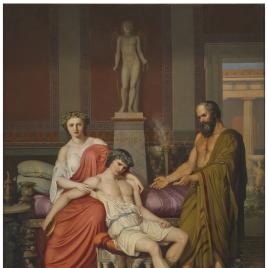
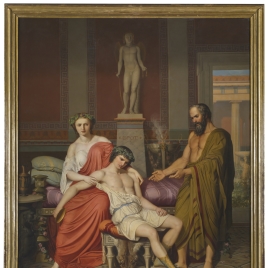
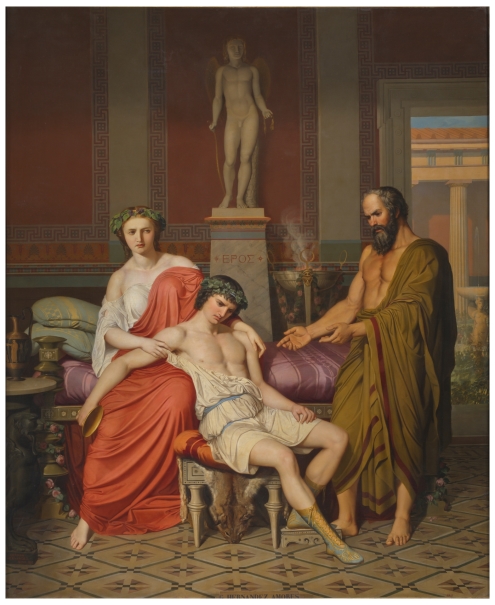
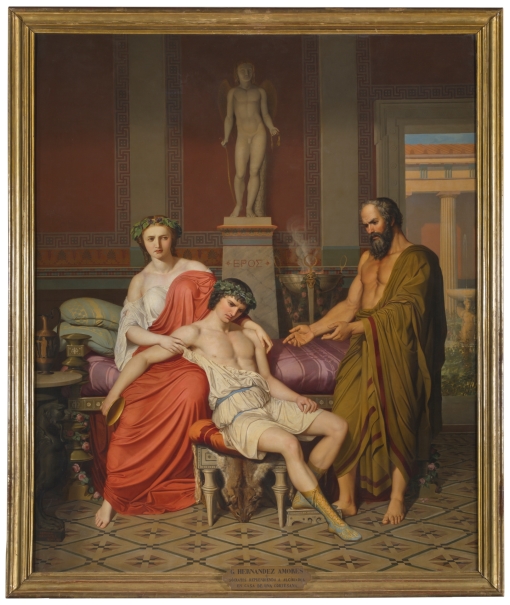
Socrates rebuking Alcibiades at a courtesan's house

1857. Oil on canvas.
Not on display

This work is the most important of those executed by the artist during his time in Rome, where he resided on a pension extraordinaria (special allowance) between 1853 and 1858. The painter made careful study of the subject, as shown in the preparatory sketch kept in the Museo de Bellas Artes in Murcia. It underlines the reliance of the subject on the classical motif of Youth, or Hercules, between Virtue and Vice, with the convetional female allegory of Virtue, here replaced by the figure of Socrates. The philosopher goes from holding Alcibiades´ arm in the sketch to questioning him in the final painting, with a didactic rather than a cautionary gesture, thus expressing his moral authority over the libertine young man, as described by Plutarch in his Alcibiades.

The subject had been a theme in Neoclassicism, representing the value of the moral example of a philosopher of antiquity. The artist’s restraint is most evident in the balance of the composition, the order of the planes parallel to the viewer, the accuracy of the drawing, and the somewhat muted softness of the colouring. The almost archaeological fidelity to the past in characters and details – praised by the Spanish critics– is an essential feature of this painting and particularly evident in the depiction of the characters. The face of Alcibiades recalls that of Antinous, as depicted in the bas-relief at Villa Albani (Torlonia) in Rome; nonetheless, his pose, the feline skin on which he is seated, and the crown of vine leaves evoke the figure of Dionysus with Ariadne in depictions on ancient vases and mosaics, the latter motif also suggested by the wine the young man has just drunk. The head of Socrates is that of the well-known ancient archetype in the Vatican Museum. For the figure of the courtesan Theodota, the painter used a study he had made of a female head (Murcia, Private Coll.), which he painted in 1855.

The details of the furnishings and ornamentation also strive for veracity. The Praxitelean-like Eros presiding over the room of the luxurious house is drawn from the iconography of the Apollo Lacchaeus, to which the painter adds the bow and the bandage, as well as the epigraphic inscription. The red-figured oenochoe on the bedside table, for pouring wine into the bronze cup held by Alcibiades and alluding to the other vice that provokes Socrates´ reprimand, is decorated with a female figure associated with the beginnings of early Greek classicism. The interior is not that of a Greek house, but rather an ancient Roman one, like those the artist himself had seen in Pompeii. However, the motifs of fretwork and sticks and the Doric order of the courtyard also refer –in a broad sense– to the Hellenistic world.

The painter sent the work to Madrid in 1858, tagged as a pensioner work. On 14 April of that year it was exhibited in the main gallery of the Ministry of Public Works. Shortly afterwards it was acquired by Royal Order of 10-V-1858 for 35,000 reales, addressed to the Museo Nacional de Pintura y Escultura. It was submitted for the National Exhibition of Fine Arts that same year, and was awarded a second-class medal.

The painting´s dissemination was noteworthy, to which Pedro Martí´s engravings for the Valencian magazine Revista Bellas Artes (1-VI-1858) and Tomás Carlos Capuz´s wood engravings for the Madrid magazine El Museo Universal (30-XI-1858) contributed. The critic of the latter considered the work one of the best in the exhibition: the figure of the philosopher is dignified, and his attitude suitable; that the courtesan –whose head is beautiful in form and expression– has a colour in her throat and breast that leaves nothing to be desired; that her form is at once grandiose and delicate, reveals an uncommon taste and feeling for art.

Barón, Javier, Germán Hernández Amores Sócrates reprendiendo a Alcibíades en casa de una cortesana' En:. El vaso griego y sus destinos. Cabrera,P. Rouillard,P. Verbank-Pierard, A.(dir.), Madrid, Ministerio de Cultura, 2004, p.370-371 n.149
Technical data

Imagen del carrusel
Imagen del carrusel
Inventory number
P006886
Author
Germán Hernández Amores
Title
Socrates rebuking Alcibiades at a courtesan's house
Date
1857
Technique
Oil
Support
Canvas
Dimension
Width: 226 cm; Height: 278 cm
Provenance
Acquired from the artist for the Museo de la Trinidad (pension work), 1858; Museo de la Trinitdad, 1858–1872; Museo del Prado, 1872–1896; Museo de Arte Moderno, 1896–1971
Entry date
1971

Bibliography +

G. del Valle, L., Alcibíades reprendido por Sócrates. Cuadro original de D. Germán Hernández Amores, Las Bellas Artes, 1858, pp. 85-87.

Catálogo de la Exposición General de Bellas Artes de 1858, [Imprenta Nacional], Madrid, 1858, pp. 11 n.73.

Iruretagoyena G.M. de, La exposición de Bellas Artes de 1858, El Ensayo. Albúm científico literario, 1858, pp. 6-10 [7].

Puerta Vizcaíno, J. Granda, A, Exposición de Bellas Artes, El Clamor Público, 1858.

G. del Valle, L., Exposición general de Bellas Artes, Las Bellas Artes, 1858, pp. 194.

Ossorio y Bernard, Manuel, Galería biográfica de artistas españoles del Siglo XIX, Madrid, 1883-1884, pp. 330.

Ruiz Cañabate, Emilio, Catálogo de las obras del Museo Nacional de pintura y escultura : (pintores contemporáneos), [Establecimiento tipográfico L.Polo], Madrid, 1889, pp. 43 n.117.

Espinós, Adela; Orihuela, Mercedes y Royo Villanova, Mercedes, 'El Prado disperso'. Cuadros depositados en Madrid. X. Alcalá de Henares (Madrid). Ayuntamiento, Boletín del Museo del Prado, 4, 1983, pp. 71.

Exposiciones nacionales del siglo XIX : premios de pintura / [coordinación, Enrique Arias Anglés, Wifredo Rincón García, Alicia Navarro Granell], Centro Cultural del Conde Duque, Ayuntamiento, Concejalía de Cultura, Madrid, 1988.

Exposiciones nacionales del siglo XIX : premios de pintura / [coordinación, Enrique Arias Anglés, Wifredo Rincón García, Alicia Navarro Granell], Centro Cultural del Conde Duque, Ayuntamiento, Concejalía de Cultura, Madrid, 1988, pp. 86.

Díez, José Luis, La pintura de historia del siglo XIX en España, Consorcio Madrid 92 Museo del Prado, Madrid, 1992, pp. 176-179 nº.11.

Noticias. Levantamiento definitivo de depósitos. Alcalá de Henares. Ayuntamiento, Boletín del Museo del Prado, 14, 1993, pp. 100.

Paez Burruezo, Martin, El Clasicismo en la pintura del siglo XIX: Germán Hernández Amores., Consejeria de Cultura y Educacion, Murcia, 1995, pp. 224-227.

Reyero, Carlos, Apariencia e identidad masculina de la Ilustración al Decadentismo, Ediciones Cátedra, Madrid, 1996, pp. 149.

Museo Nacional del Prado, Museo del Prado. Inventario general de pinturas (III). Nuevas Adquisiciones. Museo Iconográfico. Tapices., Museo del Prado, Espasa Calpe, Madrid, 1996.

Orihuela, Mercedes, El "Prado disperso". Nuevos depósitos. Madrid, Museo Nacional de Antropología (Sede de Juan de Herrera), Boletín del Museo del Prado, 17, 1999, pp. 170.

Barón, Javier, Germán Hernández Amores Sócrates reprendiendo a Alcibíades en casa de una cortesana' En:, El vaso griego y sus destinos. Cabrera,P. Rouillard,P. Verbank-Pierard, A.(dir.), Ministerio de Cultura, Madrid, 2004, pp. 370-371 n.149.

Germán Hernandez Amores 1823-1894 :pintor del romanticismo, Fundación Caja Murcia, Murcia, 2006, pp. 56-59.

Other inventories +

Inv. Nuevas Adquisiciones (iniciado en 1856). Núm. 27.
Autor Don Germán Hernández / 27. Socrates reprendiendo a Alcibiades en casa de una cortesana. / Alto 2,71, Ancho 2,23 por la luz del marco. / Adquirido por Real Orn. de 10 de mayo de 1858 como trabajo de pensión en la cantidad de 35.000 Rs. Obtuvo premio en la exposición de dicho año. Estuvo en la exposición de Londres de 1863.

Catálogo Museo de la Trinidad, 1865. Núm. 27.
GALERIA DE CUADROS CONTEMPORÁNEOS. / HERNANDEZ (D. German). [...] 27. Sócrates reprendiendo a Alcibiades en casa de una cortesana. / Lienzo. - Al. 2'71. - An. 2'23. / Adquirido en 35.000 rs. por Real órden de 10 de Mayo de 1858.

Catálogo Museo de la Trinidad, 1889. Núm. 117.

Actas del envío de cuadros del Prado al Museo de Arte Moderno. Núm. 27.

Inv. General del Museo de Arte Moderno, 1899-1902. Núm. 197.

Catálogo Museo de Arte Moderno, 1899. Núm. 155.
SECCIÓN DE PINTURA EN SUS DIVERSAS CLASES, DIBUJOS Y GRABADOS EN LAMINAS. / HERNÁNDEZ Y AMORES (D. Germán) [...] 155.- Sócrates reprendiendo a Alcibíades en casa de una cortesana. / Alto 2'71 metros. Ancho 2'23 metros.

Registros-Inventarios Museo Nacional de Arte Moderno, 1900-1936. Núm. 196-H.

Catálogo Museo de Arte Moderno, 1900. Núm. 347.
SECCIÓN DE PINTURA EN SUS DIVERSAS CLASES, DIBUJOS Y GRABADOS EN LÁMINAS. / Hernández y Amores (D. Germán) [...] 347.- Sócrates reprendiendo a Alcibiades en casa de una cortesana. / Alto 2'71 metros. Ancho 2'23 metros.

Registros-Inventarios Museo Nacional de Arte Moderno, 1900-1936. Núm. 364-H.

Inscriptions +

GERMAN / HERNANDEZ. / ROMA. 1857
Signed and dated. Front, lower left corner

EROS
Inscribed in dark color. Front, center

T.27
Inscribed. Front, lower right corner

M.A.M
Inscribed. Front, lower right corner

Exhibitions +

Germán Hernández Amores
Murcia
28.04.2006 - 18.06.2006

El vaso griego y sus destinos
Madrid
20.12.2004 - 27.02.2005

Le vase grec et ses destins
Aviñón
12.03.2004 - 28.06.2004

La pintura de historia del Siglo XIX en España
Madrid
01.10.1992 - 01.12.1992

Exposiciones Nacionales del Siglo XIX. Premios de Pintura (1856-1900)
Madrid
06.06.1988 - 24.07.1988

Displayed objects +

Pitchers / Jugs: Enócoe

Update date: 02-06-2026 | Registry created on 28-04-2015

Visor 360

Drag with the cursor to rotate the piece

Other works by Germán Hernández Amores

Print on demand

Print artworks available in our catalogue in high quality and your preferred size and finish.

Image archive

Request artworks available in our catalogue in digital format.

Up