The Immaculate Conception as a Child
1656. Oil on canvas.Room 010A
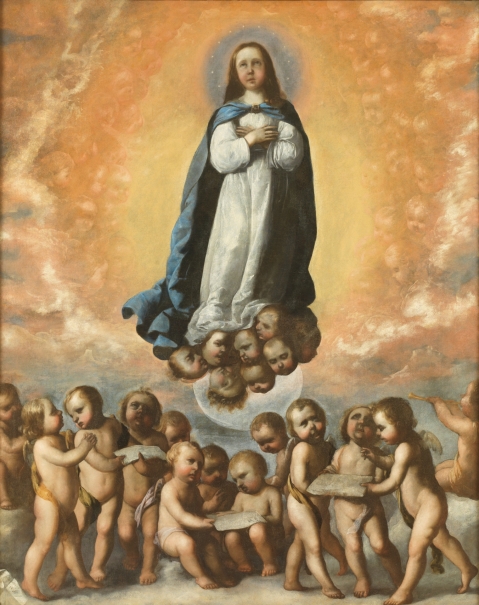
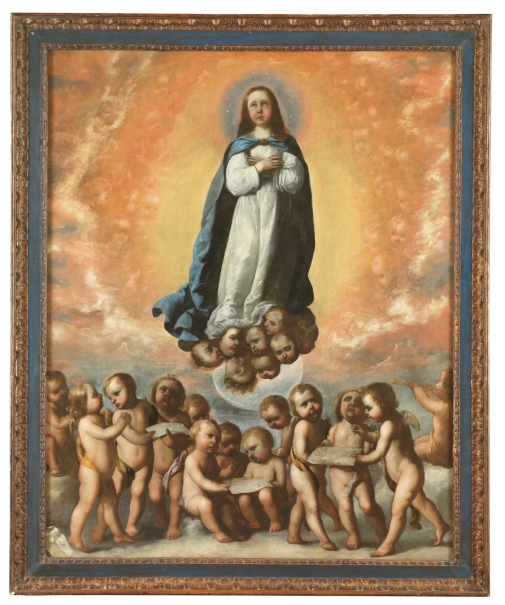
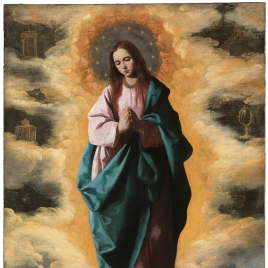
The Virgin Mary is presented as a little girl with her hands crossed over her chest. Wearing blue and white, she ascends on a group of angels’ heads as the heavens open to welcome her. This differs from earlier versions of the same subject by Zurbarán in its lack of symbols of the litanies and in the presence of a group of singing angels that occupy the entire bottom of the painting and are said to be based on models by Guido Reni.
Beside being an iconographic rarity, the group of little angels makes for a very specific formal reading of the composition, creating an extraordinarily dense and variegated zone in the lower part. That is not at all common in representations of this subject, which generally strive to emphasize aerial and ascendant aspects rather than earthly ones. The painter balances the density at the bottom by creating an extraordinarily nuanced area of light around the Virgin, reminding us that, in 1656, he was a consummate colorist.
The work’s most original contribution is its use of child angels as co-protagonists and compositional thread. They create a practically unbroken continuity running from the group of singers to those that bear the Virgin and on to those whose heads frame the opening of the heavens. All of this creates a structure with a strong geometrical content that provides a singular frame for the Virgin and announces some of the iconographic formulas that Murillo would also adopt in Seville. In that sense, this work serves as a precedent for other works at the Museo del Prado, including the much more dynamic Immaculate Conception of los Venerables, with its cascade of angels.
This work belonged to the important López-Cepero collection in Seville and was long considered a high point in Zurbarán’s oeuvre because an erroneous reading of the date (1616 rather than 1656) led it to be mistakenly considered his earliest work.