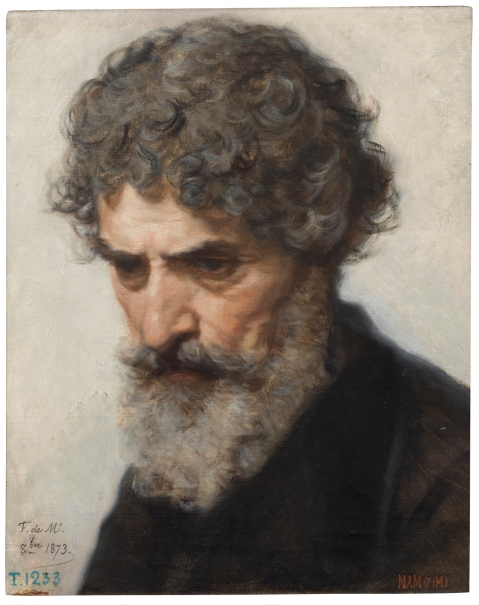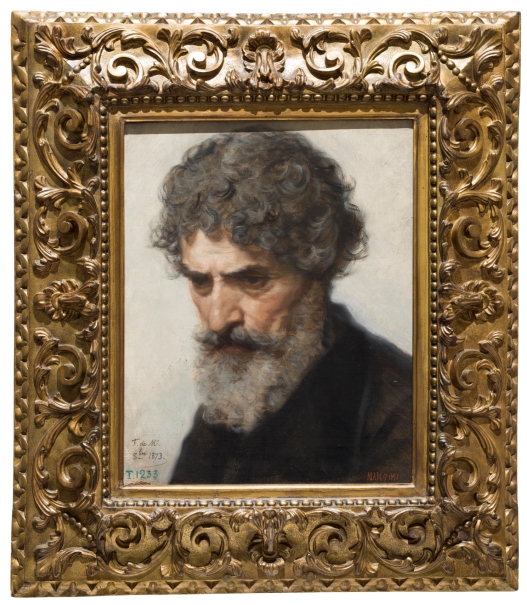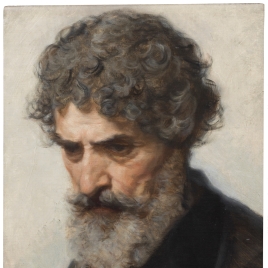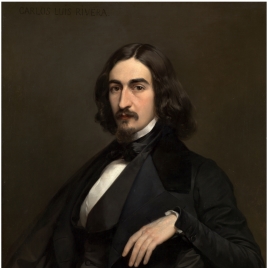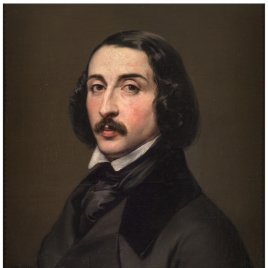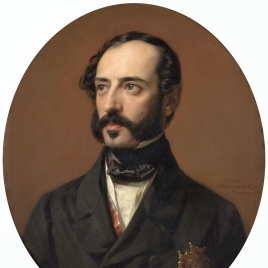
The painter and engraver Perugino Sensi
1873. Oil on canvas.Room 062A
Gaspar Sensi Baldachi was an Italian-born lithographer and painter and a pupil of Tomasso Minardi. The artist moved to Madrid when he was over thirty years old, and the city became his main residence until his death. This portrait by Federico de Madrazo is more a head study than an attempt to capture the sitter´s psychology. Nevertheless, the aged fragility of Sensi´s physiognomy is evident: the traces of age on his face, the sunken eyes that mark an area of shadow emphasising the expressionlessness of his gaze lost in a fixed point, the frizziness of his hair, and the bushy beard that contrasts with the ashen colour of the passage of time. In this mature work, this synthesis of study-portrait is underlined by Madrazo´s technique. His ability to capture the personality of the face is combined with the loose, rapid and bold technique typical of a study in which the artist has complete freedom. The painter incorporates the novelties and techniques of younger painters such as his son Raimundo and his son-in-law Fortuny.
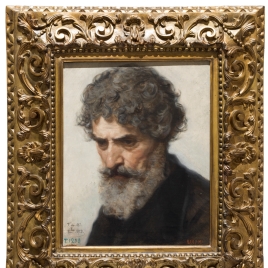
The relationship between Sensi and Federico must have continued until the death of the former. It seems to have intensified in the 1870s, and, in 1873, Federico painted this study-portrait. In 1879, there are entries in the painter´s diary indicating that he used Sensi´s hands for the portraits of the archbishop of Arequipa and the portrait of the father of the Count of Guaqui. Clearly Federico was fond of this model, but so much so that the portrait remained in the family collection until his death. As a token of friendship, he made a replica for Sensi that same year.
The portrait located in Museo del Prado was presented to the San Fernando Royal Academy of Fine Arts by the painter Eduardo Balaca, on behalf of Elisa del Moral, for a report on the possible acquisition of the painting by the Spanish State for Museo de Arte Moderno. The report was favourable, and the painting was valued at 1,500 pesetas as recorded in the minutes of the section at the session of 13 December 1899. Nevertheless, it must be assumed that it was not acquired as the work had been in Museo del Prado since 1895, as a posthumous bequest by Federico de Madrazo.Díez, J.L, Artistas pintados: retratos de pintores y escultores del siglo XIX en el Museo del Prado, Madrid, Ministerio de Educación y Cultura, Dirección General de Bellas Artes y Bienes Culturales, 1997, p.136 nº34