The Painter Carlos de Haes
1867. Oil on canvas.Room 062A
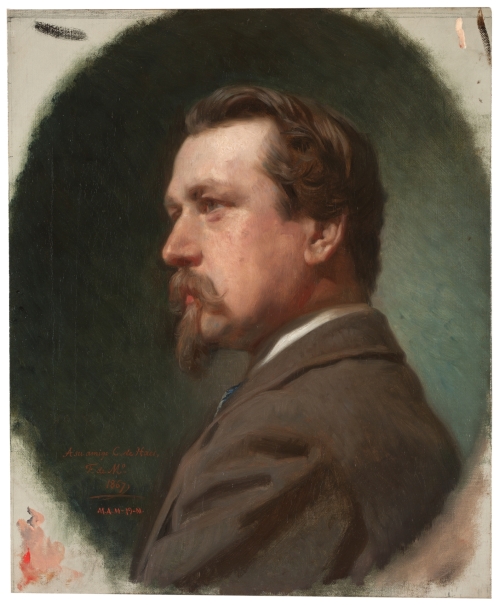
The artist depicts the painter against a neutral background shading from black to bluish-green. From the left and above, the light illuminates the painter´s face, which appears almost in profile, with abundant blond hair, a broad forehead, moustache, goatee and light-coloured eyes that reveal his native origin. The brown colours of the overcoat –under which a bow tie is evident– lead to a face in which the play of light and shade –tinged with peculiar touches of sienna– reveal a warm, intoned freshness of execution. With the exception of the engraving by his disciple Ricardo de los Ríos –published in the edition of Carlos de Haes´s Etching Essays, printed in 1898– and Querol´s bust, there are no other plastic representation of de Haes other than this one by Madrazo. Apart from showing the painter´s masterly qualities, this is a true example of the Belgian´s formal physiognomy. The various period photographs reveal an undeniable physical resemblance, even if the poses depict an affected and distant attitude.
Apart from the obvious physical similarity, the brushstrokes that make up his face convey the awareness of a painter-to-painter portrait and the consideration of an assumed judgement as equals. These values would logically have been very present between painters at the time of their execution. Indeed, in this magnificent portrait, Madrazo conveys with all his energy the sober personality of a simple, good-natured man, who is portrayed in the everyday simplicity of his normal life. There are no elements that exalts or relates him to his professional life in the midst of artistic and academic success. It is very likely that both coincided and assumed this sobriety precisely to define Haes´s modest and ‘human’ personality. Therefore, form and background link in a consistent and indisputable relationship.
Gutiérrez Márquez, Ana, Carlos de Haes en el Museo del Prado, 1826-1898 : catálogo razonado, Madrid, Museo Nacional del Prado, 2002, p.412