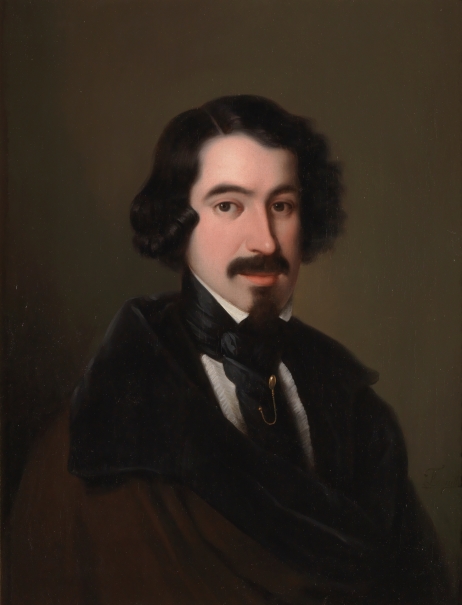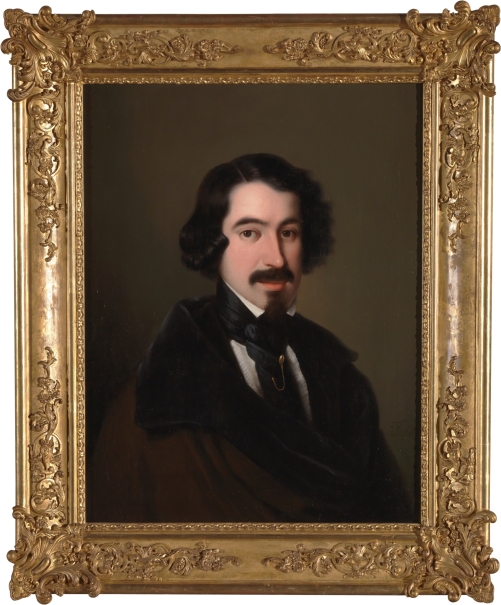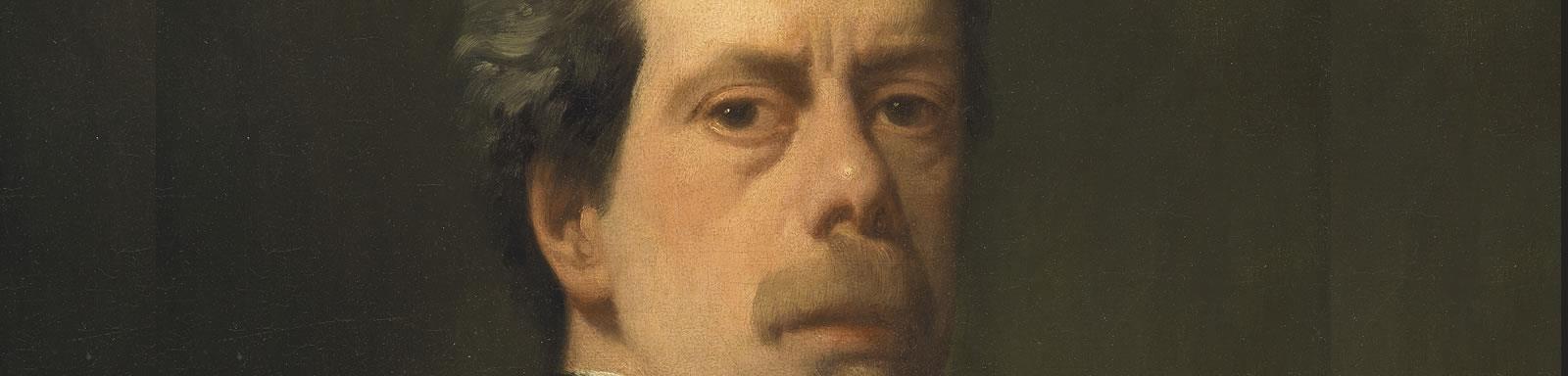
The Writer José de Espronceda
1842 - 1846. Oil on canvas.Not on display
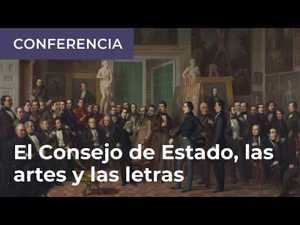
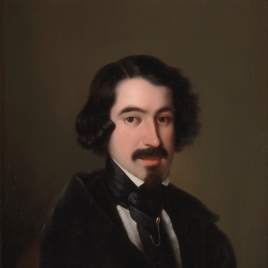
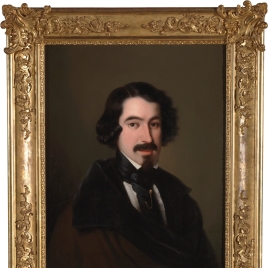
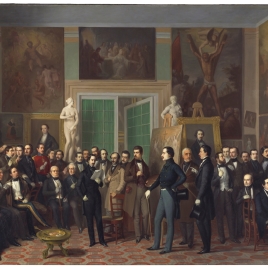
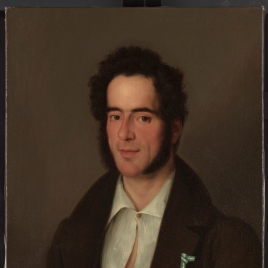
Among the painters of Spanish Romanticism, Antonio María Esquivel was one of the closest to the literary movement, of which he made many group portraits, such as his most important work: Contemporary Poets. A Reading by Zorilla in the Painter´s Studio (P004299). There, the two greatest poets of the First Spanish Romanticism – the duke of Rivas and José de Espronceda (Badajoz, 1808–Madrid, 1842), by then already deceased – each appear in a prominent place in the painting in the background of the poets meeting in the painter’s studio. For this reason, the acquisition of this painting is of particular interest to the Museo del Prado. Espronceda is depicted in this painting in the same position, represented in a long bust-length portrait, with his head slightly tilted and with moustache and goatee. He wears a brown frock coat with a lined velvet collar and silk black tie adorned with a golden pin. The portrait reveals the very same characteristics that Zorrilla would later describe: ‘Espronceda’s head exuded temperament and ingenuity. His visage, pale with malaise, was crowned by a curly, silky black mane, divided by a part almost in the middle of his head. His hair loosened on both sides over two tiny and thin ears, whose inferior lobules emerged amongst curls. His thin, straight black eyebrows canopied his immaculate inquisitive eyes, sheltered by opulent eyelashes – as are the lion’s eyes. The outline of his nose was not altogether accurate, and his disdainful mouth, whose lower lip was somewhat Bourbon-like, concealed itself half-hidden behind a thin moustache and a goatee cohered to his beard, which curled on both sides of his lower jaw. His forehead was extensive, with no other wrinkle than that knitting his brows from top to bottom. His gaze was sincere […]’ (José Zorrilla, Recuerdos del tiempo Viejo, vol. I, Barcelona, 1880, pp. 47 and 48).
In his interpretation, the painter tempered many of the writer’s features, such as the forehead cleft, but he did not leave other features unnoticed, including the deviation of the nose. In 1839, the poet gave lessons on contemporary literature in the Liceo Artístico y Literario (Artistic and Literary Lyceum) in Madrid, to which Esquivel was closely affiliated.
When comparing this painting to other iconographic interpretations of the writer, such as the anonymous aquatint printed in Espronceda’s most well-known publication, The Devil World (Madrid, 1841) and also a lithograph by Bachiller, it is noticeable that Esquivel interpreted the poet’s hair as less frizzier and curlier, and therefore straightened it. The loose parallel brushstrokes on the white shirtfront contrast with the smooth execution in the visage; the face is only enlivened by the highlights in his eyes, which is probably a result of a posthumous interpretation. There is a replica of this portrait in the Biblioteca Nacional de Madrid (Inv. 11071) and another portrait by Manuel Arroyo made on a much later date at the Ateneo de Madrid.
Museo Nacional del Prado, Memoria de Actividades 2008, Madrid, Museo Nacional del Prado, 2009, p.28-29