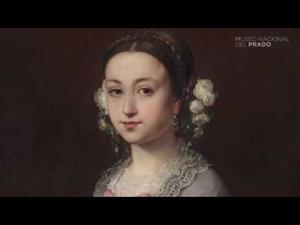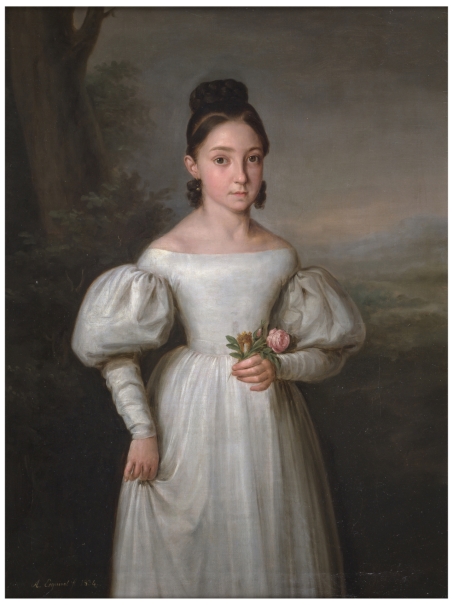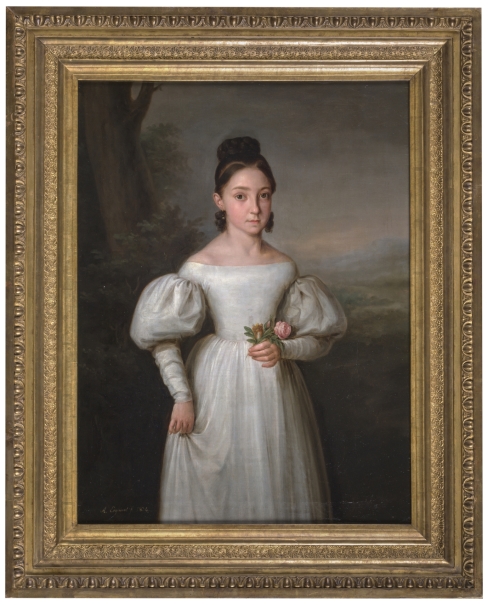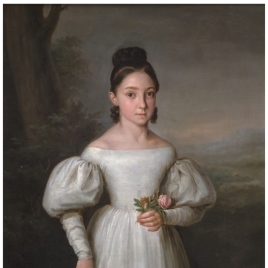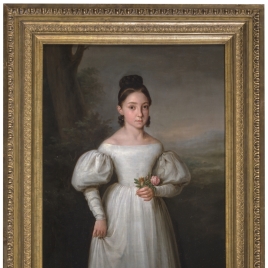
The Infanta María Luisa Teresa de Borbón, later Duchess of Sessa
1834. Oil on canvas.Not on display
This portrait of María Luisa Teresa de Borbón (Aranjuez, Madrid, 1824–Madrid, 1900) depicts the ten-year-old Infanta posing in front of a shady landscape. She carefully holds a rose in her left hand and with the other, she grasps the skirt of her dress with a typical courtly gesture of offering. This piece stands out among Esquivel´s extensive work for the exquisite delicacy of its execution. He highlights the girl´s flowing garments using subtle shading. The Infanta wears a long white dress with puffed sleeves, accompanied by discreet jewellery appropriate to her age and status. Her hair is elegantly tied up in a high bun divided in the middle into two parts that fall behind her ears and end in ringlets. The Sevillian Master, who was undoubtedly the most gifted Spanish children´s portraitist of his generation, captured the girl’s tenderness and modesty. He was also able to give it an air of gentle naturalness. It is likely that the child´s family commissioned this painting so that they would always remember her at such a tender age, making it a strictly private commission. The golden tones which illuminate the Infanta and its effective chiaroscuro echo the Baroque Sevillian tradition, from which Esquivel and other contemporary Andalusian artists often drew their inspiration. However, the formal style of the portrait is unique in Spanish painting. It places a high-ranking person in a country landscape, far away from any palatial interior. This portraiture style comes directly from the English tradition, which was so highly appreciated in Andalusia and which Esquivel used extensively throughout his career. The academic or Pusinesque size of the painting was very rare for Spanish painting of the time, which emphasises the originality of the format.
In 1834 Esquivel, who had recently arrived in Madrid, made a name for himself as a portraitist at the Elizabethan court during the regency of María Cristina de Borbón. The Queen Mother´s particular fondness for Sevillian painting and miniatures placed the painter in a very good position both on the art market in the capital and in court circles. He managed to portray the fourth wife of Ferdinand VII and painted several portraits of a markedly private nature and very interesting and original iconography of his daughters Isabella and Luisa Fernanda. He firstly painted them separately (private collection) and then he painted them together embracing in a garden (Seville, Reales Alcázares). Around this time, he also began to paint other members of the Royal Family, which he did without interruption from then on. Among them is the splendid portrait of the Infanta María Josefa Fernanda de Borbón, dated 1856 (Madrid, Royal Academy of History), who is the sister of the girl depicted in this canvas. The Infanta María Luisa Teresa del Carmen Francisca de Asís de Borbón (1824-1900) was the fifth child of the marriage between María Luisa de Borbón, Princess of the Two Sicilies, and the Infante Francisco de Paula de Borbón, Duke of Cádiz. The latter, who was the son of Charles IV and brother of Ferdinand VII, had eleven other children, and his first-born son, Francisco de Asís, married his first cousin Queen Isabella II in October 1846. The Infanta Luisa Teresa, on her part, married José María Osorio de Moscoso (1828-1881), 16th Duke of Sessa, in 1847, and gave birth to three children. The first-born son was born in the Royal Palace in Madrid, named after his royal uncle, Francisco de Asís (1847-1924), and married María del Pilar Jordán de Urríes (1852–1924), Marchioness of Ayerbe, in 1873. His two siblings were Luis María (1849–1924), Marquis of Ayamonte, and María Cristina (1850–1904), Duchess of Atrisco.
G. Navarro, C., La infanta María Luisa Teresa de Borbón, duquesa de Sessa (1834). En Barón, J.: El retrato español en el Prado. De Goya a Sorolla, Madrid, Museo Nacional del Prado, 2007, p.110, n. 28