Santiago Miranda
1832 - 1836. Oil on canvas.Not on display
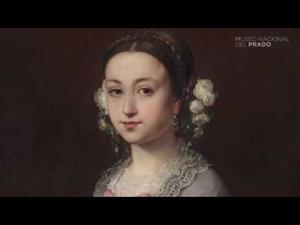
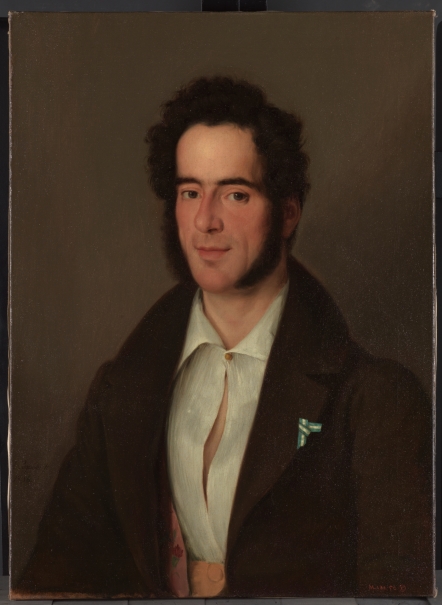
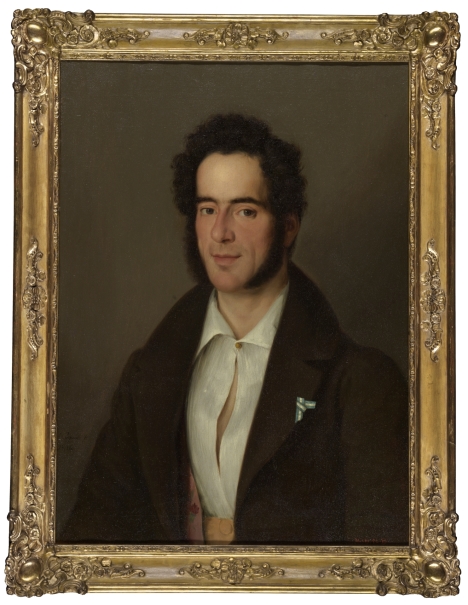
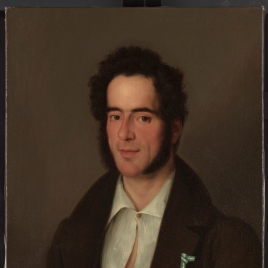
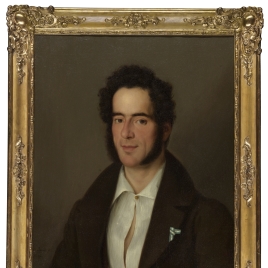
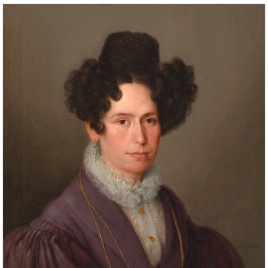
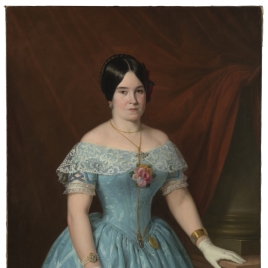
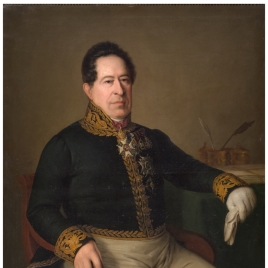
This painting portrays Santiago Miranda y Montijano, appointed in 1836 as a Supernumerary Knight of the Order of Charles III. The pair of portraits of the Miranda Pascual couple, consisting of this work and the portrait of "Fernanda Pascual" (P04296), is a clear example of one of the most widespread and characteristic forms of Spanish Romanticism, the cabinet portrait. These paintings were markedly intimate and were usually destined to the private rooms of their owners. There are numerous portraits of this format in Esquivel’s artistic production. Their small size made them very affordable, and the main aim of these works was to faithfully capture the likeness of the model. Esquivel consequently mostly focused on portraying the faces of the sitters, and avoided any details of the setting that might distract the viewer´s attention.
The portrait of Santiago Miranda repeats the iconographic approach he used for the portrait of his wife. His face is clearly defined, with a tight, precise execution that conveys his features realistically. However, the lighting is not directed onto his face as artificially as in the portrait of his wife. The simplicity of the clothing and its rough workmanship contrasts with the painstaking execution of the sitter´s features, emphasising the fact that the work was painted for strictly private use. The artist portrayed the sitter in an informal way, wearing a short jacket, an embroidered waistcoat, a sash, and no tie. His skin is white beneath his tanned face, both at the collar and in the wide opening of his shirt. He has bushy, pork chop sideburns, as was the fashion for men at the time. The pair of portraits probably date from the same year, 1832. The painter probably repainted the husband´s portrait in 1836 to coincide with his appointment that same year as a Supernumerary Knight of the Order of Charles III. His cockade is clearly visible on his lapel. Furthermore, the last digit of the date is repainted, which seems to confirm this hypothesis. Miranda was president of the Junta de Clases Pasivas of the Ministry of Finance, the institution responsible for administering pensions and subsidies granted by the State. In 1856 he received the grand cross of knighthood of the Order of Isabella the Catholic in recognition of his brilliant and long career. (G. Navarro, C. in: El retrato español en el Prado: El retrato español en el Prado. De Goya a Sorolla, Museo Nacional del Prado, 2007, pp. 108–109).
G. Navarro, C., Santiago Miranda (1836). En Barón, J.: El retrato español en el Prado. De Goya a Sorolla, Madrid, Museo Nacional del Prado, 2007, p.108-109, n. 27