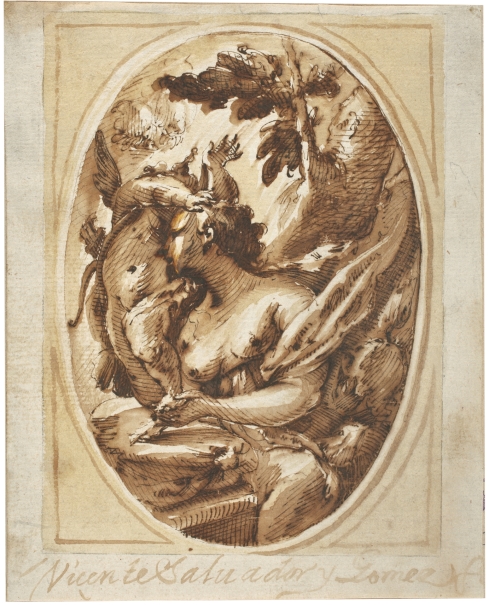
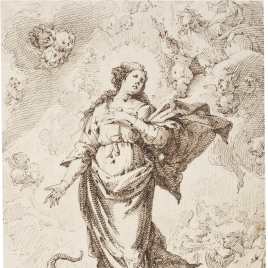
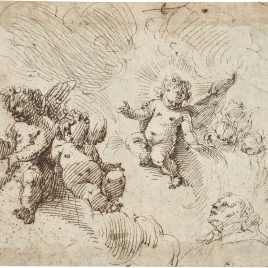
Venus and Cupid
XVII century. Yellow wash, Pencil, Grey-brown wash on laid paper.Not on display
It is a fully finished drawing in the artist’s characteristic compact style. This is evidenced by the neat arrangement of the framing lines that encircle the medallion. Just as in the burin engravings, to which it shares similarities in its handling of line, the key to this drawing lies in the study of the interplay between light and shadow (chiaroscuro), effectively achieved by keeping the white of the paper to create the most illuminated areas and by the pen-shading technique, drawn in different directions throughout the composition. In order to achieve a subtle gradation, the artist reinforced the shadowed areas with a careful application of yellowish wash with the brush by applying several layers in areas that required more shading.
This drawing seems to be inspired by a print that Alfonso E. Pérez Sánchez suggested might belong to the circle of Bartholomeus Spranger (1546–1617) and Hendrick Goltzius (1558–1617), whose figures are reminiscent of those present in this work. As was the case for other artists of his time, Vicente Salvador Gómez possessed a collection of drawings in addition to a large library and many prints that he used as a source of inspiration for his compositions. Part of his collection was acquired from the property left by Alonso Cano in the Porta Coeli Charterhouse in Valencia.
Since at least 1670, Vicente Salvador Gómez was a senior academic of the Academy of Saint Dominic in Valencia – one of the country’s first drawing schools – where artists came to draw. A sketchbook of drawings in which the rules of painting were explained constitutes his contribution to Spanish drawing and pictorial theory. Unfortunately, it remains unpublished and has been passed on in fragments to this day.
Hidalgo Caldas, Beatriz, "El coleccionismo ilustrado de dibujos en Sevilla y Madrid durante el último tercio del siglo XVIII y comienzos del XIX a la luz de la colección de Ceán Bermúdez". Ceán Bermúdez. Historiador del arte y coleccionista ilustrado, Madrid, Biblioteca Nacional de España, Centro de Estudios Europa Hispánica, 2016, p.309-339 [326]