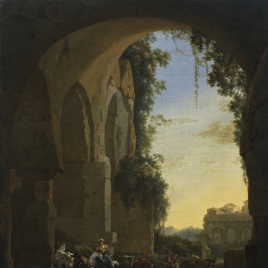
View of Tivoli
1639 - 1641. Oil on canvas.Not on display
In the 1701 inventory it is not listed among the group of landscapes with hermits or with bucolic scenes but many entries earlier, together with View of the Waterfall at Tivoli, with Fishermen (P2068) which it matches in size and theme -and Landscape with Saint Mary of Cervelló, now attributed to Claude Lorrain (P3259), which would appear to indicate that they were hung in a different room, at least at that time.
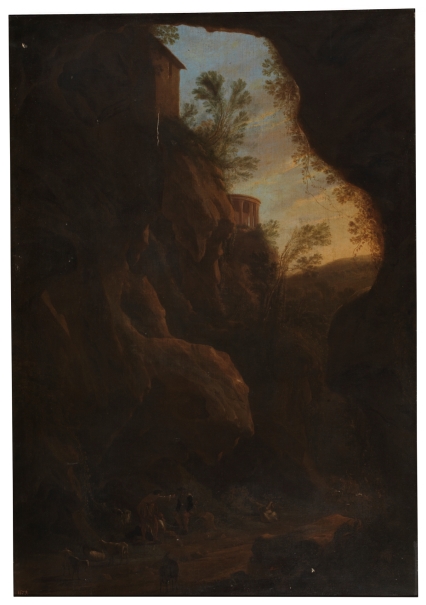
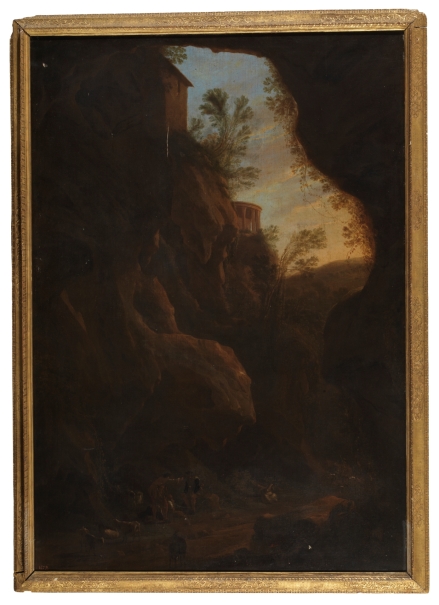
Viewed from inside the so-called grotto of Neptune at Tivoli is a mountainside with overhanging rocks, beneath which are two shepherds and a herd of goats. At the summit are two buildings, and on the furthest ledge stands the Temple of the Sibyl. The warm light that unifies the whole picture allows the landscape to be related to Both. The mountain that encloses the background is also similar to that which serves the same purpose in Landscape with Fishermen and Shepherds on a Riverbank (P2066).
The X-ray shows that the trees and the climbing plant at the entrance to the cave were added after the landscape was completed. The painting entered the Museum`s holdings as an original work by Jan Both. This attribution is maintained in later Museum catalogues and accepted by Waddingham (1964), Burke and Barghahn (1986). The figures, however, are ascribed to Andries Both in early Museum catalogues, and Waddingham maintains this attribution. Despite this, certain elements suggest the work may possibly be attributed to Jan Asselijn. First, the treatment of the leaves of the tree located between the two buildings is not characteristic of Both but recalls, for example, that of the tree protruding above an arch in Jan Asselijn`s drawing Ruins of the Colosseum or Theatre of Marcellus in Rome. Furthermore, the figures, particularly that of the standing shepherd, greatly resemble those of Asselijn in type. Finally, Both`s known output includes no other similar composition, whereas landscapes viewed from inside a cave (or through an arch) are very frequent in Asselijn`s oeuvre. It is known that the two artists coincided in Rome, where they went on outings together to draw from the life.
There was a landscape in the former Wenen collection, Tivoli with the Temple of the Sibyl attributed to Cornelis van Poelenburch , which could have been the iconographic source for this landscape (Posada Kubissa, T.: Pintura holandesa en el Museo Nacional del Prado. Catálogo razonado. 2009, p. 333).