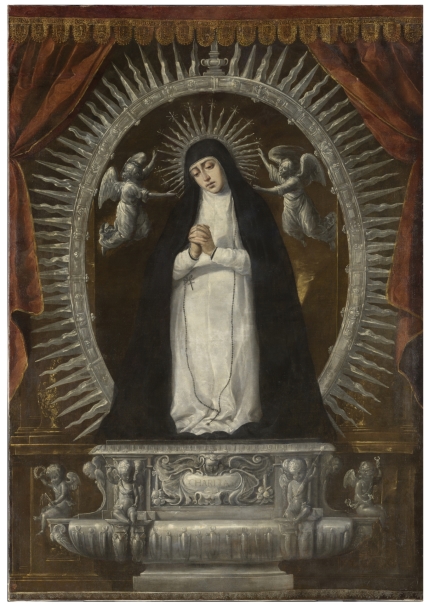
Virgin of Solitude
Ca. 1665. Oil on canvas.Not on display
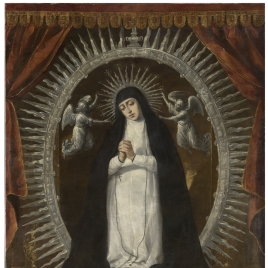
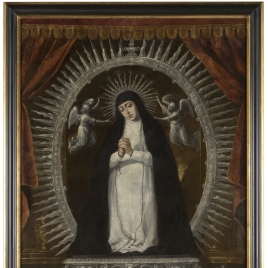
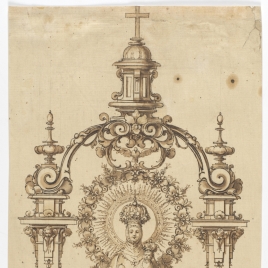
The Virgin of Solitude that was venerated from 1568 in Nuestra Señora de la Victoria, a Madrid friary belonging to the order of Minims of Saint Francis of Paola. It caught on as a popular iconography and expanded surprisingly throughout Spain’s foreign possessions, not only in Europe but also overseas, from New Spain to the Philippines. Its uniqueness encompassed different aspects, starting with its miraculous crafting, but the main factor was the severe black colour of its clothing, which was also the symbolic colour worn by widowed Spanish noblewomen. Devotion to this Virgin, accompanied by an orchestrated Baroque propaganda, reached nationwide proportions and was directly linked to the court. The image was copied in an enormous variety of paintings of the most disparate quality, most of which sought to capture the appearance of the image in the friary of La Victoria as faithfully as possible. A example is this painting, which also comes from that convent and has been classified as close to the output of Sebastián Herrera Barnuevo (1619–1671). In it both the pedestal and the silver ornaments surrounding the figure are designed to reproduce its original location, as if it were a photographic snapshot.
Arias Martínez, Manuel, Darse la mano. Escultura y color en el Siglo de Oro, Madrid, Museo Nacional del Prado, 2024, p.210-213